


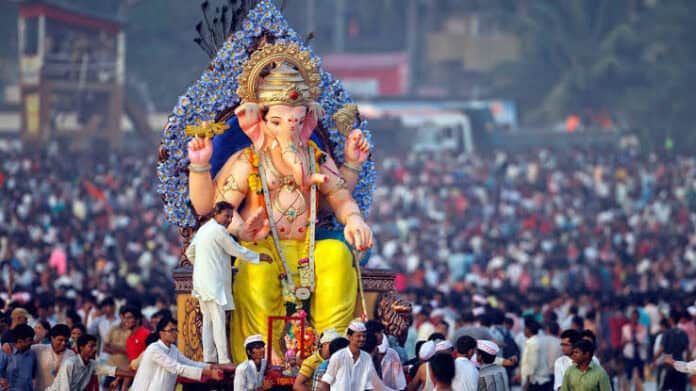
Every year, as the month of Bhadrapada arrives, homes and streets across Bharat fill with the chant of “Ganpati Bappa Morya.” Ganesh Chaturthi is, on the surface, a domestic festival — an idol installed in a corner of the house, a family gathered for aarti, a plate of modak offered with love. Yet this seemingly simple observance carries within it a civilizational weight far greater than its ten days of celebration suggest. To understand Ganesh Chaturthi only as a religious ritual is to miss what it has become: one of the clearest living demonstrations of how Hindu Dharma renews itself through community, culture and continuity.
A Festival Rooted in Meaning
Ganesh Chaturthi marks the birth of Lord Ganesha, revered across Hindu Dharma as Vighnaharta, the remover of obstacles, and as the deity of wisdom and new beginnings. It is no coincidence that Ganesha is invoked before any undertaking, ritual or journey — the tradition encodes a simple civilizational wisdom: that discernment and humility must precede ambition. The idol installed in millions of homes each year is not merely an object of devotion but a reminder, renewed annually, of this principle.
This spiritual grounding is why the festival has endured for centuries even as its outward form has changed dramatically.
From the Household to the Public Square
For much of its history, Ganesh Chaturthi was observed privately, within homes. Its transformation into a mass public festival is credited to Lokmanya Bal Gangadhar Tilak, who in 1893 encouraged the community installation of Ganesha idols in public pandals across Maharashtra. Tilak’s intent was not merely religious; it was civilizational and political. Under colonial rule, public assembly of Hindus for overtly political purposes was restricted, but a religious festival could not easily be curtailed. Tilak used Ganeshotsav to bring together Hindus across caste and class lines, fostering a shared cultural identity at a time when the British administration actively sought to fragment Hindu society along those very lines.
What began as a strategic assertion of unity became, over generations, a genuine expression of communal belonging. The public pandal, with its cultural programs, music, and shared rituals, remains one of the few spaces where Hindus of vastly different backgrounds participate in a common act of devotion, side by side, without distinction. This is Tilak’s enduring legacy — a festival that quietly continues to do the work of civilizational cohesion long after the colonial context that shaped it has passed.
A Living Tradition, Not a Museum Piece
One of the more striking aspects of Ganesh Chaturthi today is how actively it continues to evolve. The recent, widespread shift toward eco-friendly clay idols is a good example. As concerns grew over the ecological impact of Plaster of Paris idols and chemical paints on rivers, lakes and coastal waters, large numbers of devotees — not through mandate but through conviction — returned to traditional shadu mati (clay) idols and natural immersion practices.
This is worth pausing on. Critics of Hindu festivals often frame religious practice and environmental responsibility as being in tension. Ganesh Chaturthi shows the opposite: that Hindu Dharma, when allowed to express itself organically within communities rather than through top-down instruction, tends to correct itself in the direction of ecological balance. The idea that the elements borrowed from nature — clay, water, flowers — must be returned to nature is not a modern environmental slogan grafted onto an old ritual; it is close to the original spirit of Visarjan itself.
Continuity Across Generations
In an era where much of urban life pulls families apart — across cities, across time zones, across the competing demands of work — Ganesh Chaturthi remains one of the few occasions that reliably draws generations back into the same room. Grandparents narrate the stories of Ganesha to children who will one day narrate them to their own. The daily aarti, however brief, becomes a shared discipline observed by an entire household for ten consecutive days — a rare thing in contemporary life.
This is, in many ways, the quieter but more important function of the festival. Public grandeur draws attention, but it is this household continuity — unremarkable, repeated, unbroken — that actually transmits Hindu civilizational memory from one generation to the next. Every child who learns to fold their hands before Bappa, who is taught why durva grass is offered or why the idol is immersed with a promise of return, is absorbing a worldview, not just a custom.
The Challenge of Commercialization
None of this is to suggest the festival is without its tensions. The scale of public celebration in cities like Mumbai and Hyderabad has, in places, drifted toward spectacle — towering idols, loud amplification, and a commercial ecosystem around decoration and merchandise that can overshadow the festival’s devotional core. There is a legitimate conversation to be had within Hindu society about how to preserve the spiritual seriousness of Ganeshotsav even as its scale grows. The eco-friendly idol movement offers one template: change driven by communities reflecting on their own practice, rather than external criticism alone.
Conclusion
Ganesh Chaturthi endures because it operates simultaneously at two levels — the deeply personal and the broadly civilizational. It asks a family to gather each evening for a few minutes of shared devotion, and in doing so, it also keeps alive a thread of continuity that stretches back through generations of Hindu society. Tilak understood, over a century ago, that a festival could be both an act of faith and an act of unity. That dual character remains its greatest strength today. As Bharat prepares to welcome Ganesha once again this year, the task before Hindu society is not to reinvent the festival, but simply to keep observing it with the sincerity that has carried it this far — and to let it continue doing, quietly, what it has always done best: binding home to home, and generation to generation.
— Ganesh, author writes on Hindu festivals, traditions and puja practices, and is associated with BookMyPanditJee, a platform that connects devotees with verified pandits for home and community pujas across Bharat.
