


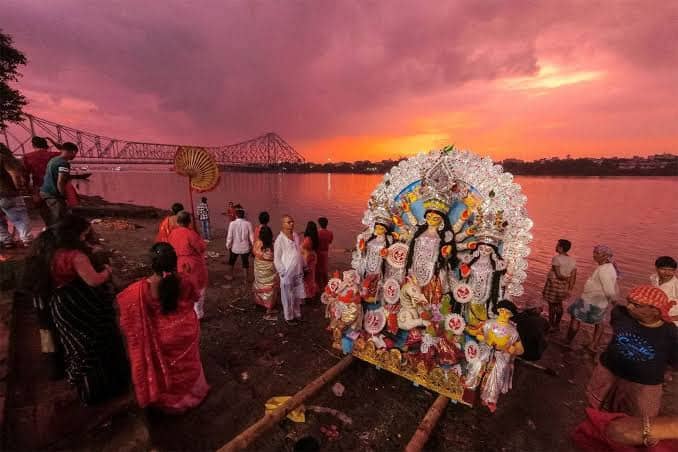
West Bengal’s Durga Puja, recognised by UNESCO as an Intangible Cultural Heritage, has repeatedly become a flashpoint for communal violence, administrative restrictions, and political controversy over the past decade. From mob attacks on murtis and processions to police crackdowns on participants and journalists, a pattern of targeted disruption has emerged—raising serious questions about law enforcement, freedom of expression, and the secular character of public festivals in the state.
The latest controversy erupted in September 2026, when Chief Minister Suvendu Adhikari directed Durga Puja committees to deny space to CPI(M) book stalls if they used the term “Sharadotsav” instead of “Durga Puja,” accusing the Left of diluting the festival’s religious identity. The CPI(M) rejected the move as authoritarian, defending its decades-old tradition of selling Marxist and progressive literature during the festivities. This incident is only the most recent in a long list of confrontations that have marked Durga Puja celebrations across West Bengal.
The September 2026 Book Stall Controversy
On 10 September 2026, during a session of the West Bengal Legislative Assembly, Chief Minister Suvendu Adhikari made a public appeal to Durga Puja organisers: do not allow CPI(M) book stalls near pandals if they display the word “Sharadotsav” instead of “Durga Puja.” He argued that the term “Sharadotsav”—popularised by Rabindranath Tagore to denote the autumn festival—was being used to minimise the religious character of the celebration.
The CPI(M) and its affiliates have operated book stalls during Durga Puja since 1954, selling Marxist literature, party publications, and works on a wide range of subjects. Party leaders responded sharply to Adhikari’s directive. CPI(M) state secretary Mohammad Salim called it a “fascist attack” and accused the government of inciting religious passion. Other CPI(M) leaders clarified that their stalls are branded as “Pragatishil Pustak Bikray Kendra” (Progressive Book Sales Centre) or “Marxiya Sahitya Pustak Bipani” (Marxist Literature Book Market), and that the term “Sharadotsav” appears only in greeting messages, not as the stall’s primary identity.
The controversy underscores a broader ideological battle over the cultural framing of Durga Puja: whether it should be celebrated primarily as a Hindu religious festival or as an inclusive, secular cultural event open to all communities.
Pattern of Violence and Disruption (2014–2024)
Beyond political disputes, Durga Puja in West Bengal has faced repeated physical attacks, administrative hurdles, and law-enforcement overreach. The following incidents, compiled from media reports and official statements, illustrate a troubling trend.
1. Howrah (Shyampur) Pandal Arson – 13 October 2024
In Shyampur, Howrah district, a Muslim mob returning after submitting a memorandum at the local police station began vandalising shops and establishments, specifically targeting the Shyampur Bazaar Vyavasayi Samiti Durga Puja pandal. Eyewitnesses and viral videos showed the mob breaking murtis of Goddess Durga, setting sound systems ablaze, destroying decorations, and pelting stones at the immersion ghat. Police arrested 67 individuals, mostly from the protesting community, and imposed curfew-like restrictions under Section 144 (now Section 163 of BNSS).
2. Kolkata (Garden Reach) Pandal Intrusion – 11 October 2024
At the New Bengal Sporting Club pandal in Garden Reach, Kolkata, a group of 50–60 Muslim youths entered during Ashtami–Navami rituals, objecting to devotional music (Chandipath) on grounds that it disturbed Friday prayers. According to the club’s complaint, the intruders used abusive language, threatened to break the murti if the music was not stopped, and warned against holding future pujas.
3. Narkeldanga Immersion Procession Attack – 9 October 2024
During a Kali and Lakshmi murti immersion procession in Narkeldanga, Kolkata, rioters pelted stones, glass bottles, and bricks from neighbouring buildings, causing panic and forcing some participants to retreat. Police intervened with lathi charges and tear gas to restore order.
4. Police Halt Doctors’ ‘Abhaya Parikrama’ – 9 October 2024
Kolkata Police stopped a rally by junior doctors participating in Durga Puja pandals as part of their “Abhaya Parikrama” protest related to the RG Kar case. Twenty-nine people, including women doctors, were detained.
5. 112-Foot Durga Murti Ban in Nadia – 11 October 2024
In Ranaghat, Nadia district, the Mamata Banerjee-led administration denied permission for a 112-foot Durga murti installation, citing law-and-order concerns. The club, which had organised Durga Puja for 50 years, decided not to hold the event due to administrative non-cooperation.
6. Arrest of Nine Youths from Alipur Pandal – 11 October 2024
Alipur police arrested nine youths from a Durga Puja pandal, citing their protest related to the RG Kar case. A court later granted interim bail, noting that the youths had no intention of spreading hatred or engaging in anti-national activities.
7. Doctor Detained at Kolkata Puja Carnival – 15 October 2024
Dr. Tapabrata Roy, a government on-duty doctor, was arrested at a Durga Puja carnival for wearing a badge supporting junior doctors protesting in the RG Kar case. He was released four hours later after protests from Hindu groups and fellow doctors.
8. Journalist Arrested for Covering Kali Puja Attacks – 15 October 2024
Ananyo Gupta, a journalist running the portal “Madhyam,” was arrested by West Bengal Police for reporting on attacks at Kali Puja pandals on 5 November 2024. The arrest drew criticism from press freedom advocates.
9. NHRC Notice to Kolkata Police – 7 November 2024
The National Human Rights Commission issued a notice to Kolkata Police, seeking an action-taken report on allegations of excessive force against protesting medics at the Tridhara Sammilani Durga Puja pandal. The notice followed a complaint filed by the All India Students Union (AISU).
10. NCW Member Alleges Police Misconduct – 2 November 2024
National Commission for Women member Archana Majumdar wrote to the Governor, alleging that police officers misbehaved with her and lathi-charged victims during the Narkeldanga immersion violence.
11. Birbhum Lathi Charge on Immersion Procession – 27 October 2020
In Birbhum district, police lathi-charged devotees participating in a Vijayadashami immersion procession. Viral videos showed officers dragging a young man by the collar and beating participants..
12. Cultural and Symbolic Controversies – 20 October 2021
In Kolkata, allegations surfaced that azan was played in front of Hindu deity murtis at some Durga Puja pandals. Additionally, the Barisha Club faced criticism for a pandal theme depicting a Hindu woman and child in a supposed “detention centre” with a Durga murti, referencing the NRC controversy.
13. Burdwan Blast Case Convictions – 28 August 2014 (Incident: 2 October 2014)
A special NIA court convicted 19 individuals, including four Bangladeshi nationals, for the 2014 Burdwan blast that targeted a Durga Puja pandal. The explosion, allegedly orchestrated by the Jama’atul Mujahideen Bangladesh (JMB) module, damaged several murtis and killed two bomb-makers.
Administrative and Political Dimensions
These incidents reveal a dual challenge: communal violence from non-state actors and heavy-handed or selective enforcement by state agencies. While some attacks involve mob violence and murti desecration, others involve administrative bans, police detentions, and restrictions on cultural expression. The 2026 book stall controversy adds another layer, framing Durga Puja as a battleground for ideological control over language, symbolism, and public space.
Implications for Secularism and Cultural Heritage
UNESCO’s recognition of Kolkata’s Durga Puja as an Intangible Cultural Heritage underscores its global significance as a symbol of community, artistry, and shared celebration. Yet the recurring violence and restrictions threaten to undermine this status. Ensuring the safety of participants, protecting freedom of expression, and maintaining administrative neutrality are critical to preserving the festival’s inclusive spirit.
As West Bengal moves into the 2026 Durga Puja season, the book stall dispute serves as a reminder that the festival remains deeply entangled in political and communal fault lines. How authorities, civil society, and citizens navigate these tensions will determine whether Durga Puja continues to thrive as a unifying cultural force—or becomes further polarised along ideological lines.
Hindu Society and Civilisation: Resilience Amid Adversity
The repeated targeting of Durga Puja in West Bengal must be understood within a broader historical and civilisational context: the endurance of Hindu society through centuries of external pressure, internal fragmentation, and modern political contestation. Durga Puja is not merely a religious festival; it is a living expression of Shakti worship, community solidarity, and artistic innovation that has survived invasions, colonial rule, and post-independence ideological battles.
Hindu civilisation has always been decentralised, pluralistic, and adaptive—qualities that have allowed it to absorb shocks without losing its core identity. The goddess Durga herself symbolises this resilience: a divine force that emerges to restore dharma when adharma threatens cosmic and social order. In contemporary West Bengal, the persistence of Durga Puja despite mob violence, administrative hurdles, and political instrumentalisation reflects this same civilisational stamina.
Yet resilience should not be mistaken for complacency. The pattern of attacks—from the 2014 Burdwan blast to the 2024 Howrah arson and the 2026 book stall controversy—reveals a strategic vulnerability: Hindu festivals are often treated as open targets because Hindu society lacks unified institutional protection and political leverage. While other communities organise around religious identity with clear leadership and advocacy, Hindu public life remains fragmented along caste, regional, and ideological lines, making it easier for adversaries to exploit divisions.
The path forward requires more than reactive outrage. It demands a conscious reassertion of Hindu cultural confidence—rooted in knowledge, organisation, and ethical clarity. This includes documenting and publicising attacks (as this report does), building legal and media support networks for affected communities, and fostering intergenerational transmission of cultural values beyond ritual performance. It also calls for Hindu leaders and institutions to engage constructively with the state, not as supplicants but as stakeholders in a plural democracy.
Ultimately, the defence of Durga Puja is not about exclusion or majoritarian assertion; it is about securing the right of a civilisation to celebrate its heritage without fear, intimidation, or administrative obstruction. As West Bengal navigates another volatile Puja season, the choices made by citizens, authorities, and civil society will signal whether Bharat can accommodate Hindu identity with dignity—or whether it will continue to treat Hindu expression as negotiable, secondary, or suspect.
Reference: 13 प्रमुख घटनाएं: पश्चिम बंगाल में दुर्गा पंडालों में मजहबियों का हमला और प्रतिबंध (2017-2026)
