


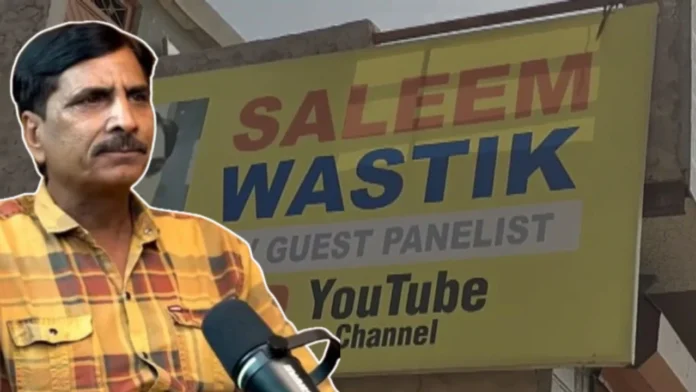
In the quiet lanes of Ghaziabad, ex-Muslim YouTuber Saleem Wastik became the latest symbol of a chilling global reality: the knife’s edge awaiting those who dare to leave Islam. On February 26, 2026, two helmeted assailants stormed his home-office, stabbing him repeatedly in the neck and abdomen in a brutal bid that left him fighting for life in a Delhi hospital. While police gunned down suspect Zeeshan in a swift encounter, the attack’s echoes reverberate far beyond Uttar Pradesh—linking to a doctrine-rooted intolerance that spans families, mobs, and militants worldwide, where apostasy isn’t just rejected but often punished with blood.
An ex-Muslim YouTuber being stabbed at his own home in Bharat is not an “isolated local crime”; it sits on top of a long, uncomfortable pattern of intolerance against dissenters from Islam, especially those who publicly criticise the faith.
What happened to Saleem Wastik
- On 26–27 February 2026, ex-Muslim YouTuber Saleem Wastik was attacked inside his home-office in Ashok Vihar Colony, Loni, Ghaziabad (U.P.).
- Two men arrived on a motorcycle without a number plate, kept their helmets on, went into his office and stabbed him repeatedly in the neck and abdomen; there was even an apparent attempt to slit his throat.
- Family and local residents rushed him first to a nearby hospital, after which he was referred to GTB Hospital in Delhi, where doctors described his condition as extremely serious and critical.
- Police formed multiple teams, scanned over 200 CCTV cameras, and identified one suspect, Zeeshan, who was later killed in an encounter in Loni; police say he was the man who repeatedly stabbed Wastik before fleeing with an associate.
- While several groups and commentators have explicitly linked the attack to Wastik’s ex-Muslim identity and his criticism of Islam, the police have so far maintained that the investigation is ongoing and they are not officially attributing a motive yet.
In other words, the facts we know already match a familiar pattern: a critic of Islam, marked out as an apostate, is targeted in his private space with lethal intent, and the most plausible motive in public discourse is his religious dissent.
Ex-Muslims as a global “internal enemy”
The important context is that ex-Muslims are not just people who changed their mind; in many conservative Muslim milieus they are treated as traitors.
- A global study of apostates (people leaving coercive or high-control religious groups) across 30 countries found they experience high levels of abuse, often hidden inside families.
- Within that sample, ex-Muslim apostates were significantly more likely to face both physical and psychological victimisation than ex-Christian apostates, and the perpetrators were “almost exclusively close family members”, making reporting to police rare.
This is crucial: the first layer of intolerance is often not jihadist outfits but family and community, using domestic pressure, economic control, and sometimes violence to punish those who leave the faith.
Public ex-Muslims like Saleem Wastik, who appear on TV panels and social media to criticise Islamic theology or political Islam, are a second category: they are no longer just “wayward relatives” but visible enemies, to be silenced to deter others.
From social shunning to targeted violence
The Wastik case echoes a broader spectrum of responses to apostasy and blasphemy, from “soft” repression to open terrorism.
- In a few Muslim-majority societies, formal law may not always prescribe death for apostasy, but social norms can still enforce a de facto blasphemy regime: shunning, threats, loss of livelihood, and mob violence. This is evident in global apostasy reports and case studies of ex-Muslims who are forced to hide their beliefs to survive.
- High-profile examples outside Bharat include bloggers, secularists and ex-Muslims attacked or killed in Bangladesh, Pakistan, and parts of the Middle East over the last decade, often after accusations of insulting Islam. These incidents fit into a wider pattern of Islamist violence documented globally since 1979.
- A major quantitative study estimates 66,872 Islamist terrorist attacks worldwide between 1979 and April 2024, killing at least 249,941 people.
While not every attack is about apostasy, the ideology driving a large share of this violence is a rigid, exclusivist reading of Islam that treats criticism and “leaving” as existential threats worthy of death.
Saleem Wastik’s public identity as an ex-Muslim and a defender of Sanatan Dharma placed him precisely in that crosshair. Even before a charge sheet is filed, the modus operandi—anonymous attackers, throat-focused stabbing, targeting at home—resembles punishment operations seen against critics in other contexts.
Bharat as part of this larger pattern
Bharat’s case is unique because it is a Hindu-majority, constitutionally secular republic with both strong free-speech protections on paper and an increasingly polarised religious discourse in practice.
In this environment:
- Ex-Muslim voices like Wastik or “Ex-Muslim Sahil” build large online followings by narrating their journey out of Islam and criticising Islamic texts, practices, and Islamist politics.
- These voices inevitably clash with online and offline Muslim activists who see them as bigoted, traitorous, or “anti-Muslim propagandists”; on platforms like Reddit, for instance, some Muslims openly describe ex-Muslim YouTubers as spreading “hatred and dehumanization against Islam and Muslims”.
- When that ideological hostility is normalised, it lowers the psychological barrier for fringe elements to cross from verbal delegitimisation to physical elimination. The same rhetoric that calls someone “wajib-ul-qatl” (deserving of death) or “murtad” (apostate) becomes a moral licence for attackers.
The state response in Wastik’s case has two faces. On one hand, the U.P. police have moved quickly, identified a suspect and engaged him in an encounter, signalling that the state will not tolerate such vigilantism. On the other hand, the reluctance to clearly acknowledge ideological motives, if they exist, can blur the larger pattern and treat what may be targeted religious violence as just another “personal enmity” case.
Connecting the dots on intolerance
Putting these threads together, several structural features of intolerance within parts of the global Muslim community become visible:
- Doctrinal absolutism: Classical jurisprudence on apostasy and blasphemy, even where not codified in modern criminal law, continues to influence attitudes. “Leaving Islam” is framed not as a private choice but as treason against God and community, which many believe merits severe punishment, if not by the state then by “true believers”.
- Family and community enforcement: The global apostasy study shows that in Muslim families, punishment of ex-Muslims is often domestic and intimate—emotional blackmail, beatings, forced marriages, or confinement. This enforces conformity long before any formal legal mechanism comes into play.
- Ideological ecosystems: From local mosques to transnational Islamist networks, certain preachers and influencers constantly delegitimise critics, minorities, and reformers. Their sermons may stop short of explicit incitement, yet their framing of ex-Muslims as enemies creates a fertile ground for “lone wolves” to act. This ecosystem is reflected in the sheer volume of Islamist terror attacks counted globally.
- Globalisation of outrage: Social media allows local dissent—like the YouTuber in Ghaziabad—to be instantly framed as a global insult to Islam. Echo chambers form across continents, amplifying calls for punishment and supplying ideological justification to potential attackers.
In this sense, the attack on Saleem Wastik is both deeply local (Ghaziabad lanes, U.P. politics, local TV debates) and unmistakably global in its logic: punish the apostate to warn others, and demonstrate that no amount of state law can protect someone who publicly “betrays” the faith.
Despite the fact that not every Muslim might endorse such violence, the presence of a sizeable, organised current within the global Muslim ummah that sees apostasy and blasphemy as capital offences is undeniable, and it manifests—from family abuse to assassination attempts—whenever someone like Saleem Wastik decides to speak without fear.
Closure
Bharat, as a Hindu-majority democracy rooted in Sanatana Dharma’s timeless ethos stands uniquely equipped to shield ex-Muslims like Saleem Wastik from the ummah’s apostasy enforcers. By bolstering police vigilance, fast-tracking hate-crime probes, and offering witness protection programs tailored for public dissenters, the state can deter such blade-wielding zealots while upholding constitutional free speech.
Beyond mere safety, Hindu organizations and dharma-centric initiatives could extend a welcoming hand—through cultural immersion programs, philosophical dialogues, and community support networks—guiding these truth-seekers back to their ancestral Sanatana fold, where doubt is celebrated, not knifed, and spiritual inquiry blooms freely for all.
