


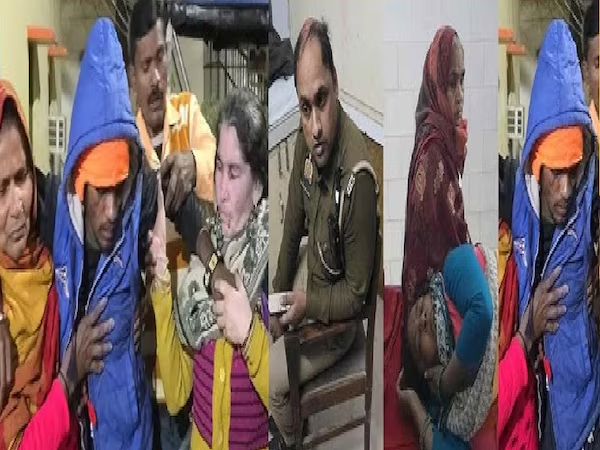
A late-night clash near a Kanwar camp in Uttar Pradesh’s Amroha turned violent on the eve of Mahashivratri, leaving at least five people, including a police constable and several Kanwariyas, injured and prompting the registration of an FIR against 29 accused and the deployment of additional force in the communally sensitive Muslim dominated area.
Location, timing and background
The incident took place on Saturday night in Mohalla Chebda (also written Chevda/Chhebda) under Amroha Nagar Kotwali, near a Shiva temple located on the bypass. A large group of local residents had recently returned from Haridwar with Ganga water and were staying at the temple complex as Kanwariyas to perform Jalabhishek of Lord Shiva the following morning, for which a religious camp and community feast (bhandara) had been organised. A DJ system had reportedly been installed at the temple for devotional songs as part of the Kanwar-related celebrations.
According to multiple local reports, the clash occurred just a day before Mahashivratri, when religious activity and footfall of Kanwar pilgrims in the region are at their peak, increasing the sensitivity of any law‑and‑order disturbance. Police sources stated that the atmosphere in the area turned tense following the late‑night violence and stone‑pelting.

How the dispute started
Initial information from police and eyewitness‑based reports suggests that the confrontation began over a seemingly minor dispute near the Kanwar camp. While Kanwariyas were resting at the camp and bhajans were playing on a DJ, a group of youths from another community were reportedly celebrating a birthday a short distance away from the temple.
Some accounts say the dispute escalated after comments and objections were exchanged over noise and behaviour around the camp, while another detailed narrative mentions that certain youths came near the Kanwar camp, cut a cake and allegedly used abusive language and made religious remarks, triggering protests from those present. The argument quickly spiralled into a physical clash, and both sides are reported to have engaged in manhandling and stone‑pelting in the presence of police personnel.
Stone‑pelting, injuries and damage
During the confrontation, stones were hurled at the Kanwariya group and towards police, leading to multiple injuries. One of the most seriously injured was constable Shoaeb Raza Khan (also reported as Shane/Shane Raza Khan), who was hit on the head by a stone while attempting to intervene and was left bleeding. Reports from the ground state that at least four Kanwariyas and local devotees, identified in various accounts as Chandra Shekhar, Vidya Devi, Shikhar and one more Kanwariya, were injured in the melee.
Overall, police and media reports converge on the figure of around five injured persons, including one constable and four civilians linked to the Kanwar camp. Kanwariyas have also alleged that some of their sacred Kanwars (bamboo structures carrying Ganga water) were damaged or broken during the stone‑pelting, further inflaming sentiment among the pilgrims and the local Hindu community. All injured individuals were taken to hospital for treatment, and they were later reported to be out of danger.
Communal tension and overnight protest
Following the incident, a large crowd of Kanwariyas, local Hindu residents and activists gathered at the Nagar Kotwali, accusing the attackers of targeting Hindu devotees and demanding immediate arrests. Protesters, including local BJP leaders and members of Hindu outfits, allegedly surrounded the police inspector, raised slogans and staged a prolonged demonstration through the night, accusing the police of initially showing leniency and reacting slowly despite being present at the spot when the situation escalated.
The tension spilled over into Sunday as anger simmered in the neighbourhood, with reports of palpable communal strain in Mohalla Chebda and adjoining areas. In view of the situation, officers from nearby police stations and additional forces were rushed to the locality to prevent any further flare‑up and to reassure residents. Despite the unrest, police maintained that the situation was brought under control and that Kanwariyas were later able to perform their Jalabhishek at the Shiva temple under security cover.
FIR, sections and named accused
After preliminary inquiry, police registered a case based on a written complaint by local resident Abhishek Saini. The FIR names four accused individuals from the other community—identified in reports as Imran, Mukeem (also spelt Mukim), Yunus Ali and Mohammed Zahid—along with 25 unidentified persons, taking the total number of accused to 29.
According to statements attributed to Amroha Superintendent of Police (SP) Amit Kumar Anand, the case has been registered under multiple serious sections of the Bharatiya Nyaya Samhita, including rioting and stone‑pelting offences, as well as provisions related to attacking public servants on duty, though specific section numbers were not uniformly detailed across reports. The FIR formally states that the named and unidentified accused engaged in assault, stone‑pelting and disruption of a religious event, resulting in injuries to Hindu devotees and a police constable and damage to religious paraphernalia.
Arrests, investigation and police version
By Sunday, police had arrested three key accused linked to the incident, whose names are reported as Imran, Shanu and Adnan in some accounts, while other reports stress the four‑name FIR list and the continued search for additional suspects. Authorities emphasised that raids were being conducted to trace the remaining named and unidentified accused and that video footage and local intelligence were being used to identify stone‑pelters captured on camera.
Police sources also claimed that the original trigger for the confrontation involved a youth, who described himself as a journalist, allegedly making a video during the celebrations, which led to objections and heated arguments before the situation spiralled out of control. In a number of reports, officers acknowledged that their personnel were present at the spot when the altercation began but argued that the intensity and speed of the escalation made it difficult to immediately stop the stone‑pelting, though they insisted that the violence was ultimately contained and further escalation prevented.
In response to criticism from protesters, senior officers reiterated that strong legal action was being taken, and they appealed to residents of both communities to maintain peace and avoid circulating unverified videos or inflammatory rumours on social media.
Security measures and current situation
In the aftermath of the clash, police maintained a continuous presence in Mohalla Chebda and nearby areas, deploying forces from multiple police stations and keeping a close watch on sensitive localities. Checkpoints and patrols were strengthened, and senior officers visited the area to take stock of the law‑and‑order situation and to interact with community representatives.
Despite overnight protests and initial tension, officials reported that the situation in Amroha city was brought under control, with no major fresh incidents reported after the initial clash. With police presence on the ground, Kanwariyas were able to complete their Jalabhishek rituals at the Shiva temple, and authorities expressed confidence that further arrests and a thorough investigation would help stabilise the atmosphere.
Wider context: Kanwar Yatra and recent incidents
The Amroha clash comes against the backdrop of heightened religious activity around Mahashivratri, when thousands of Kanwar pilgrims in western Uttar Pradesh carry Ganga water from Haridwar to local Shiva temples, sometimes passing through densely populated Muslim neighbourhoods.
The Amroha clash fits into a pattern of reported tensions during Kanwar yatras and Shivratri periods in Muslim-dominated areas, where stone-pelting or assaults on pilgrims have been alleged against local youths. In 2022 UP Kanwar Yatra, multiple attacks occurred: 15 Kanwariyas wounded by sticks and stones in Badaun’s Doongon village after DJ objections (11 arrested including Pradhan Babu Khan); three injured in Amroha’s Sultan Nagar; and pilgrims assaulted in Bareilly’s Pargawan and Nawabganj by mobs led by Shakina and Ishtiaq. More recently, in 2023 Bareilly’s Jogi Nawada, Kanwariyas were pelted with stones near Shahnoori mosque amid loud music disputes, injuring six per locals (though police disputed severity). On February 17, 2026, in Uttarakhand’s Udham Singh Nagar, Muslim boys threw empty soft drink packets at Kanwariyas on Mahashivratri, echoing the Amroha incident days later. These events highlight the thin line that Hindus have to tread to practice their festivals in Muslim dominated areas in Bharat.
Local administration and police have repeatedly highlighted that maintaining communal harmony during large religious gatherings is a priority, and the Amroha stone‑pelting case is likely to be closely watched as a test of preventive policing, swift investigation and the ability of authorities to defuse tensions through transparent action against those found guilty, regardless of community.
