


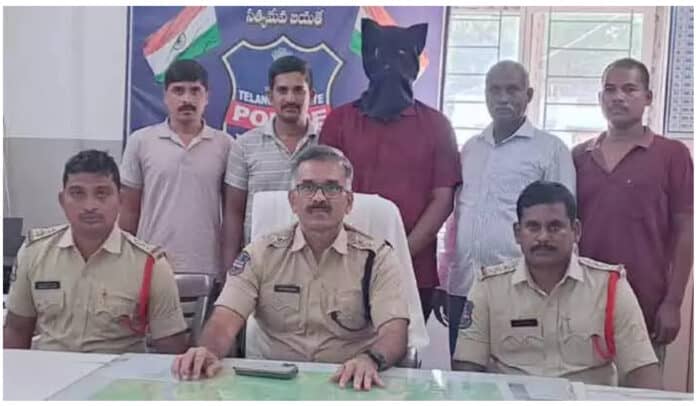
A dispute over a relatively modest debt of ₹80,000 has culminated in a shocking murder that has sent ripples through a village in Telangana. Police investigations suggest that a prolonged financial disagreement between two acquaintances escalated into a premeditated act of violence, resulting in the death of a young man and the subsequent arrest of the prime accused.
The incident occurred in the jurisdiction of Karakagudem, where investigators say financial transactions between the victim and the accused had become a source of tension for several months. What began as a monetary dispute allegedly evolved into a carefully planned murder, highlighting the tragic consequences that can arise from unresolved debt-related conflicts.
Complaint by Victim’s Family Triggers Investigation
The case came to light after Badavath Vijaya, mother of the deceased Badavath Ravichandra, approached the Karakagudem Police Station on October 12 and lodged a complaint alleging that her son had been killed by Mohammed Imran. Acting on the complaint, police registered a case and launched an investigation into the circumstances surrounding the death.
According to investigators, preliminary inquiries and evidence collection quickly pointed towards a financial motive. During the course of the investigation, police reportedly established that the deceased had lent ₹80,000 to the accused. Authorities further revealed that disagreements over repayment of the amount had persisted for some time, creating friction between the two men.
Debt of ₹80,000 at the Centre of the Dispute
Investigators identified the unpaid debt as the primary trigger behind the crime. Police stated that Ravichandra had extended a loan of ₹80,000 to Imran, and disputes regarding the repayment of the money had become increasingly contentious in recent months.
While ₹80,000 may appear to be a relatively small sum in comparison with larger financial crimes, local authorities noted that personal debt-related disputes often become emotionally charged, particularly in rural and semi-urban settings where private lending between acquaintances is common. In this case, investigators believe the disagreement deteriorated to the point where violence became the alleged solution pursued by the accused.
Police Allege a Planned Murder
According to the police investigation, the murder was not a spontaneous act but a carefully orchestrated crime. Authorities allege that on the night of October 11, at approximately 9:30 p.m., Mohammed Imran persuaded Ravichandra to accompany him on a motorcycle ride.
Investigators claim that the accused transported the victim to the outskirts of Kaluvala Nagaram village, an isolated area where the attack could be carried out without attracting public attention. Once there, the accused allegedly assaulted the victim and strangled him using a belt, leading to his death. Police described the sequence of events as indicative of deliberate planning rather than an impulsive altercation.
The alleged use of a belt as a murder weapon also points to the personal and close-contact nature of the crime. Law-enforcement officials believe the accused selected a secluded location to minimize the risk of intervention or eyewitness testimony.
Swift Arrest and Recovery of Evidence
Following the registration of the case and subsequent investigation, police moved quickly to apprehend the suspect. Authorities arrested Mohammed Imran at his residence on October 12 and took him into custody for questioning.
Investigators also recovered material evidence believed to be connected to the crime. Among the items seized were the motorcycle allegedly used to transport the victim and two mobile phones that may assist authorities in reconstructing communications and movements preceding the killing.
After completing initial interrogation and procedural formalities, police produced the accused before a court and secured judicial remand. The investigation remains ongoing as authorities continue to gather evidence and establish a comprehensive timeline of events.
A Case Reflecting the Dangers of Personal Financial Disputes
The murder has once again drawn attention to the dangers posed by unresolved personal financial disputes. Unlike formal banking transactions, informal loans between friends, acquaintances, and neighbours often lack written agreements and legal safeguards, increasing the potential for conflict when repayment issues arise.
In this case, police believe a debt amounting to ₹80,000 became the catalyst for a fatal confrontation, ultimately costing a man his life. The alleged planning involved, from luring the victim on a motorcycle ride to selecting a secluded location and carrying out the strangulation, has added a particularly disturbing dimension to the case.
Investigation Continues
Authorities have stated that further investigation is underway to gather additional forensic, digital, and witness evidence. Police are expected to examine seized mobile phones, verify movement patterns, and strengthen the evidentiary chain before filing a detailed charge sheet.
For now, the case stands as a stark reminder of how a financial dispute involving ₹80,000 allegedly escalated into a deadly crime, leaving one family mourning the loss of a son and another individual facing serious criminal charges.
Key Facts
- Victim: Badavath Ravichandra.
- Complainant: Badavath Vijaya (mother of the victim).
- Accused: Mohammed Imran.
- Debt amount in dispute: ₹80,000.
- Alleged murder date: October 11, 2026, around 9:30 p.m.
- Alleged method: Strangulation using a belt.
- Arrest date: October 12, 2026.
- Evidence seized: Motorcycle and two mobile phones.
- Current status: Accused remanded to judicial custody; investigation ongoing.
