


Temple waste management in Bharat has emerged as a critical issue, blending environmental concerns with the preservation of sacred traditions. Hindu dharma places immense importance on temples as centers of spiritual, cultural, and social life, where millions of devotees offer prayers, flowers, and other materials daily. However, the sheer volume of waste generated—especially floral waste—has become a significant challenge, with profound ecological and public health implications. Recent initiatives, both governmental and private, are now transforming this sacred waste into valuable resources, reflecting a harmonious balance between tradition and sustainability.
The Scale of Temple Waste in Bharat
Bharat’s temples are not just places of worship but also major centers of activity, attracting millions of visitors each year. The Mahalakaleshwar Temple in Ujjain, for example, sees between 75,000 and 100,000 devotees daily, producing an astounding 5–6 tonnes of floral waste every single day.

Nationwide, estimates suggest that over 8 million tonnes of floral waste are dumped into rivers and other water bodies annually, polluting vital sources like the Ganges and disrupting aquatic ecosystems. In cities such as Varanasi, Ayodhya, and Tirupati, the situation is equally critical, with thousands of tonnes of floral waste generated weekly from major temple towns.
Government and Private Initiatives
Recognizing the environmental impact, the Bharatiya government and various private entities have launched innovative waste management campaigns. The Swabhav Swachhata Sanskaar Swachhata (4S) campaign, aligned with the Swachh Bharat Mission, focuses on recycling floral waste from temples and converting it into compost, incense sticks, and other bio-products. In Tirumala Tirupati Devasthanams (TTD), a major pilgrimage site, over 86,000 metric tonnes of untreated waste were identified in recent years. In response, TTD has partnered with Indian Oil Corporation Limited (IOCL) to set up a bio-gas plant, aiming to convert wet waste into biogas and manure, while also exploring segregation-free waste management solutions.
In November 2025, the Rajkot Municipal Corporation (RMC) in Gujarat launched a comprehensive temple-waste recycling initiative across major temples including Panchnath Mahadev Temple and Ramnath Para Temple. The program deploys dedicated vehicles to collect floral and ritual waste, transporting it to processing units at Jubilee and Raiya where women from self-help groups convert the sacred waste into incense sticks, natural dyes, compost, and handmade paper. INTACH’s Heritage Craft and Community Division provided training to improve waste segregation and empower these self-help groups to create marketable products.

Just months earlier in September 2025, the Pune-Pimpri Chinchwad Municipal Corporation (PCMC) launched a pioneering initiative to recycle 256 tonnes of nirmalya (sacred offerings) collected during Ganpati visarjan. About 500 kg of flowers were processed by women’s Self-Help Groups into incense and dhoop sticks, providing steady employment.

The Nagpur Municipal Corporation (NMC) demonstrated impressive scale during the 2025 Ganesh festival, collecting and recycling over 200 tonnes of floral offerings using 19 special “nirmalya raths”—increased from just 10 due to overwhelming public support. The waste was processed at the Bhandewadi facility using vermicomposting, producing organic compost for city gardens and parks. Similarly, the Pune Municipal Corporation (PMC) converted over seven lakh kilograms (706,478 kg) of Ganeshotsav nirmalya into compost in 2024, deploying 3,970 sanitation workers and creating 45 artificial tanks and 516 iron tanks for eco-friendly idol immersion.
Private startups have also played a transformative role. Phool.co, founded in 2017, collects nearly21 metric tonnes of floral waste weekly from temple towns like Ayodhya, Varanasi, Bodh Gaya, Kanpur, and Badrinath. Their “flowercycling” initiative turns floral waste into incense sticks, cones, and even biodegradable packaging, employing hundreds of women from self-help groups and generating significant employment.
Hyderabad-based HolyWaste and Delhi’s Aaruhi are other notable ventures, collectively recycling thousands of kilograms of floral waste monthly and creating sustainable products that benefit both the environment and local economies.
Major Temple Infrastructure Projects
The Ayodhya Municipal Corporation initiated one of Bharat’s most ambitious temple waste management projects in January 2024, establishing a 200-tonnes-per-day solid waste management facility specifically for the Ram Temple area. This government-led project encompasses wet waste processing, dry waste processing, sanitary landfill creation, and zero-waste discharge systems, operating for seven years with a possible four-year extension. Located at Pikhrauli, the facility follows strict Swachh Bharat Mission guidelines, reinforcing scientific temple-waste management and complete resource recovery.
At the Mahakaleshwar Temple in Ujjain, Madhya Pradesh, a large-scale floral-waste recycling program collects 5–6 tonnes of daily floral waste through Pushpanjali Econirmit vehicles. The initiative, part of the 4S Campaign, converts this waste into compost, briquettes, biofuels, and eco-friendly products, led by women of the Shiv Arpan Self-Help Group.
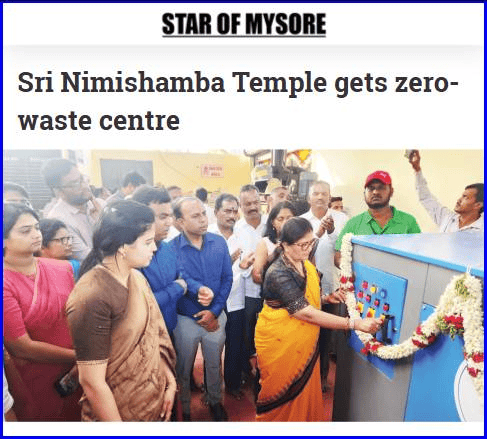
Karnataka has emerged as a leader in temple waste management with its Swachh Mandira Abhiyana, launched in February 2023. The Department of Muzrai and Endowment established zero-waste management systems in 12 major temples across the state, including Sri Nimishamba Temple in Srirangapatna. By July 2022, the government had expanded this to 25 A-Grade temples—including Kukke Subrahmanya, Sri Kollur Mookambika, and Sri Chamundeshwari—installing waste-processing plants with a ₹25 crore government investment to convert approximately three tonnes of daily temple waste into compost. The initiative aimed to achieve complete zero-waste status by December 2024.
Regional Examples and Innovations
Across Bharat, regional efforts are making a difference. In Karnataka, the Melinajuganahalli Temple has implemented composting pits, turning temple waste into nutrient-rich compost for farmers and raising awareness about waste segregation. In Bengaluru, the “Zero Waste Temples” initiative, launched in2016, encourages composting and eco-friendly practices among devotees.
Varanasi’s Kashi Vishwanath Temple has enforced a complete ban on plastic within its premises, promoting biodegradable alternatives and collaborating with local authorities to ensure compliance. These localized actions are setting benchmarks for sustainable temple management.
Civilizational Reflections
The management of temple waste is not just an environmental necessity but a civilizational responsibility. Hindu dharma teaches reverence for nature and the sacred, and these initiatives reflect a return to those principles. By transforming waste into wealth, Bharat is demonstrating how ancient traditions can coexist with modern sustainability goals. The efforts to recycle floral waste, generate energy, and create employment are not only reducing pollution but also fostering a sense of collective responsibility among devotees, temple authorities, and communities.
In conclusion, the journey from sacred waste to sustainable solutions in Bharatiya temples is a testament to the resilience and adaptability of Hindu traditions. As these initiatives gain momentum, they offer a model for integrating ecological consciousness with spiritual practice, ensuring that temples remain not only centers of faith but also beacons of environmental stewardship for generations to come.
Source: 13 Major Initiatives: Government Measures for Temple Waste Management (From year 2018 to 2025)
