


Bharat’s pharmaceutical industry is not a minor player in global healthcare. It is one of the world’s largest suppliers of generic medicines and vaccines, providing affordable treatment to countries across Africa, Asia, Latin America, and the West. Its strength lies not merely in scale but in its ability to make essential medicines accessible at prices far below those charged by many multinational companies. That success has inevitably created commercial competition.
Bharat’s pharmaceutical strength: a genuine global powerhouse
Bharat is not a marginal player in pharmaceuticals; it is one of the world’s most important medicine-producing countries. Bharat ranks 3rd globally by pharmaceutical production volume and is the world’s largest supplier of generic medicines, providing roughly 20% of global generic drug supply. Bharatiya pharmaceutical products reach more than 200 countries, including highly regulated markets such as the US, UK, EU, Canada, Japan, and Australia. Bharat’s pharmaceutical exports reached approximately US$31.1 billion in FY2025–26, demonstrating continued international demand. Bharat also has the largest number of US-FDA-compliant pharmaceutical manufacturing facilities outside the United States, with more than 750 FDA-registered sites reported for 2024.
Vaccines, affordability, and strategic importance
Bharat’s influence is even greater in vaccines and affordable essential medicines. Bharatiya manufacturers supply around 55–60% of UNICEF’s vaccines, approximately 99% of WHO’s DPT vaccine requirements, 52% of BCG vaccines, and 45% of measles vaccines. Bharatiya companies also supply more than 80% of the world’s antiretroviral medicines used against HIV/AIDS. The sector supports roughly 2.7 million direct and indirect jobs and has become an important source of foreign-exchange earnings. These numbers show why Bharat is widely described as the ‘pharmacy of the world’: minor individual manufacturing failures or regulatory shortcomings should not be extrapolated into a claim that Bharatiya pharmaceuticals as a whole are unsafe or insignificant.
The global media must also explain why product-specific allegations are so often transformed into a sweeping indictment of an entire nation’s pharmaceutical capacity. Bharat’s pharma industry is vast and highly diverse, comprising thousands of manufacturers, products and export markets; therefore, a failure involving a particular company, product, batch, or manufacturing facility should be investigated on its own evidence rather than generalized to the entire sector.
The connection is rooted in economics as much as in journalism. Bharatiya generics have intensified competition in developed markets and helped reduce medicine prices, creating pressure on established pharmaceutical interests. Most of the reports were painted by the propaganda orchestrated by Western companies. But it does justify asking who benefits when one of the world’s most important low-cost medicine suppliers is portrayed through a continuous cycle of alarming headlines. If criticism is genuinely about patient safety, it must be evidence-based and proportionate, not a media campaign that converts the mistakes of particular companies into a permanent suspicion of Bharat’s entire pharmaceutical industry, which is performing well at this time.
From product failure to national indictment
The controversy over Bharat-made cough syrups illustrates how quickly a product-specific allegation can become a country-wide narrative. The Gambia case involved four syrups manufactured by Maiden Pharmaceuticals, not every Bharatiya manufacturer. WHO warned that the products contained unacceptable levels of toxic substances and were potentially linked to acute kidney injury among children. Later investigations strengthened the connection, making it irresponsible to dismiss the tragedy entirely. But it is equally irresponsible to turn the failure of one company into a verdict against Bharat’s entire pharmaceutical ecosystem.
Indonesia exposed the headline game
The Indonesian crisis was a separate event involving locally distributed medicines and Indonesian companies. Investigations and court proceedings focused on contaminated ingredients used by domestic manufacturers, including extremely high concentrations of toxic industrial solvents. The Bharatiya products linked to the Gambian episode were not the same medicines circulating in Indonesia. Yet headlines and social media posts repeatedly placed the two tragedies side by side, creating the impression that Bharatiya cough syrups were responsible for both.
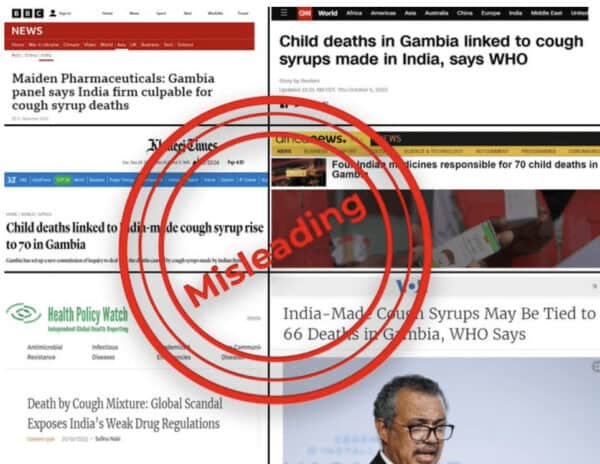
This is how propaganda often works, not necessarily by inventing every fact, but by arranging true and unrelated facts in a misleading sequence. The result is a powerful emotional association: children’s deaths, toxic syrup, and ‘Bharatiya medicine.’ Once that association is established, later clarifications rarely receive the same visibility as the original accusation.
The Iraq case requires scientific scrutiny
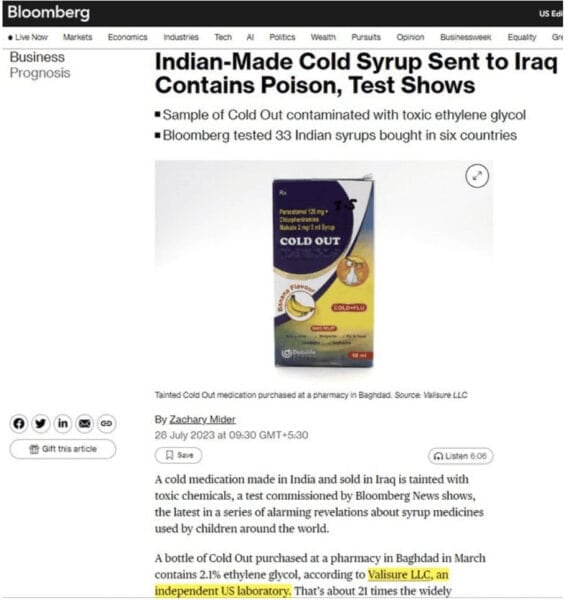
The Iraq episode added another layer to the narrative. Bloomberg reported that a sample of Cold Out syrup, manufactured in Bharat and sold in Iraq, contained ethylene glycol, based on testing commissioned from Valisure. Iraqi authorities recalled the product, and the WHO issued an alert. The allegation was serious and deserved regulatory action.
But scientific claims must be evaluated through transparent methods, independent replication, and complete disclosure of the tested sample. The US Food and Drug Administration had previously raised concerns about Valisure’s laboratory methods, equipment, data controls, and validation procedures. These concerns do not automatically disprove the Iraq finding, but they demonstrate why one laboratory’s result should not become an unquestionable global verdict.
The “Hero” narrative
As per Reuters, Dinesh Thakur’s role has received extraordinary attention because of his history as a Ranbaxy whistleblower. The Ranbaxy case was a major regulatory scandal, and the company ultimately pleaded guilty in the United States to seven felony charges and agreed to pay $500 million in penalties and settlements. That history gives Thakur relevant experience in pharmaceutical compliance and data integrity.
Soon after, the whistleblower evolved into a broader campaign narrative, in which individual regulatory failures were repeatedly presented as evidence of systemic failure across an entire national industry. The proper test, therefore, remains evidence: laboratory reproducibility, regulatory records, chain-of-custody documentation, batch-level analysis, and independent expert review. Portraying Thakur either as a flawless hero whose every allegation must be accepted or, conversely, as a foreign agent without evidence, reduces a complex issue to propaganda from either side.
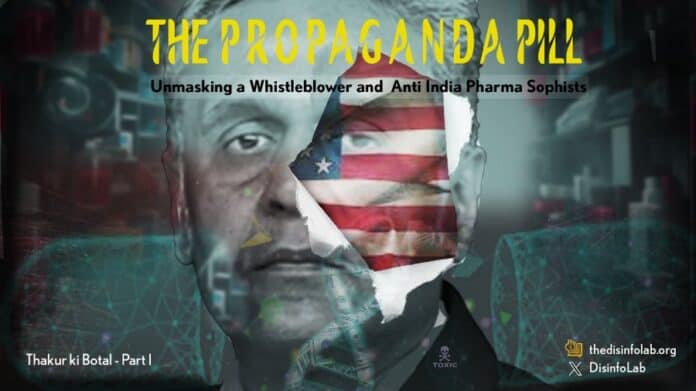
The report, The Propaganda Pill, argues that several separate episodes were amplified through similar headlines and commentary, while subsequent clarifications received limited attention. It also questions the timing of the Gambia controversy and the promotion of books and public health campaigns critical of Bharat’s drug regulatory system. These are legitimate questions for media researchers to investigate.
At the same time, allegations of a coordinated Western propaganda campaign against Bharatiya pharma companies must not be presented as established facts without documentary evidence. The presence of Western funding, foreign laboratories, or international media coverage may raise questions about incentives and influence.
Propaganda against Bharat is not new, and neither is the attempt to undermine its achievements through selective narratives. But Bharat’s record speaks for itself: its pharmaceutical industry has made essential medicines and vaccines affordable and accessible to millions across the developing world, while building a global manufacturing and export capacity that few countries can match. The contribution of Bharatiya Pharmaceuticals to global healthcare affordability cannot be dismissed through sensational headlines, isolated failures, or sweeping generalizations.
Bharatiya Pharma should not merely be defended; it should be recognized and appreciated for its indispensable contribution to global public health. No corporate lobby, media ecosystem, geopolitical interest, or ideological campaign should be permitted to turn legitimate regulatory scrutiny into a sustained narrative against Bharat’s pharmaceutical capabilities. Bharat knows what it has built, the world knows what it has benefited from, and no propaganda campaign can erase that record.
Read the full report here: https://thedisinfolab.org/the-propaganda-pill/
