


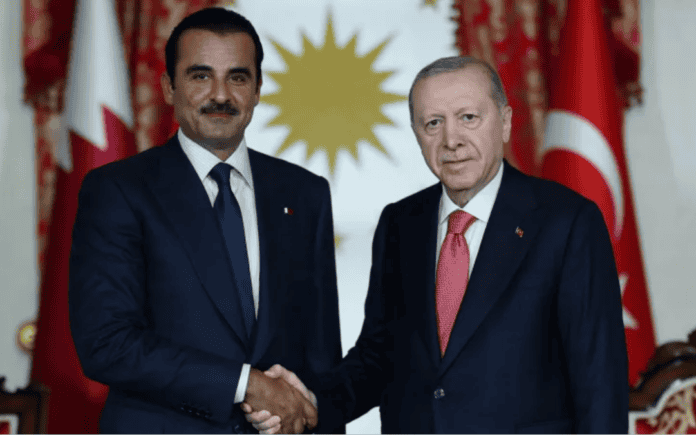
Lakhs of Bharatiyas fly through Doha every year, lakhs more work in Qatar, and Istanbul has become a favourite holiday stop. Few of them know that Qatar’s own religious ministry tells Muslims the conquest of Bharat is a prophecy yet to be fulfilled, or that Turkey’s president told Pakistan’s parliament that Kashmir is his country’s Gallipoli. HinduPost’s new series, Doha and Ankara Unmasked, sets out what these two states believe, what they fund and whom they shelter, because the Islamism they export does not stay in West Asia. It reaches Europe’s mosques, Kerala’s Salafi networks and the Kashmir Valley.
What Qatar’s state teaches about Hindus
Islamweb, the fatwa portal set up by Qatar’s Ministry of Awqaf and Islamic Affairs, leaves no doubt about how it sees Hindus. One fatwa calls Hinduism “a polytheistic and idolatrous religion”. Another brands pooja ‘idol worship’, a form of shirk, or associating partners with Allah, which the Quran calls the one sin Allah will not forgive. It tells Muslim students and employees to leave schools and workplaces that make them attend it, and forbids greeting Hindus on their festivals.
On Bharat’s past and future, the ministry is clearer still. Fatwa 84702 hails Muhammad bin Qasim, who invaded Sindh in 712 CE, as a “great Muslim Hero”. Fatwa 143847 grades as authentic the hadith of Thawban on the conquest of Bharat, the Ghazwa-e-Hind prophecy beloved of Pakistan’s jihadist groups, cites Ibn Kathir’s account of Mahmud of Ghazni breaking the Somnath murti, and adds that the end-times conquest of Bharat “has not yet taken place”. A 2020 study at the Qatar Foundation’s own Hamad Bin Khalifa University examined all 82 of the portal’s fatwas on Hindu Dharma and conceded that their vision “is not fully aligned with state policy”. The fatwas are still online.
Qatar’s classrooms teach the same lesson. A February 2026 review of 52 state textbooks by the watchdog IMPACT-se, summarised by the Middle East Forum, found ninth graders taught that those who partake of polytheism will spend eternity in hellfire, and a Grade 6 lesson that glorifies Ali bin Abu Talib’s killing of polytheists and Jews as proof of his excellence. Hindus are the world’s largest ‘polytheist’ community.
The Brotherhood’s pulpit in Doha
Qatar’s theology would matter less if it stayed at home. It does not, because Doha has made itself the chief patron of the Muslim Brotherhood, the movement founded in Egypt in 1928 whose creed declares “Jihad is our way. Dying in the way of Allah is our highest hope.” The Brotherhood fathered Hamas, and Egypt, Saudi Arabia and the UAE ban it as a terrorist organisation.
Its chief cleric, Yusuf al-Qaradawi, found refuge in Qatar after Egypt jailed him. Qatar gave him citizenship, a Sharia faculty at Qatar University, a weekly Al Jazeera programme from 1996 and, in 2004, the Doha-based International Union of Muslim Scholars (IUMS), as MEMRI documents. From those platforms Qaradawi called suicide bombing “the supreme form of Jihad”, said of Hitler’s persecution of the Jews that “the next time will be at the hand of the believers”, and predicted that Islam would return to Europe “as a conqueror and victor” (Hudson Institute). In Fiqh al-Jihad he wrote that moderates “accept offensive jihad, and attacking the infidels in their lands” (as translated). In this theology Hindus are both infidels and polytheists.
Qaradawi died in 2022; his union lives on. During the June 2022 row, which erupted after a BJP spokesperson, provoked by an Islamist panellist’s derogatory remarks about Bhagwan Shiva in a TV debate, cited Islam’s own scriptural sources on the life of its Prophet, the IUMS called the BJP “racist”, urged rallies at Bharatiya embassies and threatened a boycott of Bharat by Muslim countries. Qatar’s foreign ministry summoned Bharat’s ambassador and demanded a public apology from the Government of Bharat. In March 2024, Qatar University hosted Zakir Naik, wanted in Bharat under anti-terror and money-laundering laws, for a Ramadan lecture.
Qatar’s state-funded Al Jazeera has done its part. When The Kashmir Files brought the 1990 exodus of Kashmiri Hindus to cinema screens, it ran an opinion piece that disputed the Pandit toll and argued the violence was “not centrally a conflict between Muslims and Hindus”.
The money trail, from Europe to Kerala
Doha’s money follows its theology. Qatar Papers, a 2019 book by French journalists Christian Chesnot and Georges Malbrunot built on leaked Qatar Charity files, showed that Qatar funded 140 mosques and Islamic centres across Europe for 71 million euros, much of it to Brotherhood-linked groups, as Giulio Meotti recounts. Tariq Ramadan, grandson of Brotherhood founder Hassan al-Banna and the West’s favourite face of “moderate” Islam, drew 35,000 euros a month from the Qatar Foundation; he has since been convicted of rape in Switzerland and France.
Bharat is on the list too. Leaked files recovered by the Middle East Forum show that Qatar’s Eid Charity, whose co-founder the US Treasury designated an al-Qaeda financier in 2013, sent about QR 28.5 million ($7.8 million) to eight Salafi groups in India, most of it to Kerala, Abhinav Pandya and Akshay Kumar report. Qatar also gave Hamas more than $1.1 billion between 2012 and 2018, according to the Foundation for Defense of Democracies.
Ankara, in Erdogan’s own words
Where Qatar works through money and clerics, Turkey adds state power and an army. Recep Tayyip Erdogan has never hidden his creed. In a 2015 speech in Siirt he recited the lines he had once been jailed for: “The minarets are the bayonets, the domes are the helmets, the mosques are our barracks, the believers are the soldiers” (MEMRI). In October 2023 he called Hamas “a liberation group, mujahideen” (JTA). When Hagia Sophia was turned back into a mosque in 2020, his religious affairs chief Ali Erbas climbed its pulpit carrying a sword (MEMRI).
On Bharat, his words are as plain. Weeks after Article 370 was revoked he raised Kashmir at the UN General Assembly, and in February 2020 he told Pakistan’s parliament: “It was Canakkale yesterday and it is Kashmir today”, likening Kashmir to Turkey’s own war of survival at Gallipoli, as a Centre for Land Warfare Studies brief records.
Words have become deeds. The state religious body, the Diyanet, runs mosques and imams abroad as “a parallel diplomatic machine”, CLAWS notes, and Turkish leaders speak openly of a Muslim Europe: “Europe will be Muslim,” a senior MP proclaimed in 2018 (Foreign Policy). Turkey courts Kerala’s clerics and students with scholarships, about 80 in a single year (VIF), and the Turkish charity IHH, close to the ruling AKP and Turkish intelligence, hosted members of the now-banned PFI in 2018. At a November 2022 meeting run by Erdogan’s paramilitary contractor SADAT, a speaker floated sending foreign fighters to Kashmir as Erdogan’s security adviser looked on (Nordic Monitor). During Operation Sindoor, Turkish-made drones were used against Bharat, OpIndia reports.
One axis, and the Muslim states that see it
These are not two separate stories. When Saudi Arabia, the UAE, Bahrain and Egypt blockaded Qatar in 2017, charging it with supporting terrorists, Turkey began flying in food within 48 hours and sped troops to its base in Doha, named after Tariq ibn Ziyad, the eighth-century conqueror of Spain. When the Gulf forced seven Brotherhood leaders out of Doha in 2014, every one of them moved to Turkey. And when Turkey launched its 2019 offensive into northeast Syria, Qatar, Hamas and Pakistan were among the few who backed it (FDD). Analyst Jonathan Spyer calls the Turkey-Qatar-Brotherhood bloc a “third force” in West Asia (Middle East Forum).
The Muslim states next door see this clearly. The blockade itself was their verdict. And at a June 2026 conference at the European Parliament that urged the EU to list the Brotherhood as a terrorist organisation, the UAE’s ambassador welcomed the designations other countries have made. Hindus have no reason to be more trusting than Abu Dhabi or Cairo.
What Hindus should take from this
Qatar and Turkey are not merely countries that disagree with Bharat on Kashmir. Their states promote a theology that brands Hindus hell-bound polytheists, glorifies Bharat’s invaders and treats the historical conquest of much of the subcontinent as unfinished business. They fund the networks that carry this theology into Europe and Kerala, and they shelter or applaud those who would carry it to Kashmir. Hindus who holiday in Istanbul, transit through Doha or binge on Turkish conquest dramas owe it to themselves to know this, and policymakers should ask why Turkish scholarships and Gulf charity money still flow so freely into Bharat’s institutions.
Over the coming weeks, HinduPost will bring readers thirteen long-form investigations, from the Qatar Papers to the SADAT files, that document this record. Follow them all under Doha and Ankara Unmasked.
