


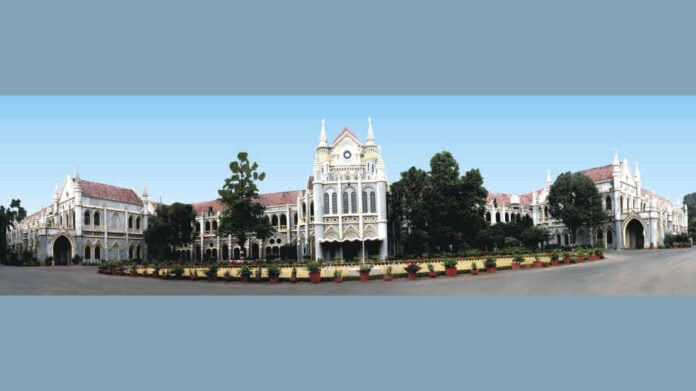
On 12 June 2026, a sessions court in Dindori, Madhya Pradesh, convicted seven Christian men of luring janjatiya (ST) people to convert, promoting enmity between religious groups and outraging religious feelings, and sentenced each to five years’ rigorous imprisonment and a fine of Rs 1 lakh. Sixty-seven days later, on 18 August, the Madhya Pradesh High Court at Jabalpur released the Dindori pastors on bail of Rs 20,000 each and gave them leave to appeal. They walked out of Dindori district jail to a welcome from nearly 150 Christians, reports Church in Chains.
Within days the story was on church news sites from London to Dublin to Washington. Barnabas Aid, a British charity, celebrated the “joy” of their release and told readers that their gifts had paid the men’s legal costs and continue to support their families. Morning Star News and the Christian Post had already told American readers in July that the men were jailed on “false charges”, a claim an Indian court rejected after a full trial.
The case the courts heard
The case began on 28 April 2024 at a child’s birthday party in Pipariya village. The complainant, Angad Singh Maravi, a neighbour and relative of the host who follows his community’s traditional Janjatiya Dharma, told police the pastors had urged those present to convert. The seven were arrested and got bail within weeks, in May 2024. The chargesheet came in December 2024 and charges were framed in November 2025. After hearing the evidence, including the host’s testimony for the defence, Second Additional Sessions Judge Shiv Kumar Kaushal convicted all seven. By Morning Star’s own account, it was only the second conviction under the Madhya Pradesh Freedom of Religion Act, 2021, since the law came into force.
That figure says more about how the law is enforced than any cry of “persecution”. Madhya Pradesh Home Department data cited by ThePrint show 216 cases registered under the Act between 2021 and 2024, against 329 people. Five years on, two have ended in conviction. In Uttar Pradesh, the United Christian Forum counted 184 FIRs under the state’s conversion law from 2020 to 2023, and its own national coordinator conceded there had been “very few convictions”. Laws meant to shield Janjatiya, SC and other poor Hindus from predatory proselytisation are almost never enforced to a verdict, and when they are, the convicts are out in weeks.
Ten weeks for some, a decade for others
This is not the first time the wheels have turned so fast. Bishop Franco Mulakkal was arrested on 21 September 2018 on charges of repeatedly raping a nun. The Kerala High Court refused him bail on 3 October and granted it on 15 October, 24 days after his arrest. He was acquitted in January 2022. The survivor filed her appeal on 28 March 2022; nearly four years later, in January 2026, the Kerala government was only appointing a special prosecutor to argue it, and only after the nun went public about the delay.
Now consider the ordinary Bharatiya caught in the system. Of the 5.11 lakh people in Bharat’s prisons at the end of 2024, about 73 per cent were undertrials, not yet convicted of anything, according to NCRB’s Prison Statistics India. In 2021 the Supreme Court found 7,214 convicts in Uttar Pradesh who had spent more than ten years in jail because the Allahabad High Court had not heard their appeals.
The law promises all of them what the Dindori pastors got. As recently as 2025, in Aasif @ Pasha v. State of UP, the Supreme Court held that a fixed-term sentence should ordinarily be suspended while the appeal is pending. But a right on paper is worth only as much as the lawyer who can get it listed and argued. Seven men from two Dindori villages had a British charity paying their legal bills and an international press waiting at the jail gate. The poor Hindu undertrial in the next barrack has neither.
The machine behind the headlines
Look at who carried the story. Barnabas Aid in Britain claimed to have paid the lawyers. Church in Chains in Ireland relayed the release. Morning Star News and the Christian Post in the United States called the charges false. UCA News, the Asian Catholic agency, tracks every bail order in conversion cases across Uttar Pradesh. Global Christian Relief, another American group, ran an earlier account of a similar case under the headline “Seven pastors persecuted in India by Hindu nationalists”, beside a “Donate Now” button and a pitch for monthly giving. Open Doors ranks Bharat 12th on its 2026 World Watch List, up from 31st in 2013. And the US Commission on International Religious Freedom, in its August 2026 India brief, repeats its call for Washington to designate Bharat a “Country of Particular Concern” and to sanction its intelligence agency.
A single village case thus moves from prayer request to fundraising appeal to diplomatic pressure within weeks. Nearly every link in the chain is rooted in the West and deeply invested in ‘civilizing’ Asia, and the “secular” human-rights bodies that amplify it discover religious freedom only when a missionary is charged with breaking another country’s law. None of them ever reports the complainant’s side.
Who stands with Angad Singh Maravi?
No foreign charity pays the complainant’s lawyer. No website in London or Washington carries his account of what happened at the party, or asks why a man defending his ancestral faith should have to take on a transnational organisation with a budget, a press operation and a line to the US Congress.
This imbalance has a history. Colonial rule drained Bharat’s wealth on a scale economist Utsa Patnaik has put at about $45 trillion, and left Janjatiya and rural Hindu communities among the poorest on earth. For decades after independence they were governed by a secular elite, led by the Nehru-Gandhi family, that treated Hindu tradition as backwardness to be reformed rather than a civilisation to be protected. Into that vacuum came the missions, with schools, hospitals, cash and a theology that teaches converts to see their ancestors’ gods as false.
Hindus who ask the state to enforce its own laws are not persecuting anyone. They are asking for what every other civilisation takes for granted: that its faith and its poor are not treated as a harvest field.
What Bharat should do
Conversion cases should be fast-tracked, so that both the accused and the complainant get a verdict in months, not years. The money that funds legal defence in these cases should be followed, and the authorities should ask whether it reaches Bharat through FCRA-registered channels. Prosecutors must contest these appeals as hard as the accused fight them, and seek stiffer sentences where the law allows. And Hindu organisations must fund legal aid for complainants as seriously as Barnabas Aid funds the accused.
Above all, the judiciary must be decolonised and made answerable to the people, not to liberal elites and a coterie of Hinduphobic senior lawyers such as Kapil Sibal, who sought to put off the Ayodhya hearing until after the 2019 election, and Indira Jaising, who has moved the Supreme Court against state anti-conversion laws. Until then, the scales will stay tipped, whatever mandates voters hand to governments that pass the anti-conversion laws citizens want, only to see an ossified and hijacked justice system fail to enforce them.
