


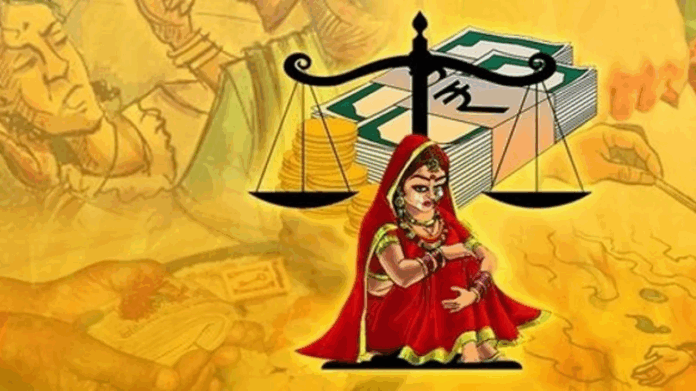
The cries of anguish from 26-year-old Nikki Bhati when her body was consumed by a fire on August 21, 2025, in Greater Noida’s Sirsa village are a more than a useless isolated tragedy. They are the voice of the thousands of Bharatiya women who continue to burn—metaphorically and, often enough, literally—on the altar of an ancient practice that has evolved from empowering women to killing them. Having been a sociologist firmly rooted in gender studies, I interpret this ghastly case not as yet another dowry death, but as the culmination of a millennia-long transformation that has distorted what was once a women’s economic lifeline into a death warrant.
The Sacred Origins: Stridhan as Women’s Economic Sanctuary
In order to understand the horror that dowry has become, we must go back in history to the Vedic period (1500-500 BCE), where the word Stridhan—”women’s property” emerged as a revolutionary logo of women’s economic power. In historical Bharat, Stridhan was the token of exclusive property ownership among women, encompassing gifts from one’s relatives and parents and from one’s husband too, as well as property acquired through one’s efforts and talent. This was not almsgiving but recognition—an assertion that women, irrespective of the patriarchal limitations put on inheritance, were entitled to economic independence and security.
The Vedic works, and specifically the ones quoting Manusmriti, classified Stridhan as women’s exclusive property, including ornaments, clothes, cattle, and even very rarely, land. The striking feature was that even though the husband was not interested in depriving his wife of her Stridhan, she had a very strong level of ownership over its use. This was a pre-mortem gift of a kind that made women financially independent—far superior to that which was conferred through many a society well into the next couple of centuries.
Historical records of Alexander the Great’s conquest of the region around 300 BCE offer overwhelming evidence that dowry in the manner in which we conceive it today was well-nigh nonexistent in Bharatiya wedding ceremonies. Arrian’s version reports that native Bharatiya “care nothing whether she have a dowry and a handsome fortune, but regard only her beauty and other values of the external person”. This lack of dowry further necessitates that Vedic society, although male-centered, did not commodity women by money values in marriage.
Ancient practice of Kanyadan, wrongly understood today, was solely religious and not money-based exchange. Unlike the modern connotation of “giving away the girl,” the Vedic ritual of Kanyadan was more a spiritual pact between two souls, and the parents brokered a spiritual and not mercantile deal. The ritual included respect for both bride and groom as receptacles of divine souls and not a contract based on mere material exchange.
The Colonial Catastrophe: How British Rule Distorted Ancient Procedures
The transformation of Bharatiya’s marriage culture from empowerment to exploitation can be traced directly to British colonial policies and more specifically Lord Cornwalli’s Permanent Settlement of Bengal in 1793. The act of introducing private land ownership to Bharat had disastrous consequences for women’s rights within the economy. The British system prohibited women from owning land—an element that never existed in traditional Bharatiya societies.
Prior to colonialism, the dowry system was a “women’s institution, run by women,” which provided women with economic independence and security. The dowries expended on brides were the property of the women, under their command, and served as protection against bad times in the future. The colonial court system, however, appropriated all gifts from male relatives and thereby altered the very basic power relations in Bharatiya families.
This colonial intrusion created a perfect storm of economic and social forces. After women lost their traditional property rights, the transaction of transferring wealth at marriage shifted from empowerment to dowry in the shape of bride price or compensation. Dowry was perceived by families as necessary payment so that daughters could gain admission into families where they would not enjoy material status. The patriarchal English common law-based English legal system supported these constraints and accepted the commodification of women through wedlock.
The psychological effect of this change cannot be overemphasized. While Vedic women had been recognized as economic agents worthy of property rights, colonial law made them dependents whose worth was the wealth their families could offer. This change from Stridhan to dowry is one of the most institutionalized annihilations of women’s economic independence in history
The Modern Mutation: From Economic Security to Extortion Economy
The 20th and 21st centuries have seen the total perversion of the ancient practices into systematic extortion. Today’s dowry is unrelated to the protective Stridhan of the Vedic period. Far from empowering women, it has turned into an instrument of their ongoing exploitation and, unfortunately, annihilation.
Latest statistical trends expose the shocking extent of this change. In 2022 alone, Bharat reported 6,516 dowry deaths—over 25 times the number killed after rape or gang rape. That is more than 18 women dying every single day due to their families being unable to keep up with increasing demands placed by their in-laws. Leading this chilling list is Uttar Pradesh, the state where Nikki Bhati was killed, with 2,138 cases, followed by Bihar with 1,057.
The dowry system today is a lifetime extractive system. Contrary to the single transfer of Stridhan in traditional practice, dowries today are lifetime and continuous for a woman. The family that donated a Scorpio SUV, a Royal Enfield bullet, a pair of golden items, and some cash during marriage in 2016 was greeted with a dowry demand of Rs. 36 lakh and an expensive car nine years later. This escalation turns marriage into a hostage situation and not a sacrament.
The Sociological Anatomy of Violence: Understanding Patriarchal Capitalism
From a feminist sociological viewpoint, dowry violence today is the intersection of patriarchal control and exploitation of capital. The commodification of women in terms of dowries gives us “patriarchal capitalism”—an economy that renders women’s bodies sites of valor-extraction for men’s class ascension.
Social reproduction theory makes clear how dowry violence works via broader systems of capital. Bharatiya women are made into instruments of labor power on behalf of socially reproducing economically dependent men. Girls are institutionally denied work and education so that male-dominated households can invest in them, and then men pull dowry from other households during marriage. It is a vicious cycle where oppression of women leads to capital accumulation in male-dominated households.
This psychological violence of this system extends much further than physical violence. From childhood, girls are taught to internalize the role of “paraya dhan” (other people’s property), where their value is more dependent on the ability of their families to afford their placement than upon themselves. Such conditioning leads to what feminist scholars refer to as “internalized misogyny”—women internalizing and replicating systems of oppression upon themselves.
The case studies reveal the systematic nature of this violence. Nikki Bhati’s sister Kanchan described that both women experienced systematic beatings, even in front of their children. Normalization of such violence in homes is an indication of how dowry culture renders women’s oppression invisible and acceptable. Video images in Nikki’s situation show her by her hair being pulled by family members—a raw example of how communities engage in women’s dehumanization.
Legislation and its Failures: Why Legislation Fails to Address Cultural Pathology
Despite elaborate legal codes—the Dowry Prohibition Act of 1961, IPC Section 498A (harassments of married women), and Section 304B (dowry death)—the practice not only persists but thrives. The futility of legal intervention suggests the inadequacy of addressing cultural pathology by punishment and punishment alone.
Statistical analysis of legal cases demonstrates the failure of the system. Out of an annual average of 6,500 dowry death cases that come on trial, fewer than 100 are converted to convictions. Over 60,577 cases were pending at the end of 2022 in courts, out of which 54,416 cases were carryovers from previous years. This means women such as Nikki Bhati have fewer than a 2% chance of the guilty being convicted in her year of death.
The low conviction rate is a reflection of broader structural problems within the legal system of Bharat. Police officials habitually discourage women from filing charges, as shown by instances of women police officers taunting victims and asking them to withdraw cases in the interests of preserving their reputations. The evidence always and only rests with the victim in order to establish dowry harassment, and it is an unrealistic demand when even the institution of marriage itself becomes routinized violence.
Resistance and Change: Fighting for Freedom In spite of huge systemic repression, women keep fighting and changing dowry culture. The 2003 case of Nisha Sharma is a turning point when a 21-year-old student of software engineering named police during her wedding ceremony when the groom’s family insisted on more dowry. Although the case was subsequently dismissed with the court ruling in favor of false charges, Nisha’s initial defiance galvanized thousands of women and became an icon of resistance to dowry demands.
Contemporary campaigns of resistance present the possibility of cultural change. Organizations like the Sri Kurumba Educational and Charitable Trust organized 697 dowry-free weddings from 2008 until the time of writing, showing that weddings can happily celebrate love and marriage without exploiting material. In one village in Nawabpet, Telangana, teenagers initiated a “Katnam Vaapasi” (back of dowry) campaign, encouraging 10 men to give up dowry taken at the time of marriage. These represent grassroots efforts at reversing the loss of integrity of marriage relationships.
The individual anecdote of a 28-year-old doctor in London who has an annual income of ₹1 crore provides us with an image of how financial freedom allows women to reject dowries. When her distant relatives insisted on her marrying within the family and collecting a good dowry, her own economic independence allowed her to reject the idea flat out and choose her own guy. This situation illustrates how financial empowerment of women is the most effective shield against dowry exploitation.
Bharatiya mass wedding schemes have the potential for structural change. Organizations that provide dowry-free weddings provide commodities of basic needs and take away the financial burden that typically comes with a wedding. They redefine wedding commercialization and demonstrate that weddings can be dignified without economic exploitation.
The Relationship Between Gender, Class, and Violence
Dowry violence operates differently across classes, requiring class-specific understanding of how class and gender oppression intersect. In educated urban classes, dowry will disguise itself as “gifts” and lifestyle maintenance, but rural communities may demand outright transfers of money. Violence is the same across classes—women suffer regardless of the economic status of the family.
The instance of Yukta Mookhey, a former Miss World, filing a charge against dowry harassment of her husband shows that even privileged women are not exempt from vulnerability in patriarchal marriage systems. The life threat and children’s custody threat she faced reflects that dowry violence is not confined to any class, and it can have implications for women from any part of society.
Rural women are also disadvantaged by limited access to work and a greater sense of traditional gender conduct. Cases involving the type of abuse that Saraswathi endured for 23 years from her husband, until he abandoned her, are typical of rural women’s entry to means of escaping abusive marriages. The intersection of rural poverty, illiteracy, and patriarchal control makes some groups highly vulnerable and in need of targeted intervention.
Paths Forward: Renewing Marriage Culture
In order to put an end to dowry violence, there must be fundamental reconstruction of Bharatiya wedding culture beyond legal reform and engaging the underlying patriarchal assumptions. This transformation must begin at the level of economic empowerment—keeping women educated, working, and holders of property that would enable them to enter into marriages as equals and not as dependents.
There is a necessity for education to subvert gender stereotypes in early childhood. Girls and boys should be made aware that women derive value not from the family’s material possessions. Feminist Bharatiya histories should be included within curricula, and women’s pre-colonial and colonial economic rights should be prominent.
Religion and community leaders occupy central roles in interpreting the traditional practices. Kanyadan practice may be reconstructed for bringing to the fore parental blessings rather than the conveyance of ownership, and Stridhan practices may be reconstructed for the economic security of women. These reinterpretations must be based on the original Vedic traditions and not on colonial-imposed tradition.
Media portrayal needs drastic change to prevent idealization of dowry culture. Movies and TV programs need to discontinue depicting dowry demands as natural parts of marriage while focusing on women’s resistance and agency. Positive depiction of dowry-free marriages can normalize alternative practices.
The Global and Comparative Perspective
Bharat’s dowry issue gains greater context when considered in comparative context to gender violence and exploitation globally. Dowries are also seen in other South Asian countries and parts of Africa, but Bharat’s scale and systematic nature would not seem different. This would then necessitate solutions based on specifically Bharatiya historical and cultural contexts and not superimpose universal solutions to violence against women.
Feminist movements in other countries present viable models for resisting system oppression. The success of women’s economic development campaigns in Rwanda and Bangladesh illustrates how quickly positive intervention can reverse gender relations. Bharat can learn from other countries while translating methods for implementation within its own cultural setting.
The global campaign for violence against gender offers schemata for thinking about violence associated with dowry in larger patterns for patriarchal dominance. Situating violence associated with dowry within a context of international debate surrounding human rights legitimates women’s resistance and elicits international support for change.
Technology and Contemporary Dilemmas
New technology creates new forms of dowry violence as it simultaneously offers means for resistance. Social communication networks enable families to boast about their status and material wealth, in effect amplifying competitions between families for dowries. The Nikki Bhati case involved disputes over her Facebook updates and desire to reopen a beauty parlour, showing how new communications technologies interpose with tried systems of control.
But technology also facilitates new acts of accompaniment and resistance. Sites on the internet provide women with the ability to exchange experiences, access legal documents, and establish networks of solidarity that are not bounded by geography. Documentation of violence online, as in the case of Nikki where videos recorded abuse, can serve as evidence for the legal process while generating popular consciousness.
Mobile banking and digital financial services offer channels for direct access and control over women’s own economic resources. They can potentially avoid male-dominated traditional financial channels and enable women autonomous economics in marital relationships.
Conclusion: Reclaiming Sacred Traditions from Patriarchal Distortion The evolution from Vedic Stridhan to Bharatiya dowry death is one of the darkest examples in history of a perversion of forward-looking traditions into tools of subjugation by colonialism and patriarchal capitalism. Nikki Bhati’s murder was not inevitable—it was a consequence of systemic inability to transcend the colonial legacy that had made women’s economic agency their commodification. We also need to recall that opposition to dowry practice is opposition to wider systems of patriarchal oppression. Each woman who stands against dowry demands, each family that celebrates dowry-free, each community challenging entrenched definitions of gender peels away millennia of accumulated oppression.
The path to freedom requires courage to confront uncomfortable truths about the devaluation of women in our society. It needs acknowledgment that today’s Bharatiya culture is not ancient at all, but a distorted colonial one that needs to be actively opposed and changed. Above all, it needs comprehension that women’s economic empowerment and not legal change or cultural invocation offers the platform for bringing dowry violence to an end. The death of Nikki Bhati should not go in vain. Her case must initiate a complete transformation in Bharatiya wedding culture, leading us to a day when women come to marriages as equal partners and not objects, where their qualifications are recognized through their humanity and not through the wealth of their families, and where the sacred traditions of Stridhan and Kanyadan regain their unblemished meanings of power and divine grace and not exploitation and commercialization. The feminist sociological understanding reveals that dowry violence is not individual psychopathology or cultural determinism, but structural oppression that can be deconstructed by collective resistance. That deconstruction requires not legal reform or education, but fundamental restructuring of economic and social relations that have subordinated women for millennia.
It is only by this fundamental transformation that we can show respect to the memory of women such as Nikki Bhati by refusing to let any other sisters sacrifice themselves at the altar of male greed in the name of tradition. The time for gradual reform is past. Bharat’s women deserve nothing short of complete freedom from the economic terrorism masquerading as marital tradition. This liberty begins by not believing dowry murders are “social issues” requiring subtle reform.
They are crimes against humanity that need a revolutionary answer. The revolution starts from each one of us—refusing complicity in dowry transactions, challenging patriarchal axiomatics, and building new paradigms of marriage out of equality, dignity, and love rather than money exploitation and organized violence.
-Kushagra Garg
