


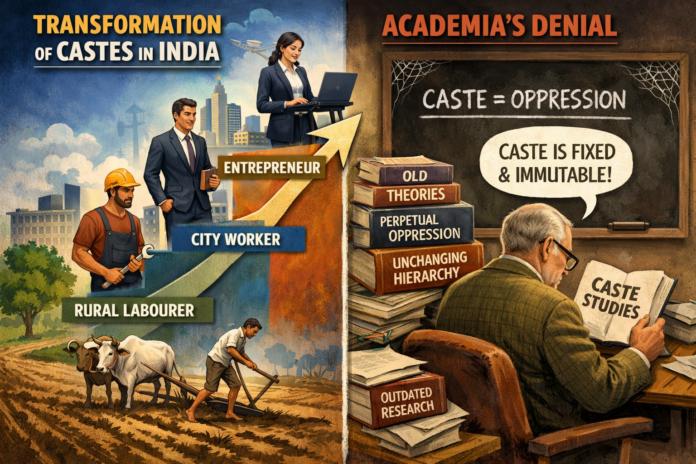
“Caste in Transition: Progress, Intellectual Pessimism, and the Limits of Binary Policy in Contemporary India”, India Fact, February 26, 2026
“Few subjects in India provoke as much moral intensity as caste. It is invoked as an explanation for violence, inequality, humiliation, privilege, exclusion, and even for the failures of modern institutions. Yet when we listen carefully to public discourse, two dominant attitudes repeatedly emerge. At one extreme stands the denialist claim: caste is a relic, a colonial exaggeration, or at most a marginal remnant that no longer structures contemporary life. At the other stands a more pessimistic intellectual position: caste has not fundamentally changed; it has merely altered its techniques. Where once there was open exclusion, there is now subtle discrimination. Where once there was physical segregation, there is now psychological violence. According to this view, caste today is essentially what it was centuries ago, only more refined. While these positions appear opposed, they are in fact bound together by a shared rigidity. Both treat caste as static: either fully intact or fully obsolete. In this sense, the denialist claim that caste has disappeared is not independent of the pessimistic claim that nothing has changed; it is often a reaction to it. When discourse presents caste as immovable and omnipresent, the counterreaction is to dismiss it altogether. Thus, both narratives become two sides of the same coin, each flattening the complexity of social transformation.
This essay begins with the second proposition, the claim that caste has not meaningfully changed because it has gained intellectual legitimacy in academic and policy spaces. The insistence on structural continuity, however, risks overlooking gradual but measurable shifts in education, interaction, and representation. Here, Steven Pinker’s idea of “progress-phobia” becomes relevant: the tendency of intellectual cultures to under-recognise incremental improvement because injustice has not vanished entirely. To acknowledge change is not to deny discrimination; it is to refuse the assumption that deeply embedded systems cannot evolve. The sections that follow, therefore, turn to empirical evidence, not to proclaim the end of caste, but to examine whether its social grip is loosening in measurable ways.
The evidence of a fundamental shift in the power of caste within Indian society is grounded in a vast array of empirical data, most notably in the unprecedented democratization of higher education and the universalization of basic living standards. Hardcore numbers from the All-India Survey on Higher Education (AISHE) Report (November 2025) demonstrate a structural revolution. Between 2010-11 and 2022-23, overall higher education enrolment in India grew by 59.3%, rising from 2.75 crores to 4.38 crores. Within this expansion, the growth rates for marginalized groups have been exponential compared to the General Category. Enrolment for Scheduled Castes (SC) grew by 122.9%, Scheduled Tribes (ST) by 133.8%, and Other Backward Classes (OBC) by 124.8%. In stark contrast, the General Category (including EWS) saw a growth of only 9.5% during the same thirteen-year period. This disparity is even more pronounced in absolute terms: SC/ST/OBC enrolment increased by 1.48 crores, while the General Category grew by only 15 lakhs (Caste-Based Enrolment 13-14)……”
Read full article at indiafacts.org.in
