


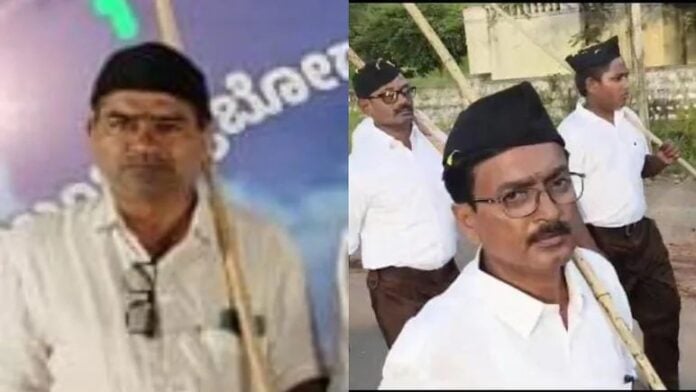
The Karnataka government’s suspension of two government school teachers for participating in an RSS route march has triggered a sharp political confrontation. The opposition BJP pointed out that the ruling Congress was intentionally targeting employees over their association with the Rashtriya Swayamsevak Sangh (RSS).
As per India TV reports, the two teachers, Gururaj Joshi, an assistant teacher at Government Girls High School in Hunasagi, and Anna Saheb Deshmukh, headmaster of Government Lower Primary School in Kuppi, Surpur taluk, were suspended by the Karnataka Education Department on Thursday after they participated in an RSS Patha Sanchalana.
The Education Department said its participation prima facie violated provisions of the Karnataka Civil Services (Conduct) Rules, 2021. The action has, however, drawn strong criticism from BJP leaders, who have questioned why government teachers should face suspension merely for attending an RSS program, particularly when the event itself did not result in violence or damage; it was just a Patha Sanchalana.
Union Education Minister Pralhad Joshi accused the Congress government of acting out of “hatred” and “vindictiveness” and demanded that the suspension orders be withdrawn. He argued that attempts to restrict RSS activities and take disciplinary action against government employees for participating in Sangh programs have faced judicial scrutiny in the past.
Union Minister H D Kumaraswamy also criticized the Karnataka government’s action, questioning what wrongdoing the teachers had committed by attending the RSS event. He asked whether the program had caused any violence, destruction, or other disturbance, arguing that participation in a meeting or procession by itself should not automatically be treated as misconduct.
The Congress government has defended the disciplinary action. Karnataka Home Minister Priyank Kharge, who started anti-RSS speech, hatred, and derogatory remarks, maintained that government employees are bound by service conduct rules and questioned why officials should participate in activities organized by an unregistered organization. According to the government, the issue is therefore not merely one of personal participation but whether such participation is compatible with the conduct obligations imposed on state employees.
The controversy has consequently widened into a larger political battle over the rights and restrictions applicable to government employees and the government’s approach towards RSS-linked activities. While the Congress insists that civil servants must remain within the boundaries prescribed by service rules, the BJP stated that the suspensions were an example of political vindictiveness and selective targeting.
The controversy once again raises questions over the Congress government’s continued targeting of the RSS. Despite there being no established record of RSS involvement in violent incidents in Karnataka, Congress leaders, including Priyank Kharge, have repeatedly trained their political fire on the organization. At the same time, why does the government not apply the same scrutiny to organizations such as the SDPI, SFI, or the now-banned PFI, which have faced investigations over extremist or unlawful activities several times? For many Hindus, the growing perception of selective political targeting has become deeply troubling. If an individual is not allowed to participate in a public Patha Sanchalana, it is declared as a crime, as in the case of an RSS event, where is the freedom of expression? It amounts to a violation of individual rights and reflects the draconian tactics of the Congress government in Karnataka.
