


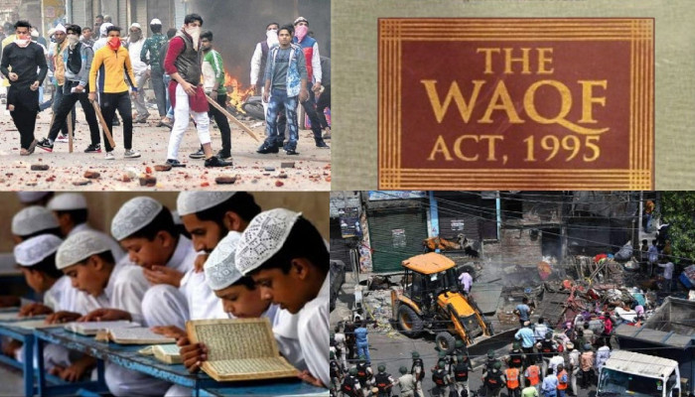
“The Rise of the Syndicate: Muslim Demographics, Appeasement, and Mafia Politics in UP Part 20”, MyIndMakers, 09 Sep 2026.
“No analysis of Uttar Pradesh’s political economy over the past three decades is complete without an honest examination of the relationship between communal appeasement, criminal networks, and electoral politics a relationship the secular establishment has systematically avoided discussing with the clarity governance requires. The institutionalisation of what critics have called the ‘appeasement-mafia nexus’ — the mutual reinforcement between ruling parties’ cultivation of Muslim vote banks through symbolic and substantive concessions, and the protection of criminal networks that operated across communal lines in exchange for political support — had profound consequences for law and order, economic development, and the civil rights of ordinary citizens across communities. Understanding this nexus is essential not for communal point-scoring but for honestly reckoning with why UP’s governance failed so comprehensively for so long.
The Demographic and Electoral Arithmetic
Muslims constitute approximately 19-20 per cent of UP’s population, the highest proportion of any large Indian state outside Jammu and Kashmir and Kerala. They are concentrated in specific geographic clusters: the western districts bordering Delhi (Saharanpur, Muzaffarnagar, Bijnor, Moradabad), the central belt around Lucknow and Kanpur, and the eastern districts of Azamgarh and its surrounds. This concentration means Muslims form a decisive or significant vote share in many of UP’s 403 assembly constituencies; estimates suggest between 100 and 140 constituencies where the Muslim vote can be decisive.
For the SP and the BSP, and before them the Congress, Muslim votes were essential components of winning coalitions. The SP’s M-Y (Muslim-Yadav) formula explicitly incorporated Muslim mobilisation as one of the two pillars of its electoral arithmetic. The BSP’s Bahujan concept included Muslims as part of the exploited majority. The Congress had historically been the preferred party of the Muslim community as the perceived bulwark against Hindu nationalist politics. All three parties competed, with varying strategies, for Muslim electoral support…………”
Read the full article at MyIndMakers.
