


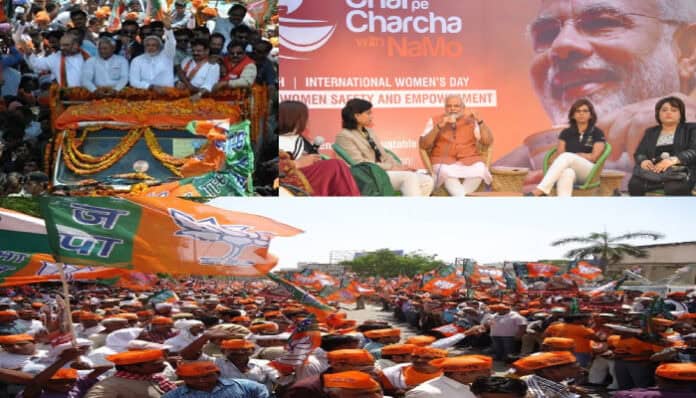
“The Gujarat Model and the Great Awakening: Narendra Modi and the Resurgence of Cultural Nationalism in Uttar Pradesh Part 23”, MyIndMakers, 12 Sep 2026.
“When Narendra Damodardas Modi became Chief Minister of Gujarat in October 2001, replacing Keshubhai Patel at a moment when the state’s political situation was unstable and its economic management stagnant, few commentators predicted that this RSS pracharak-turned-state-politician would become the most consequential figure in Indian politics since Indira Gandhi. Fewer still anticipated that the governance model he would construct in Gujarat over the following twelve years — combining uncompromising cultural nationalism with relentless developmental focus, organisational discipline with mass communication genius, and Hindu civilisational pride with economic modernisation would provide the template for a political transformation that would remake Uttar Pradesh more thoroughly than any event since the RSS’s first shakhas were established in the state in the late 1920s. The story of how the Gujarat model travelled to UP how a development narrative rooted in a specific cultural identity was translated from a western state with a particular economic character to the Hindi heartland’s vast and complex political landscape—is one of the most important stories in contemporary Indian political history.
What the Gujarat Model Actually Was
The ‘Gujarat model’ became a contested term in the 2014 election campaign, with the BJP’s opponents trying to reduce it to either the 2002 riots (which Modi’s opponents persistently associated with him despite his two Supreme Court-sanctioned clean chits) or a set of disputed economic statistics. Understanding what the Gujarat model actually represented as a governance philosophy and a political proposition requires going beyond the polemical shorthand.
At its core, the Gujarat model showed that Hindu cultural nationalism and development-oriented governance were not merely compatible but mutually reinforcing. Gujarat under Modi consistently ranked among India’s top states in industrial investment, infrastructure development, agricultural productivity, and improvements in human development indicators. The state’s power sector shifted from one of India’s most dysfunctional to one of its best-managed; 24-hour power supply to agricultural consumers and the Jyotigram scheme became a landmark of infrastructure governance. The Sardar Sarovar Dam, delayed for decades by legal challenges and political controversy, was completed, and water was delivered to Saurashtra’s drought-prone districts. Industrial investment from across India and globally was attracted by the Vibrant Gujarat investor summits, which showed that a BJP-governed state was a reliable environment for business, a claim no SP- or BSP-governed UP could plausibly make………”
Read the full article at MyIndMakers.
