


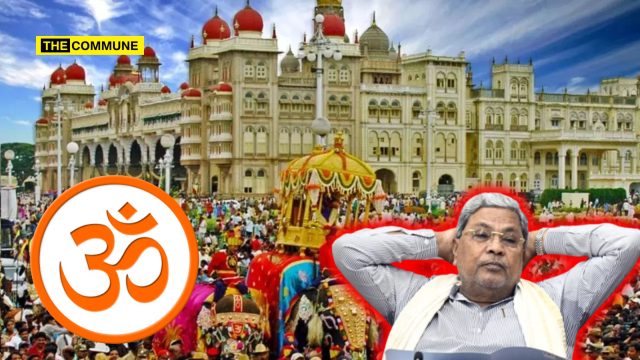
The Mysore Dasara festival, deeply woven into the fabric of Karnataka’s Hindu civilizational heritage, has long stood as a symbol of tradition, faith, and community unity. However, from 1980 to 2025, the festival has seen significant interference by Congress-led governments, resulting in repeated transformations of this cultural celebration into a stage for political messaging and administrative control, often generating tension between government initiatives and the sentiments of Mysore’s royal legacy and Hindu devotees.
Politicization of a Sacred Tradition
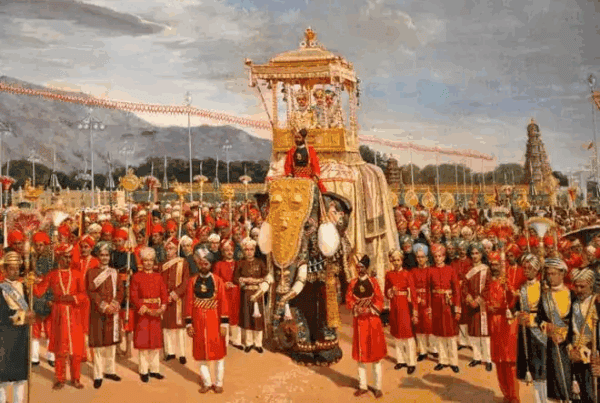
The Congress party’s approach has been characterized by assertive state involvement in the festival, primarily through the selection of inaugurators and policy decisions that curtailed or altered longstanding rituals. Traditionally, Dasara rituals were overseen by Mysore’s royal family, considered the religious and cultural custodians of the event. This safeguarding of customs honored the Devi Chamundeshwari and reflected the region’s deep Hindu civilizational roots, connecting the people to an unbroken cultural lineage.
Timeline of Interference
Across eight major incidents spanning four decades, Congress governments have redefined the festival’s tone and ritual composition. These include:
- 1980: The Congress regime under R. Gundu Rao institutionalized state control by creating a divisional-level committee headed by a bureaucrat, sidelining the Maharaja’s role and signaling the start of formal government intervention in religious and cultural matters.
- 2001 & 2005: Congress Chief Ministers S. M. Krishna and Dharam Singh respectively assumed the mantle of inaugurators, performing ancient rituals such as floral tributes and the worship of the goddess atop the royal elephant. These acts, typically performed by the Maharaja, blurred the boundaries between spiritual custodianship and political authority, undermining the festival’s royal and Hindu identity.
- 2013 & 2017: The Siddaramaiah-led Congress government’s invitations to literary figures (Dr. Chandrashekar Kambar in 2013 and Prof. K.S. Nissar Ahmed in 2017) brought the festival squarely into the political domain. Rather than embracing continuity, these inaugurations were marked by speeches critiquing the political climate, further alienating those seeking spiritual communion and tradition at Dasara.
- 2023: The festival was curtailed with an official order for simplicity, citing drought, despite allocations and local requests for grandeur. Such measures, while practical in appearance, were criticized for their impact on cultural morale and heritage stewardship, reflecting a bureaucratic mindset disconnected from the lived spiritual and communal resonance of Dasara.
- 2024: Political crises further delayed preparations for the festival, underscoring a pattern where administrative or political distractions overshadowed devotion and continuity, affecting the festival’s stature and sanctity.
- 2025: The invitation of Kannada writer Banu Mushtaq to inaugurate Dasara by the current Congress government reignited debates over secularism and tradition. The Chief Minister’s vocal defense of the decision, framing the event as “secular” and “cultural,” was seen by many traditionalists as a dilution of the festival’s Hindu essence, sparking criticism from royal family members and the broader Hindu community.
The Erosion of Heritage and Civilizational Identity
For many who view Mysore Dasara as the flourishing of Hindu civilizational identity, these repeated interventions constitute more than mere administrative changes—they signal a weakening of the spiritual and cultural bedrock upon which the festival stands. Each act of political selection, each bypassing of royal ritual, and each downplaying of traditional ceremonies represents an incremental erasure of indigenous continuity of the perennial Hindu civilization.
The festival is not merely a tourist attraction but a reaffirmation of communal identity forged through ritual, worship, and generational stewardship. The tendency to recast Dasara into a secular or “inclusive” event, while ostensibly promoting harmony, risks severing it from the divine and historical forces that shaped it. The shifting of inauguration rights, the prioritizing of political appropriateness over sacred custom, and the expanding role of government committees represent attempts to remodel a living tradition from above, rather than preserving its soul as held by the community and its original custodians.
Conclusion
In summary, the past forty-five years have witnessed a recurring pattern of Congress-led government intervention in Mysore Dasara, altering its intrinsic Hindu character and sidestepping the festival’s royal and dharmic stewards. For defenders of Hindu civilization, this underscores a call to reclaim, protect, and celebrate the festival’s sacred essence so that the deeper meaning of Dasara—victory of good over evil, dharma over adharma—remains unbroken for generations to come.
Source: 8 Incidents : Congress-led government’s interference in Mysore Dussehra (1980 to 2025)
