


A formal complaint has been lodged against Chitekala Salomi, a member of the District SC/ST Vigilance & Monitoring Committee in Nandyal District, Andhra Pradesh, who allegedly misused her official position to influence religious construction activities, a potential violation of caste status regulations. Based on the reports from the Organiser, the complaint, submitted by the SC ST Rights Forum in collaboration with the Legal Rights Protection Forum (LRPF), highlights concerns over the illegal construction of a church and the questionable caste status of Salomi.
Chitekala Salomi, a member of the District SC/ST Vigilance & Monitoring Committee, is accused of threatening public officials and unlawfully interfering in matters outside her official purview. The controversy revolves around a church construction initiated by Hosanna Ministries Society on agricultural land located at Survey No. 433-1 in Bandi Atmakur Mandal, Nandyal District. The construction allegedly began without obtaining the necessary permissions, in violation of the Andhra Pradesh Agricultural Land (Conversion for Non-Agricultural Purposes) Act, 2006, which mandates prior approval from the competent authority for converting agricultural land to non-agricultural use.
Further compounding the issue, the Andhra Pradesh Government’s Panchayat Raj & Rural Development Department issued G.O. M.S. No. 376 in 2012, which explicitly requires the District Collector’s approval for any religious constructions. The G.O. specifies that approval may be denied if the proposed construction is likely to endanger public peace and order.
Allegations against Chitekala Salomi
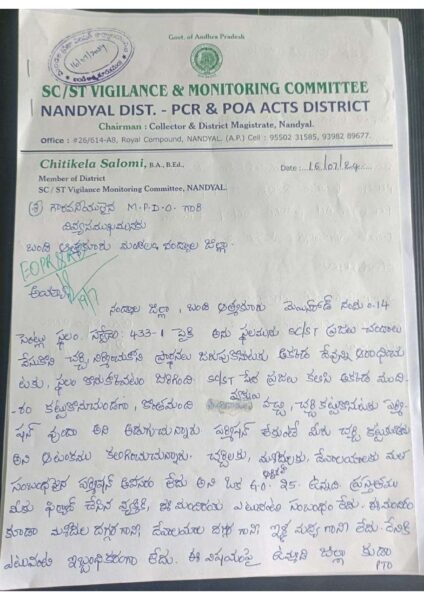
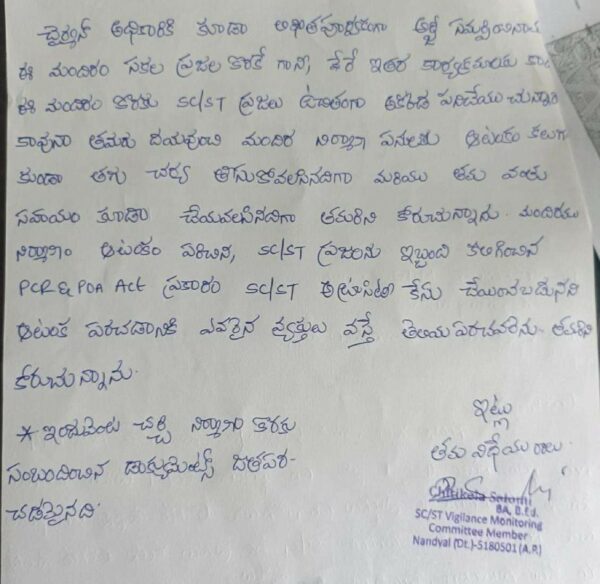
The complaint asserts that Salomi issued a warning letter to the Mandal Parishad Development Officer (MPDO) of Bandi Atmakur, threatening criminal charges under the SC ST (Prevention of Atrocities) Act against those obstructing the illegal church construction. This action has been criticized as an abuse of her official position to favor a particular community, portraying the matter as a caste conflict when, in fact, the issue pertains to unauthorized construction.
Chitekala Salomi, in her letter dated July 16, 2024, allegedly claimed that local Scheduled Castes (SCs) were behind the church’s construction, though she did not clarify whether these individuals were Christians. This claim has raised additional concerns regarding the misuse of her position to protect religious construction under the guise of caste-related issues.
The complaint also raises concerns about Salomi’s caste status. It has been reported that she is a practicing Christian, which, under the Constitution (Scheduled Castes) Order 1950, would disqualify her from claiming Scheduled Caste status. The Hon’ble Supreme Court of India has also upheld this position in Civil Appeal No. 4870 of 2015, stating that individuals who convert to Christianity or Islam cannot retain Scheduled Caste status.
Call for Action
The SC ST Rights Forum and LRPF have urged the District Collector and Chairman of the District Level SC/ST Vigilance & Monitoring Committee to initiate disciplinary action against Chitekala Salomi. They have requested a formal inquiry into her caste status by the District Level Scrutiny Committee, citing the potential misuse of her SC certificate and her official position to facilitate the illegal construction.
This case reflects ongoing concerns about the enforcement of caste status regulations and the responsibilities of public officials to adhere to legal and ethical standards. The SC ST Rights Forum and LRPF have previously highlighted similar issues, advocating for strict compliance with the law to prevent the misuse of caste-based privileges.
In 2021, a similar incident occurred where the Legal Rights Protection Forum (LRPF) lodged a complaint regarding the actions of the pastors of the “Believers Eastern Church” in Pittalavanpalem, Guntur district, Andhra Pradesh. The LRPF reported that these pastors were coercing local villagers to convert to Christianity by offering them a monthly payment of Rs. 5,000. The complaint further alleged that those who refused to convert were threatened with legal action under the stringent SC/ST Act. This case highlighted concerns about the misuse of legal protections intended for marginalized communities and the unethical methods employed to force religious conversions.
