


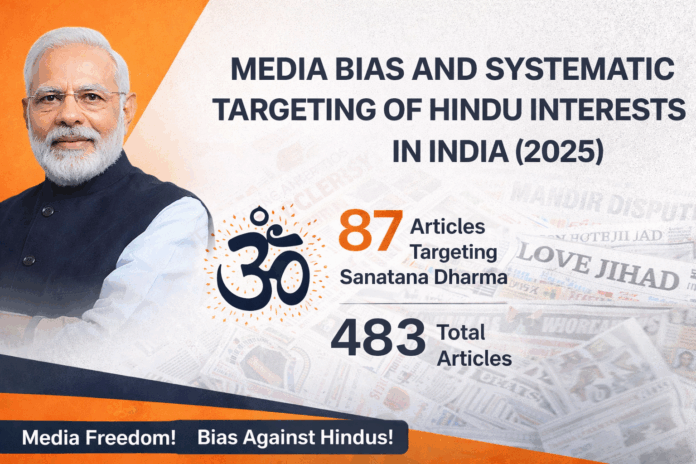
The Media Sentiment Scorecard for 2025, published by hindumisia.ai, offers a data-driven examination of Bharat’s media ecosystem and decisively exposes a persistent and disproportionate negative focus on Hindu identity, Hindu institutions, and Hindu Dharma. Based on an analysis of 483 articles across 18 prominent digital media portals, the report demonstrates that Bharatiya media operates with complete editorial freedom, yet frequently exercises that freedom to frame Hindu civilizational issues through adversarial, politicized, and often delegitimizing narratives.
This sustained negative framing is not incidental; it reflects a deliberate narrative strategy aimed at creating a distorted public perception of Hindu Dharma by repeatedly highlighting alleged flaws, controversies, and caricatured representations. Such messaging disproportionately targets lower- and upper-middle-class Hindu families, shaping social attitudes and political behavior through subtle but continuous psychological conditioning.
By portraying Hindu identity as regressive, conflict-prone, or morally suspect, these narratives weaken civilizational self-confidence and render Hindu society more vulnerable to vote-bank manipulation and ideological realignment. This environment also indirectly facilitates religious conversion ecosystems, where sustained denigration of Hindu Dharma is followed by the projection of alternative faith systems, particularly Islamist and Christian evangelical networks, as morally superior or socially emancipatory. Alarmingly, sections of the political Left have either actively endorsed or passively legitimized these portrayals, lending ideological cover to media narratives that normalize anti-Hindu actions while dismissing Hindu concerns as majoritarian excess. What emerges is not organic critique but a coordinated ecosystem of perception management operating under the guise of progressive discourse.
A striking finding of the scorecard is the overrepresentation of content targeting Hindu Dharma, which accounts for 87 articles, rivaling coverage of law-and-order and exceeding that of terrorism and national security. Sacred traditions, festivals, temples, and Hindu social movements are routinely framed as sources of controversy, while legitimate Hindu concerns, such as land encroachment, temple administration, demographic shifts, and civilizational rights, are presented through a lens of suspicion. This selective scrutiny reflects an entrenched editorial bias against the Hindu worldview.
Equally revealing is the source-wise concentration of narratives. A small cluster of portals, most notably Maktoob Media, Scroll, Telegraph India, The Print, and The Hindu, accounts for a disproportionate share of articles critical of Hindu-related subjects. The dominance of opinion pieces and commentaries over factual reporting further amplifies ideological positioning, blurring the line between journalism and activism. This concentration of narrative power has the effect of normalizing anti-Hindu framing while marginalizing voices that articulate Hindu perspectives with confidence and clarity.
The report also conclusively demolishes the oft-repeated international claim that Bharat suffers from declining press freedom. On the contrary, the unrestricted publication of harsh critiques against the government, Hindu organizations, and even core civilizational symbols stands as evidence of exceptional media freedom. The real issue, therefore, is not suppression but selective outrage, where criticism overwhelmingly flows in one ideological direction, particularly against Hindus, while equivalent scrutiny of other religious or ideological groups remains limited or absent.
Hindu Dharma as a recurrent target
An analysis of 483 articles across 18 media portals shows that a significant volume of reporting converges on a narrow ideological focus, repeatedly framing Hindu civilizational issues through a prism of suspicion, controversy, and political antagonism. The dominance of articles or reports (312) over neutral explanatory journalism indicates a sustained narrative momentum that disproportionately scrutinizes Hindu society while positioning itself as an objective critique.
Among all thematic categories tracked, Hindu Dharma emerges as one of the most frequently targeted subjects, with 87 articles directly engaging Hindu religious or civilizational themes, more than terrorism and internal security, and comparable to law-and-order coverage. This is not incidental. The data shows that Hindu festivals, institutions, traditions, and social assertions are persistently reframed as political flashpoints, often stripped of historical, constitutional, or cultural context. Such editorial choices reflect a deeper discomfort within sections of the media with Hindu self-articulation, where expressions of faith or identity are treated less as legitimate social realities and more as ideological provocations demanding correction or containment.
Freedom of the press or freedom from balance?
Ironically, the same dataset decisively dismantles the narrative that Bharat’s press operates under constraint. The unrestricted publication of sharp criticism aimed at the government, Hindu organizations, and majority civilizational symbols demonstrates that editorial autonomy is not only intact but also vigorously exercised. The real democratic concern, therefore, is not censorship but asymmetry. When criticism flows predominantly in one direction, when certain religious and ideological frameworks enjoy insulation while Hindu concerns invite relentless interrogation, journalism risks mutating into advocacy. A truly plural democracy requires not curated outrage but equitable scrutiny, and the scorecard is a reminder that balance, not volume, is the true measure of a free press.
Furthermore, the identification of trigger events, such as the Mahakumbh, WAQF disputes, Love Jihad, temple-related conflicts, and the RSS centenary, reveals a consistent pattern: moments of Hindu assertion are rapidly turned into media flashpoints, often stripped of historical and constitutional context. This pattern contributes to a broader delegitimization of Hindu civilizational consciousness, portraying Hindu resurgence as inherently problematic while ignoring centuries of marginalization and state control over Hindu institutions.
In conclusion, the Media Sentiment Scorecard for 2025 stands as a crucial empirical document that calls for introspection within Bharat’s media fraternity. It underscores the urgent need for balanced journalism that respects Hindu identity, history, and constitutional rights, rather than treating them as ideological obstacles. A truly pluralistic democracy cannot thrive when its majority civilization is persistently viewed through a hostile or dismissive lens. Media freedom must be accompanied by media responsibility, and that responsibility includes fairness to Hindus and Hindu Dharma.
