


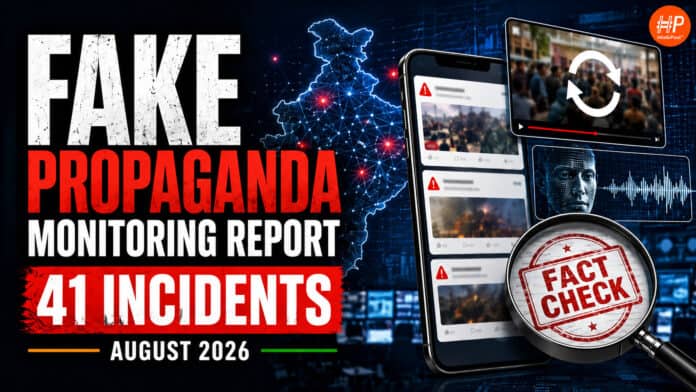
During August 1–31, 2026, 41 major false or misleading claims circulated across Bharat’s digital information space, involving social media influencers, political actors, media portals, and journalists. This report examines these incidents through fact-checking and identifies the narratives, sources, dates, and evidence associated with each claim, highlighting the continuing spread of misinformation and propaganda across digital platforms.
The figures present a striking picture of how rapidly misleading narratives can enter the public information space. According to the report’s classification, 31 of the 41 incidents—75.61%—were associated with social media influencers or individual social media accounts. Media portals and journalists accounted for 5 incidents (12.20%), while 3 incidents (7.32%) were attributed to RSS-related narratives and 2 incidents (4.88%) to political leaders or political actors.

Social media dominates the misinformation pipeline
The dominance of social media cases is particularly significant. Nearly three out of every four incidents documented in August came through influencer or social media channels. The report, therefore, identifies social media as the principal distribution layer through which questionable claims, manipulated material, and false contexts reach audiences. At the same time, the smaller number of cases involving media and journalist accounts warrants attention because such accounts can be perceived as more credible by readers.
The report’s thematic classification shows that political disinformation was the largest category, with 12 incidents (29.27%). It was followed by Social Issues & Protests with 9 incidents (21.95%), while Policies & Laws accounted for 4 incidents (9.76%). RSS-related narratives accounted for 3 incidents (7.32%), while Elections & Voter Manipulation, Health & Medicine, Diplomacy, and Government Schemes each accounted for 2 incidents (4.88%).
The remaining categories each recorded one incident, or 2.44%: Communal/Religious Propaganda, Environment, Economy & Finance, Claims Against Bharat’s Image, and Corruption & Scams. Although numerically smaller, these categories demonstrate the breadth of misinformation—from sensitive communal issues and international affairs to public health, taxation, and Bharat’s global image.

Altered graphics and misleading contexts fuel politically sensitive misinformation
Several incidents involved old photographs or videos being presented as recent events, a familiar technique that can radically alter the meaning of otherwise genuine footage. On August 24, for example, old Jantar Mantar footage was circulated as though it depicted a recent anti-reservation protest, while another police-action video from Jantar Mantar was similarly presented in a false context. The report also documented an old Ranchi clash video being falsely connected to a recent Jharkhand student protest on August 10.
Another major pattern was the use of digitally altered graphics, edited videos, and manipulated statements involving prominent political figures. The report records, among other cases, a digitally altered Prajatantra TV graphic falsely attributing remarks to Prime Minister Narendra Modi on August 21, a fake Class 10 marksheet attributed to him on August 20, and a manipulated graphic falsely attributing a jobs-related statement to Sudhanshu Trivedi on August 19.
The report also highlights how politically sensitive claims can be manufactured by taking genuine material and placing it in a completely different context. On August 16, a video was circulated claiming that Prime Minister Modi was walking while the national anthem was playing. The fact-check found that the viral clip had been taken from an event in Siwan, Bihar, in June 2025, and that the national anthem could not be heard during the portion circulated online. The claim that the prime minister had disrespected the national anthem was consequently found to be false.

Security, communal, and health misinformation
The International and national security narratives were also targeted. On August 13, an old Manipur video was circulated with the claim that it showed Chinese soldiers infiltrating Bharatiya territory. The report classified this as a false territorial/infiltration narrative. On the same date, digitally generated promotional material falsely suggesting free mobile phones, cars, tractors, and scooters in the name of Prime Minister Modi was also identified.
Communal narratives formed another important part of the misinformation landscape. On August 30, a martial-arts video was given a communal interpretation involving a Muslim passenger. The fact-check found no evidence that the martial arts performance was carried out because of the passenger’s religion; the person in the video had previously posted similar karate, Muay Thai, and kickboxing content. The report, therefore, concluded that the communal interpretation was unsupported and misleading.
Health misinformation was another area where emotionally alarming claims were used to attract attention. On August 20, a claim that 87% of people in Bharat would develop cancer by 2035 because of adulterated milk was found to be false. A similar claim was again documented on August 2, when a viral message falsely attributed an alleged warning to the WHO. Such claims demonstrate how fabricated statistics and the names of respected institutions can be used to give misinformation an appearance of authority.
Economic policies and RSS targeted by false narratives
On August 5, a claim that the Modi government would charge users for UPI transactions above ₹2,000 was found to be false. On August 3, a claim by Arvind Kejriwal connecting Bharat’s E20 program with US ethanol imports was classified by the report as misleading. These examples show that misinformation is not limited to sensational social media controversies; it can also target policies that directly affect citizens’ understanding of government decisions and the economy.
The report further documents misinformation directed at the RSS and its associated public figures. On August 31, a digitally altered graphic falsely attributed a controversial statement to Uttar Pradesh Chief Minister Yogi Adityanath in connection with RSS chief Mohan Bhagwat. On August 28, another false claim alleged that the US government had banned the RSS and its members, while on August 13, a statement falsely attributed to Mohan Bhagwat claimed that he had described the Tricolour as inauspicious. The report found these narratives unsupported or digitally manipulated.
The pattern becomes even more concerning when claims are designed to portray Bharat or Bharatiyas in a negative light. One example involved a viral video that was claimed to show a Bharatiya dressed as Bhagwan Shiva being assaulted in Nepal. The report found that the video was actually from October 2025 and showed a man disguised as a yogi who was assaulted after being accused of cheating people. The incident was therefore given a false national and religious context when circulated as an attack on a Bharatiya in Nepal.
The digital propaganda machinery exposed
Taken together, the 41 incidents recorded during August 2026 demonstrate the scale and variety of misleading information circulating across Bharat’s digital information environment. The report’s statistics show that political narratives and social issues were the two largest thematic areas, while manipulated videos, old footage, digitally altered graphics, fabricated quotations, and false statistics repeatedly appeared as mechanisms used to create misleading narratives. The findings reinforce the need for citizens to verify viral claims before accepting or sharing them.
The central lesson from the August dataset is clear: virality is not evidence of truth. A dramatic video, an apparently authentic news graphic, a quotation attributed to a prominent leader, or a frightening statistic can all be misleading when stripped of its original context or digitally manipulated. The report therefore argues for stronger real-time fact-checking, digital-forensic capabilities, public awareness, and early-warning systems to identify emerging misinformation before it spreads widely.
August’s 41 cases should consequently be viewed not merely as a list of individual false claims but as a snapshot of the methods through which misinformation is produced and amplified. The responsibility ultimately lies with both content creators and consumers: those who manufacture or deliberately distort information must be held accountable, while citizens must develop the habit of checking dates, original sources, context, and official records before accepting viral narratives as fact.
The main agenda behind many of these false narratives appears to be to create a negative image of the BJP, RSS, and Hindutva-oriented groups. At the same time, the rise of self-proclaimed YouTubers and the anti- Hindu jihadis has contributed to the spread of fabricated claims, including misleading or digitally generated content involving Hindu mythology and religious contexts. Such content appears designed to create confusion among Hindus and distance them from their broader ideological and cultural roots. However, sustained efforts to manipulate public sentiment through fabricated videos and false narratives are unlikely to succeed in the long run.
