


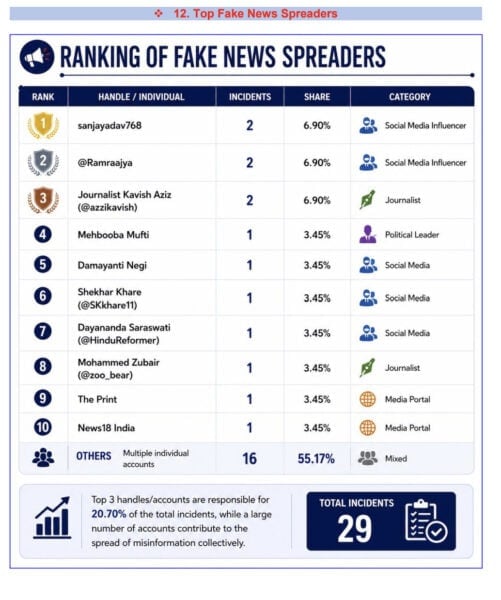
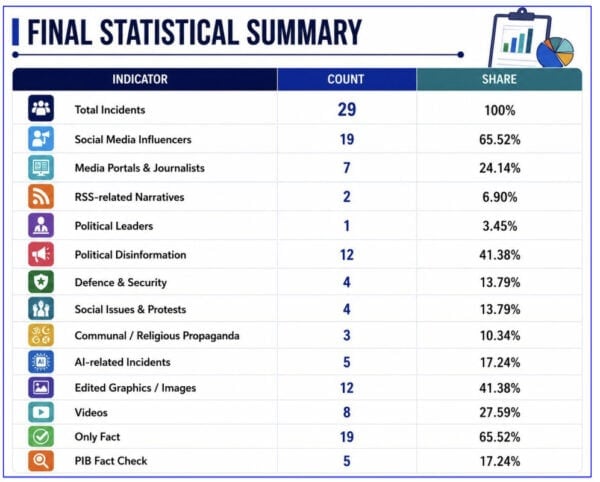
A fact-check report covering July 1–31, 2026, has documented 29 major misinformation incidents circulated across social media and digital media ecosystems in Bharat, with every case examined in the report classified as false, misleading, or fabricated. The report says social media influencers accounted for the largest share of the incidents, with 19 cases (65.52%), followed by media portals and journalists with seven cases (24.14%), RSS-related narratives with two (6.90%), and political leaders with one (3.45%). According to the report, the figures point to social media as the principal channel through which misleading political, communal, defence and protest-related narratives gained circulation.
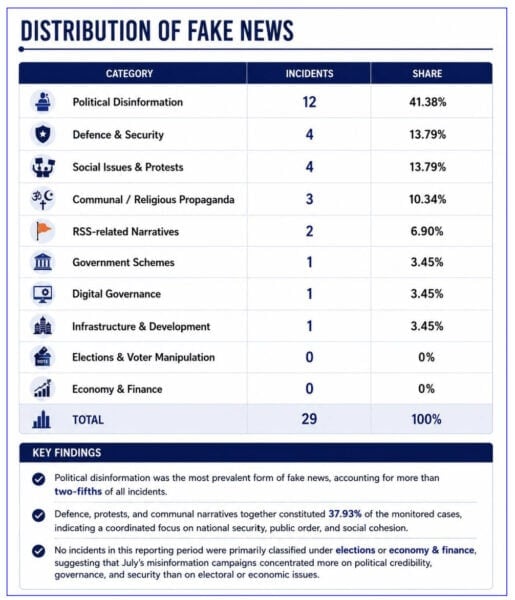
The report’s broader statistical picture is dominated by political disinformation, which accounted for 12 of the 29 incidents (41.38%). Defence and security misinformation and social-issue or protest misinformation each contributed four incidents (13.79%), while communal or religious propaganda accounted for three (10.34%). RSS-related narratives made up two cases, while government schemes, digital governance, infrastructure, and development each appeared in smaller numbers. The report therefore portrays July’s misinformation environment as heavily concentrated around political narratives, public protests, national security, and socially sensitive issues.
Fabricated or misattributed statements
One of the clearest patterns identified in the report was the systematic use of fabricated or misattributed statements. Misattributed quotes accounted for 12 incidents (41.38%), making them the most common misinformation technique. Genuine photographs, television graphics, and news templates were altered and then presented as authentic statements by political leaders, public personalities, military officials, and ideological figures. False contextualization accounted for another six incidents (20.69%), while AI-generated or AI-manipulated images and videos accounted for five (17.24%). The report also identified recycled content and fabricated documents as recurring methods.
Several of the most prominent cases involved Prime Minister Narendra Modi and other political figures. A purported resignation letter carrying PM Modi’s signature was circulated on July 29, but the report says the document was digitally fabricated and that no such resignation letter had been issued or signed by him. Other manipulated graphics falsely attributed remarks to Modi, including a claim that he had said he had both a man and a woman within him during Mann Ki Baat, and another that he had said he was the best student in his school. The report says the original media graphics had been altered to insert entirely different statements.
The pattern extended beyond the prime minister. A fabricated post claimed that actor Deepika Padukone had criticized Modi while supporting Sonam Wangchuk’s hunger strike, but the report says no such post appeared on her verified social media accounts. A digitally altered graphic also falsely portrayed former Bangladesh Prime Minister Sheikh Hasina as warning Modi that Bharat could face the same fate as Bangladesh. Another manipulated graphic attributed an insulting statement about welfare beneficiaries to BJP president J.P. Nadda, while a fabricated postcard falsely claimed that Shankaracharya Avimukteshwaranand had predicted Yogi Adityanath’s return as Uttar Pradesh Chief Minister in 2027. The report says the original statements or source material did not support these claims.
Defence and national-security narratives
Defence and national-security narratives formed another important cluster. One viral video was presented as evidence that China had crossed the Bharat border to capture Bharatiya territory. The fact-check found that the footage actually dated to April 2026 and reportedly showed an Assam Rifles convoy confronting a barricade erected by local women in Talui village in Manipur. In another case, an old 2021 video showing Chinese People’s Liberation Army personnel being intercepted by Bharatiya security forces near Bum La in Arunachal Pradesh was recirculated as evidence that China was establishing a new colony on the Bharatiya side of the Line of Actual Control. The report says neither video had any connection to the claims with which it was circulated.
AI manipulation also entered the defence-information space. A viral video featuring Lt Gen Rajeev Puri was circulated with the claim that he had ordered additional forces to New Delhi amid protests. According to the report, the video had been generated or manipulated using AI, with fabricated audio superimposed on an older press interaction. The report found no official statement or credible news report supporting the alleged deployment announcement. Another case involved an AI-manipulated video of BJP MP Ravi Kishan, which was falsely linked to the Bharat Tiwari encounter. The report says Kishan’s original remarks concerned the broader law-and-order situation in Uttar Pradesh and did not refer to the alleged encounter.
Protest-related misinformation
Protest-related misinformation formed a separate four-incident cluster. Viral posts claimed that Delhi Police had used batons fitted with nails against protesters, while another video was presented as showing Delhi Police assaulting women during demonstrations. The report says police had clarified that the nail-fitted-baton footage was unrelated to the protest in question. The purported Delhi Police assault video was also found to be unrelated: according to the report, it was actually footage from Dehradun in October 2025 involving a dispute after a truck crashed into a house. A separate claim that activist Sonam Wangchuk had died during a hunger strike was also found to be false, with the report noting that there had been no official confirmation of his death.
Religious and communal narratives also featured prominently. A claim circulated by PDP leader Mehbooba Mufti alleged that Friday prayers and the Azaan had been restricted at the historic Pakherpora Mosque in Budgam. The report says security officials clarified that a cordon-and-search operation was underway in the area but that Friday prayers and the Azaan had proceeded as scheduled. The report also examined repeated claims concerning the Ancient Hanuman Temple in Connaught Place, where social media posts alleged that the temple had been closed to prevent student protesters from entering. According to the fact-check, the students were already inside the temple, and the premises were briefly closed on police instructions to maintain order and safety following a heated exchange.
Infrastructure and government policy.
The report also identified misinformation involving international figures, infrastructure and government policy. An edited Navbharat Times graphic falsely claimed that Donald Trump had called Bharat a dictatorship; the report says the original remarks concerned free and fair elections generally and did not make the alleged statement about Bharat. Another AI-generated graphic falsely claimed that a Chinese journalist had exposed massive commissions in the Statue of Unity project; the report says the woman shown was actually Chinese Vice Foreign Minister Hua Chunying and not a journalist. A separate AI-generated video falsely claimed that Modi had announced a free mobile phone scheme for Aadhaar and ration-card holders. The report says no such Central Government scheme had been announced.
Digital governance became another target when The Print reported that a MeitY body had directed ministries to hold off on deploying OpenAI and Anthropic cybersecurity models.
The report records a subsequent MeitY clarification that no such direction or advisory prohibiting ministries from using OpenAI or Anthropic had been issued. Another manipulated image, shared through News18, falsely portrayed PM Modi signing a girl’s T-shirt in an inappropriate location. According to the fact-check, the original photograph showed him signing the shoulder area of the shirt; the viral version digitally shifted the autograph and altered his posture to create a misleading impression.
RSS-related narratives,
The final cluster involved RSS-related narratives, with two cases concerning RSS chief Mohan Bhagwat. One digitally altered graphic falsely attributed a controversial statement concerning homosexuality and Brahmins to Bhagwat. The report says the authentic graphic carried a different ideological message and contained no such reference. Another AI-generated graphic claimed that Bhagwat had described the slogan “Jai Bhim” as political and divisive; the report found no credible evidence in any speech, interview, or public statement to support that attribution. Together, these cases illustrate how familiar photographs and recognizable political or ideological figures can be used as vehicles for fabricated quotations.
Perhaps the most significant finding of the report is that visual manipulation has become central to the misinformation ecosystem. Edited graphics and images accounted for 41.38% of the documented content format, videos for 27.59%, and AI-generated or AI-manipulated media for 17.24%. The report estimates that 72.41% of all 29 incidents involved manipulated visual content, combining AI-generated or manipulated material, edited graphics, recycled videos, and other forms of visual alteration. It also identifies social media influencers as the dominant source category and says Only Fact accounted for the verification of 19 incidents, followed by PIB Fact Check with five and DFRAC Officials with two.
The report’s overall conclusion is that July’s misinformation landscape was increasingly visual, politically charged, and enabled by digital manipulation. Its recommended response includes faster fact-checking, stronger AI-content detection, digital forensic capabilities, cooperation with social media platforms, public digital literacy campaigns, and integrated monitoring systems capable of detecting sudden spikes in activity around political leadership, defense, communal issues, and government schemes. The report argues that early-warning mechanisms could help identify emerging misinformation narratives before they achieve widespread reach. Taken together, the 29 cases documented across the 46-page report suggest that the challenge is no longer limited to fabricated text: altered news graphics, recycled footage, AI-generated videos, synthetic images, and invented quotations are increasingly being used to manufacture apparently credible narratives around some of the most sensitive political and social issues in the country.
Read the detailed report at: https://sl1nk.com/ft69h2w
