


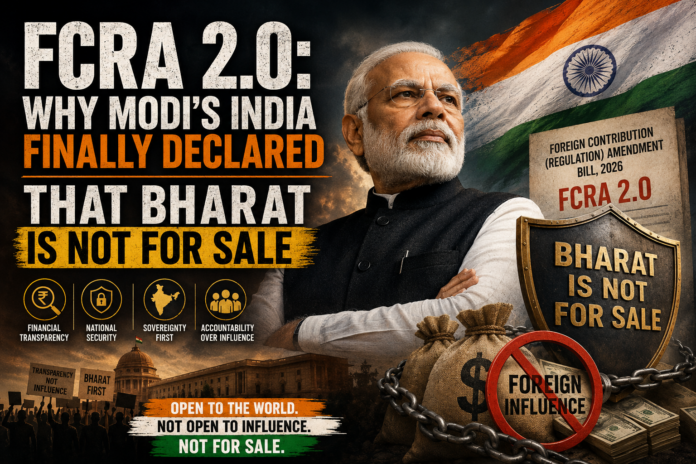
“FCRA 2.0: Why Modi’s India Finally Declared That Bharat Is Not for Sale”, Goa Chronicles, July 03, 2026
“There comes a moment in the life of every civilisation when it must decide whether it wishes to remain sovereign or become vulnerable to influence disguised as benevolence. For decades, India treated foreign funding as charity. Prime Minister Narendra Modi’s India has finally recognised a geopolitical reality that every major power in the world understood long ago: foreign money is rarely just about philanthropy. It is often about influence, leverage, strategic penetration, narrative building, demographic transformation, and long-term geopolitical positioning. The Foreign Contribution (Regulation) Amendment Bill, 2026, and the subsequent implementation of FCRA 2.0 represent one of the most significant national security and sovereignty reforms undertaken by independent India. Predictably, sections of the global NGO ecosystem, international advocacy groups, opposition political parties, and certain religious organisations have reacted with alarm. But their outrage only underscores the strategic importance of these reforms.
Most Indians remain unaware of the sheer scale of foreign financial influence operating within the country’s social ecosystem. According to government data presented alongside the FCRA Amendment Bill, approximately 16,000 associations are currently registered under the FCRA framework and collectively receive nearly ₹22,000 crore annually in foreign contributions. Between FY2019-20 and FY2021-22 alone, over 13,500 organisations received more than ₹55,700 crore in foreign contributions. These funds have flowed into sectors ranging from education, healthcare, and social welfare to religion, environmental activism, advocacy, policy research, media engagement, and community mobilisation. No serious nation can afford to ignore the strategic implications of financial inflows of this magnitude.
The uncomfortable truth is that India remained strategically naïve for far too long. We fought wars on our borders while leaving our intellectual, cultural, religious, and institutional ecosystems vulnerable to external influence. The battlefields of the twenty-first century are no longer defined merely by tanks, missiles, and aircraft carriers. Today’s wars are fought through universities, media narratives, think tanks, digital ecosystems, religious institutions, advocacy networks, environmental campaigns, and social movements. The weapon of choice is no longer the bullet. It is the grant. Every major geopolitical power understands this reality. The United States operates the Foreign Agents Registration Act and aggressively monitors foreign influence operations. Australia enacted the Foreign Influence Transparency Scheme Act in 2018. China subjects foreign NGOs to one of the world’s toughest regulatory regimes. European countries have increasingly tightened oversight of foreign-funded political and social networks. Why then should Bharat, a civilisation-state of over 1.4 billion people, be expected to operate under weaker standards…….”
Read full article at goachronicle.com
