


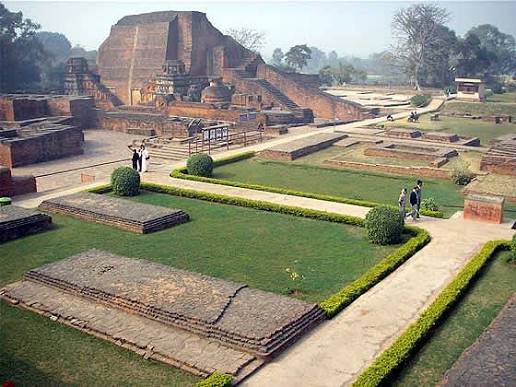
When discussions of higher education in Bhāratavarṣa begin with colonial universities, they overlook a far older intellectual world—one that once made Nālandā a global centre of learning. The assumption that systematic and rational education emerged only under modern, particularly colonial, influence does not withstand historical scrutiny. The real question is not whether Bhāratavarṣa possessed advanced institutions of knowledge, but how their continuity was broken.
Institutions such as Nalanda University demonstrate that higher learning in Bhāratavarṣa had reached a remarkable level of sophistication long before the rise of European universities. Nālandā was not a peripheral monastic centre; it was an international hub attracting students from across Asia. The account of Xuanzang describes a rigorous intellectual culture where entry required proven mastery and where debate formed the core of pedagogy. Subjects included grammar, logic, medicine, metaphysics, and astronomy, reflecting both intellectual breadth and methodological depth.
What distinguished Nālandā was its underlying civilisational ethos. Knowledge was not reduced to utility; it was pursued as a disciplined inquiry into reality. Supported by royal patronage yet intellectually autonomous, Nālandā cultivated an environment in which scholars were not trained merely for employment, but for critical engagement with philosophical and scientific questions. This model reflects a broader orientation within Bhāratavarṣa, where learning was embedded in a continuous tradition of debate, interpretation, and reflection.
This trajectory, however, did not continue uninterrupted. The destruction of Nālandā in the late twelfth century, associated with the campaign of Bakhtiyar Khilji, marks a decisive civilisational rupture. Historical accounts converge on the large-scale devastation of the institution, including its libraries, which had accumulated knowledge over centuries. The consequence was not merely architectural loss, but the collapse of intellectual continuity. Traditions of learning depend on sustained transmission—of teachers, texts, and institutional frameworks—and once disrupted, they cannot be easily restored.
Yet the erosion of indigenous knowledge systems did not end with medieval invasions. It was deepened and formalised under colonial rule, which introduced a fundamentally different conception of education. The policies associated with Thomas Babington Macaulay reveal this shift with striking clarity. Education was reoriented toward producing a class suited for administrative functions within the colonial state. Learning was no longer valued as an autonomous pursuit of knowledge, but as a means to bureaucratic efficiency.
This transformation had lasting consequences. Indigenous intellectual traditions— preserved in classical languages and sustained through established institutions—were marginalised. The sophisticated methodologies of Bhāratīya thought, including its traditions of logic, linguistic analysis, and metaphysics, were gradually displaced. What replaced them was not a neutral or universally superior system, but one aligned with the priorities of colonial governance.
The contrast is stark. Nālandā represents a civilisational model of knowledge rooted in continuity, plurality, and intellectual depth. The colonial university, by contrast, was structured around utility, producing functionaries rather than thinkers. While modern institutions have contributed to scientific and technical progress, their introduction in Bhāratavarṣa came at the cost of displacing an existing and highly developed intellectual ecosystem.
The effects of this dual disruption—first through invasions, then through colonial restructuring—are still visible. Higher education in Bhāratavarṣa often operates within frameworks that remain externally derived, with limited engagement with indigenous knowledge systems. This has resulted in a persistent intellectual imbalance, where the criteria of knowledge and legitimacy are frequently shaped outside the civilisation’s own historical and philosophical context.
Recognising this trajectory is not an exercise in nostalgia; it is a matter of intellectual clarity. A civilisation that once sustained institutions such as Nālandā cannot be understood through narratives that portray it as intellectually deficient prior to modern intervention. Such narratives obscure more than they reveal.
The task before Bhāratavarṣa is therefore not merely to expand its university system, but to rethink its intellectual foundations. This requires engaging seriously with indigenous traditions—not as relics, but as enduring sources of knowledge—and reassessing inherited frameworks that continue to shape academic discourse.
Nālandā stands as more than a symbol of past achievement. It represents a model of intellectual seriousness, methodological rigor, and civilisational confidence. If Bhāratavarṣa is to recover its place as a centre of knowledge, it must begin by acknowledging not only what was lost, but also what remains to be reclaimed as the foundation of its intellectual future.
— Dr. Vandana Sharma Diya, an Indian philosopher, researcher, and assistant professor at Zakir Husain Delhi College, University of Delhi
