


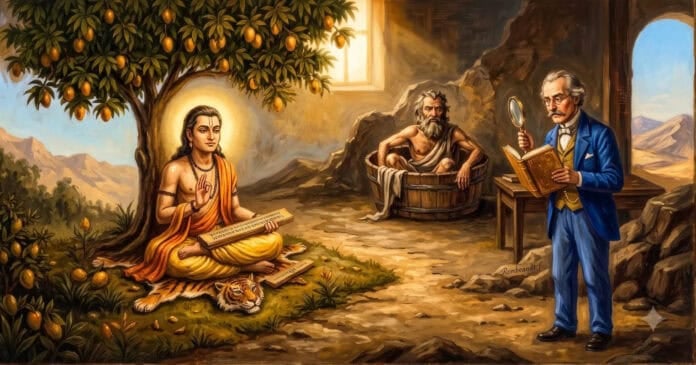
“How Western Indology Misread Sanskrit: The Colonial Distortion of Bhartṛhari”, TheDharmaDispatch, 30 Aug 2026.
“T IS REALLY quite remarkable how in less than a century, India has ceded ground — perhaps permanently — to the West in a discipline that had once been coveted worldwide and had drawn the best and brightest minds: Sanskrit.
Today, what is generally known as Sanskrit studies (Indology, to use a dated but broad term), resembles the scorching Thar desert, which was formed after the perennial Saraswati dried up; the few scattered oases are the only saving grace.
What compounds this erosion is the fact that it was entirely self-inflicted. Indeed, Mahāmahopādhyāya P.V. Kane had foreseen this precise situation in his ominous speech delivered exactly eighty years ago.
Notwithstanding the slew of feel-good messaging and exaggerated claims of an alleged grand revival of Sanskrit after 2014, the verifiable reality is that Sanskrit is perched on the edge of irreversible loss in the sacred land of its realisation—indeed, Sanskrit is not merely a language but a realisation. As Shatavadhani Dr. Ganesh memorably put it, Sanskrit is an expression of Bhauma.
Today, there is a generation of fairly learned Sanskrit scholars whose highest ambition is to garner—for example—a lecturership or to occupy a chair in some American university. This psyche operates on a plane that is lower than avarice, approval-seeking or inferiority complex—it is the willing embrace of the obliteration of one’s own identity……………………….”
Read the full article at TheDharmaDispatch.

Author Sandeep Balakrishna has made several pertinent observations, which actually raises more questions, which requires honest analysis:
1) …there is a generation of fairly learned Sanskrit scholars whose highest ambition is to garner—for example—a lecturership or to occupy a chair in some American university. … High-quality and faithful translations done by Sanskrit scholars of the modern Indian Renaissance continue to languish in obscurity.
Yes, there is not much respect for patronizing academic rigor in linguistics, philosophy and religion studies in our country. It creates more “secular” people. But are we really ready to face rigorous research?
2) Even on mundane planes—for example, our pūjā-paddhati—both Islam and Christianity have miserably failed to make a dent even after a millennium of relentless assault. Not one among our ṣaḍ-darśanas has been tainted by Abrahamic ideas.
Ok, Ṣaḍ-darśanas predates Muhammadan and Christian influences. But, is the assertion in essence really sustainable ? This does not explain these inferiority complex ridden developments:
Kabir panth, Sikh and Satnam panth, Brahmo Samāj, Ārya Samāj, Loṅkāgaccha and Sthānakavāsī panth, Terāpanth.
Then you must realize that, Ṣaḍ-darśanas, brilliant in thought, have not much relation to original Sanatan dharm of Rigveda. Śraman dharm predates the 4 vedas. Vedic dharm and ṣaḍ-darśanas synthesis of Śraman philosophies marks a substantial discontinuation of epistemological and ontological arguments of rigvedic school. Yes, their propounders were opposed to Śraman systems, but they coopted their philosophies. We need a disciplined and rigorous approach and depth in analysis and corresponding academic studies or else we end up with Western academic references for credibility.
By the way, which Bharatiya scholar/s does author recommends for studies on Bhartṛhari? Did I miss that?