


“The Proofs Historians Said Bharatiya Mathematics Lacked”, Swarajya, 29 Sep 2026.
“In December 1832, the Royal Asiatic Society in London heard a remarkable paper from a civil servant of the East India Company.
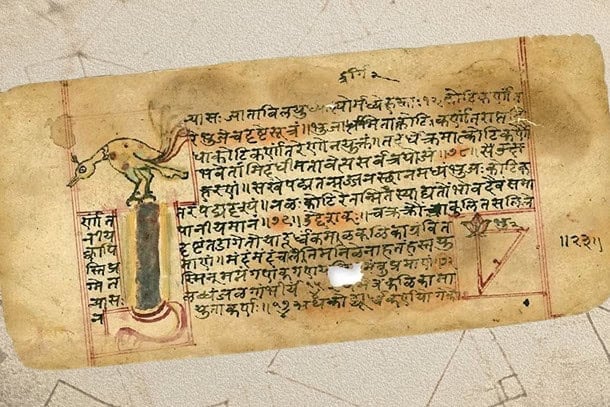
Charles Matthew Whish had been studying mathematical manuscripts from Kerala, and he expected what he had found to astonish European mathematicians. The manuscripts described infinite series for π, the sine, and the cosine, which predated similar discoveries in Europe by centuries.
Here was evidence that Indian mathematicians had ventured into territory long associated with Gregory, Leibniz, and the beginnings of calculus.
Among the results Whish reported was a deceptively simple infinite series.
π/4 = 1 − 1/3 + 1/5 − 1/7 + …
Keep adding the fractions, alternating the signs, and the sum creeps ever closer to a quarter of π. The same series would not appear in Europe until the seventeenth century………..”
Read the full article at Swarajya.
