


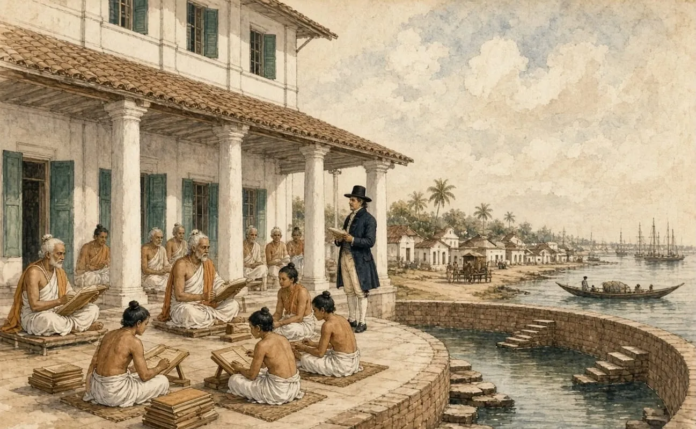
“When the Company Built a Pathshala: The Calcutta Sanskrit College in Newspapers, 1822–1830”, TheDharmaDispatch, 10 Sep 2026.
“AT THIS DISTANCE in time, we do not associate West Bengal and specifically Calcutta, with Sanskrit. In the heydays of Hindu rule, the Gauda and Vanga Deshas rubbed shoulders with great centres of Sanskrit learning in Bharatavarsha. Even under the dark and prolonged spell of Muslim rule, Sanskrit flourished to an extent in the region thanks largely to the patronage of Hindu chieftains and zamindars.
Indeed, more than six decades after the decisive Battle of Palashi, British administrators found abundant numbers of Sanskrit Pāṭhaśālās throughout the Bengal Presidency. These proved to be the biggest obstacles to Macaulay’s evil project of spreading English education. The resistance they offered to English methods is an independent chapter of heroism. It is this resistance that led him to physically uproot traditional centres of learning; a slice of this story has already been narrated in the heart-rending episode of how the Golisri Sanskrit College was destroyed by Macaulay.
There is an ironical side to this story. Around 1822, the same Macaulay and James Prinsep made a recommendation to Governor General Amherst to establish a dedicated Sanskrit College in Calcutta “to impart knowledge of ancient literature, philosophy, Hindu Law, grammar, Indian Culture and to promote the learning of Sanskrit among British officials as well as the Indians.” Amherst laid its foundation stone in 1824.
When the proposal to establish this college was made public, it received mixed but overwhelming response. Among others, notable Bengali papers such as Samachar Chandrika and Samachar Darpan kept a keen watch on the developments and communicated them to the public. These are the two primary sources that supply the most authentic information about this colonial British project…………”
Read the full article at TheDharmaDispatch.
