


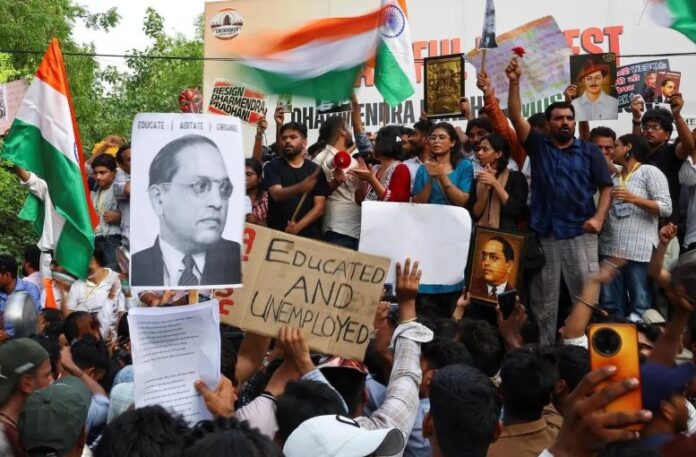
Look at that photograph for a moment. Really look at it.
Hundreds of young people have gathered under the tricolour at Jantar Mantar. Their placards talk about exams, jobs, justice and constitutional rights. Most of the names you see sound completely ordinary and familiar to Hindu families. At first glance, it looks like any other gathering of concerned young Indians who simply showed up because something felt wrong.
Now look again — this time for what is not there.
There are no red flags. No hammer and sickle. No pictures of Marx, Lenin or Mao. The gathering doesn’t present itself as a Left platform or an opposition coalition. It looks like ordinary citizens who have come together on their own.
But appearances in politics are rarely innocent.
Hindu names have always existed inside communist, Congress and Left circles. That’s not new. What feels striking here is the near-total absence of any visible trace of the Hindutva worldview — even though that worldview now shapes the thinking of millions across the country. In a mobilisation that claims to represent young India, where are the voices that speak from the nationalist tradition? Instead, the tone, the arguments and the moral urgency feel much closer to the world of Sitaram Yechury, Yogendra Yadav and Arvind Kejriwal.
The names may be Hindu. The political language is not.
This doesn’t automatically mean some central command is running everything. To prove that, we would need internal messages, funding trails and direct evidence. But the pattern itself is worth examining honestly. How did these people come together? Which networks and organisations quietly supplied the volunteers, the stage, the sound, the publicity? How many of the same faces keep appearing in different movements that were also presented as spontaneous? These are fair questions, not conspiracy theories.
The Red Flag No Longer Works
The Indian Left understood something important after the Soviet Union collapsed. The old symbols and language stopped working with most young people. The red flag, the hammer and sickle, open talk of class war — these no longer move the kind of crowds they once did.
So the symbols changed.
The red flag quietly gave way to the tricolour. Talk of revolution was replaced by talk of saving the Constitution and democracy. The party worker became the “concerned citizen”. This wasn’t just a cosmetic change. It was a deliberate shift. The tricolour carries deep emotional power in India. It allows movements that have historically been uneasy with nationalism to appear patriotic and reassuring to people who would never join an openly communist mobilisation.
Classical Marxism never really respected nationalism. It saw it as a tool used by the ruling classes to divide workers. Yet today, many of the same ideological currents wrap themselves in the national flag. The flag is being used, at least partly, as protective colouring.
Revolutions Don’t Show Their Real Face in the Beginning
Lenin was very clear about this. A revolutionary movement doesn’t have to reveal its final goal at every stage. It speaks in whatever language the current situation allows. It uses symbols people already trust. It makes temporary compromises if those compromises help it grow stronger for the next stage.
Right now, the tricolour is useful. It gives legitimacy. It stops people from immediately connecting the protest with the older history of communism. The old symbols are not necessarily discarded — they are simply not needed yet. They can wait for a later stage when the movement has more strength and acceptance.
This is how these mobilisations usually unfold. A real grievance appears — exams, jobs, something people genuinely care about. Then a broad coalition forms around it. Soon the talk shifts to how institutions have become illegitimate. The original issue slowly becomes the doorway for a much bigger political project.
The person standing in the crowd may genuinely believe they are protesting a specific injustice. The organiser may see it as one more step in weakening the current order. Different people can be part of the same crowd for completely different reasons. They don’t need to agree on the final destination — only on travelling together for some distance.
Mao Understood Stages Better Than Most
Mao wrote clearly about this in On New Democracy. He said the revolution would happen in stages. In the first stage, you bring together many different groups — peasants, students, intellectuals, even sections of the middle class — under one broad front. Not everyone in that front needs to understand or accept the final communist goal. Some are mobilised, some are used, some are kept on the sidelines until the time is right.
It was never about emotional unity. It was always about careful political calculation: Who is the main enemy right now? Who can be brought in for this stage? Who should be dealt with later?
This cold, strategic way of thinking sits uneasily with the Hindu instinct for accommodation.
The Hindu Mind Wants to Give Everyone Space
Hindu civilisation was never built on the idea that only one path is correct and everyone else must be defeated. It grew by making room for many gods, many philosophies and many ways of living. Disagreement was seen as natural, not as something that must end in the destruction of the other side.
This is one of its greatest strengths. But it also creates a vulnerability.
When an ordinary Hindu looks at young people with Hindu names standing under the tricolour and talking about rights and the Constitution, his first instinct is to assume they are just like him — people with legitimate concerns who also love their country. He doesn’t immediately wonder whether today’s symbols are temporary or whether today’s allies might be pushed aside tomorrow. He extends the same spirit of accommodation to politics that his civilisation extended to different ways of worship.
The revolutionary organiser thinks differently. He is trained to classify people according to their usefulness at each stage of the struggle. The two ways of seeing the world are fundamentally different.
Why We Don’t See Open Left-Islamist Unity
You might notice that openly Islamist faces and slogans are also missing from these gatherings. This doesn’t mean the tactical understanding between sections of the Left and Islamist groups has disappeared. It probably means both sides have become more careful.
Hindu society today is far more alert to Islamist politics than it was earlier. An open Left-Islamist alliance would immediately alert and unite large sections of Hindu society. So the cooperation continues quietly — through common legal cases, shared media support, aligned NGOs and a common opposition to Hindutva — while staying out of the spotlight.
Marxism and Islamism are ultimately incompatible. One is atheistic; the other is deeply religious. Their current partnership is practical, not philosophical. They only need to agree on who the main obstacle is right now. What happens after that obstacle is weakened is a question they can deal with later.
This kind of tactic coming together is not new. Even in 1942, the Communist Party of India passed a resolution that gave ideological support to the demand for Pakistan.
The Familiar Old Faces Stay in the Background
The older, well-known figures from the Left are now too easily recognised. Their presence would immediately tell people what kind of mobilisation this really is. So they stay in the background. Younger faces take the front — people who speak the language of climate, jobs, gender justice or constitutional morality rather than old-fashioned class struggle.
These younger activists may not even see themselves as Marxists. They may simply have grown up inside an ecosystem where certain ways of thinking and speaking feel natural. The old communist openly declared his ideology under the red flag. The new one stands under the tricolour and says he has no ideology at all. That claim of being “non-ideological” is often the most effective ideology of all.
The Journey from WagonR to Palace
Arvind Kejriwal showed this pattern very clearly. He built his early image around simplicity — the WagonR, the muffler, ordinary clothes and the refusal of the usual political comforts. He presented the entire existing political system as corrupt and illegitimate. Many people genuinely believed he represented something cleaner and more radical.
Once he gained power, that image of austerity gave way to the normal exercise of state power — official residences, security and everything that comes with it. The man who had condemned the system from outside became deeply involved in running it from inside. This is not just about one person. It shows how simplicity and outsider rhetoric are useful for mobilisation, while power itself becomes acceptable once it has been captured.
When Anger Becomes a Political Tool
If you watch the actual footage instead of just the photographs, you often see something else. The language turns abusive. Opponents and even police are not just criticised — they are insulted and humiliated. This is not occasional frustration. When abusive language becomes normal and accepted in a movement, it tells you something about its culture.
A normal democratic protest tries to persuade people and highlight a problem. A cadre-style mobilisation often tries to dominate the space and create a sense of permanent confrontation. The other side is no longer just wrong — they are corrupt, dangerous or enemies of the people. This habit of total moral condemnation has deep roots in older Stalinist political culture.
The Cockroach Metaphor
The name “Cockroach Janata Party” is worth thinking about. A cockroach suggests something that lives in darkness, multiplies quickly, and is almost impossible to get rid of. It carries associations of dirt and disease.
Why choose such a symbol?
On one level, it says: “You may hate us and try to crush us, but we will survive and return in greater numbers.” On another level, it revives an old revolutionary idea — the oppressed and despised will one day overwhelm those who look down on them. The victim becomes the threat.
At the same time, reducing India’s actual working people — farmers, labourers, drivers, artisans — to the image of cockroaches feels like a strange kind of contempt, even if it is dressed up as revolutionary sympathy.
The Darkness That Survives
There is a kind of darkness in this way of thinking — what the ancient texts called tamas. It comes from absolute certainty that history is on your side and that anyone who stands in the way is standing against progress itself. Communist systems produced terrible human suffering, yet in parts of Indian intellectual life, communist language and imagery still carry a strange respectability that other totalitarian traditions do not enjoy.
Today there is no Indian Solzhenitsyn who forced a serious reckoning with that history inside our own society.
Who Gets to Decide What “Progressive” Means?
For a long time, the Left gave itself the power to decide who was progressive and who was reactionary. Anyone who defended traditional institutions, national identity or civilisational continuity was automatically placed on the wrong side of history. This vocabulary still shapes a lot of public debate. It turns ordinary disagreement into a question of moral worth.
Real progress should be judged by what actually happens to people’s freedom, dignity and ability to live without coercion — not by who controls the label.
The Real Battle Is Now in the Cities
India has pushed back hard against armed Maoism in the forests. But the ideological work in universities, media, NGOs and city politics is harder to counter. Here the activist does not carry a gun. He works through respectable institutions and speaks the language of rights and justice. Yet the steady effect can be to make people lose faith in their own institutions and to paint the civilisational majority as the main problem.
A person shaped by communist internationalism may carry the tricolour for now, but his deepest loyalty is not to the nation as a civilisational reality. That difference in understanding cannot be hidden forever by changing symbols.
What Hindu Society Needs to Learn to Ask
Hindu society needs to become more discerning. Giving space to others is one thing. Allowing yourself to be slowly displaced is another. When you see a mobilisation, it is worth asking: What stage do the organisers believe they are in right now? Who has been kept away from the cameras because their presence would reveal too much? Is the immediate issue being used as an entry point for something larger? The absence of the red flag does not mean the absence of the old method. It may simply mean that the organisers feel the time for openly displaying it has not yet come.
The Mask Keeps Changing
The old communist stood under the red flag and openly declared his beliefs. The new activist stands under the tricolour and says he has no ideology. The vocabulary changes. The faces change. Even the stage of the struggle changes.
What has not changed is the underlying claim: that only we represent justice and that anyone who resists us is standing in the way of progress.
Hindu sounding names on the stage do not automatically mean Hindu civilisational sympathy. The tricolour does not automatically mean the intent is patriotic. The disappearance of old communist symbols does not mean the method itself has disappeared.
The mask has changed.
The real question is whether what lies beneath the mask has changed.
