


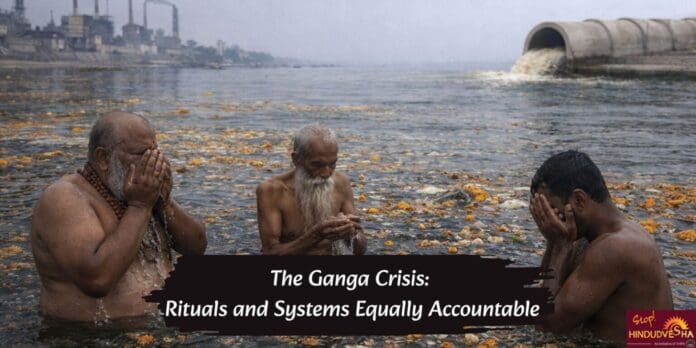
“Ganga Under Siege: How the Pollution Debate Distorts Faith, History, and Responsibility”, Stop Hindu Dvesha, May 09, 2026
“The pollution of the Ganga is commonly attributed to ritual practices, with Hindu traditions cast as primary drivers of degradation. This account is analytically incomplete. It overlooks deeper structural and historical causes, including colonial disruption of indigenous stewardship, industrial expansion, governance failures, and the erosion of civic discipline. At the same time, a credible analysis cannot ignore everyday irresponsibility in public behavior. The issue is therefore both material and epistemic: not only how the river has been polluted, but how that pollution is understood. A meaningful path to restoration requires moving beyond selective blame toward an integrated approach grounded in dharmic ethics, institutional accountability, historical clarity, and renewed civic responsibility.
The river Ganga occupies a singular place in the civilizational consciousness of India. For millions of Hindus, she is not merely a river in the geographical or hydrological sense, but a sacred presence, Ma Ganga, revered as purifier, sustainer, liberator and witness to the continuity of an ancient civilization. Yet in dominant public discourse, especially in media and policy representations, the Ganga is frequently reduced to a “pollution problem,” an ecological crisis requiring rescue through secular administration, technocratic planning and modern regulation. Within this framing, Hindu ritual practices like bathing, cremation immersions, idol offerings and mass pilgrimage gatherings, are disproportionately emphasized as the visible causes of decline.
Such a framing is analytically shallow and ideologically skewed, isolating ritual practices while ignoring the systemic and historical forces shaping ecological degradation. More importantly, it transforms a complex crisis into a civilizational accusation. The issue, therefore, is not only environmental but epistemic: prevailing discourse on the Ganga sidelines Hindu modes of stewardship while selectively moralizing Hindu devotion. A more rigorous account must examine not only the river’s physical decline but also the conceptual reduction through which a sacred relationship is displaced by technocratic abstraction and civilizational blame…….”
Read full article at stophindudvesha.org
