


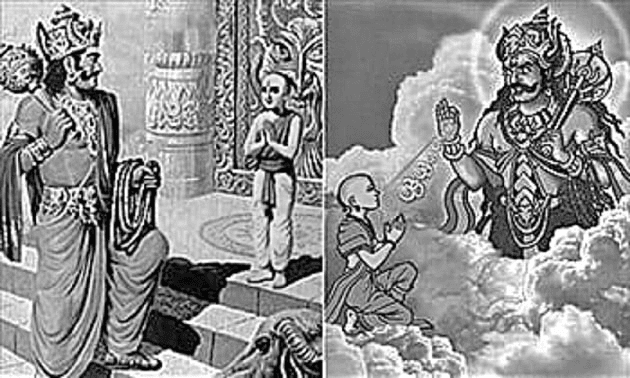
Ancient wisdom, as conveyed by Yamraj to Nachiketa in the Katha Upanishad, reveals that the distinction between knowledge and ignorance determines one’s destiny. Understanding this distinction allows an individual to transcend the illusions of the material world and move towards self-realisation.
Yamraj on merit and attachment
Human life constantly presents us with choices—between what is truly beneficial and what merely appears pleasurable. In this eternal conflict between merit (worthiness) and attachment, lies the key to our happiness or sorrow.
Explaining the difference between merit or worthiness and attachment, Yamraj says that the former is knowledge and the latter ignorance. The choice we make will lead us towards happiness or sorrow.
While merit will take us towards happiness, sorrow awaits those who choose attachment. The one who chooses attachment is kept away from making the necessary/required efforts towards achieving his/her goal. Every individual has the option to choose between knowledge and ignorance, and one’s choice will decide one’s destiny.
Shreyascha Preyashcha manushyametstau samparitya vivinakti deerah;
Shreyo hi dheero’bhi preyaso vrinite preyo mando yogakshemadrinite.
Just as a swan separates milk from water, an intelligent person is able to distinguish between merit and attachment. He weighs the pros and cons of both and, after thorough analysis, chooses the path of merit that leads him closer to his goals. In contrast, a fool, lacking intellect, always chooses love or attachment, which brings him nothing but sorrow.
Giving the example of Nachiketa himself, Yamraj explains that despite being offered many worldly and otherworldly pleasures, Nachiketa opted for knowledge; whereas many individuals remain engrossed in worldly pleasures, which lead to attachment and, in turn, to sorrow.
The major roadblock in the path of those who seek spiritual enlightenment is the mistaken belief that the body and the soul are one and the same. Vedanta aims to enlighten an individual by teaching him to look inward and realise the divine presence seated within. Once a person realises that he is the divine soul and that the body is merely a cloak, all ignorance is dispelled, and he becomes capable of distinguishing between true happiness and sorrow.
When illusion vanishes, the individual experiences divine bliss. However, this state is possible only when one realises the truth within and relinquishes all worldly emotions. Man must prepare himself for self-realisation by giving up ego, practising humility, and becoming a Sthitaprajna—one who remains unaffected by the pairs of opposites such as joy and sorrow, success and failure. In other words, when we lose interest in worldly pleasures, we move closer to self-realisation.
Yamraj explains about Atman/Parabrahman
Nachiketa said, “Tell me about the supreme divine being who is aloof from both dharma and adharma; who, while living in this mortal world, is unaffected by worldly pleasures; who is beyond both the past and the future.”
In reply, Yamraj describes the Supreme Being, also called Atman or Brahman, as the eternal and indestructible Self. This Self is untouched by the mortal world and beyond the ideas of dharma (virtue) and adharma (vice). He further reveals that this divine essence lives in the heart of every living being.
The Supreme Being is beyond time and death—it is never born, never dies, and remains unchanged even when the body perishes. It exists beyond both the past and the future. This eternal Self also transcends all moral and worldly dualities. It is not bound by concepts of right and wrong, good and bad, virtue or sin. When Nachiketa realized this truth, he became free from both virtue and vice.
The Self remains unaffected by worldly experiences. Just as the sun is not tainted by the dust or impurities seen by the eyes, the inner Self is not touched by the sorrows or imperfections of the outer world. A wise person who understands this truth finds peace and freedom within, no matter what happens outside.
The Supreme Being is both subtle and vast—it is smaller than the smallest and greater than the greatest. Although hidden deep within the heart, it can be known by those who have a pure mind and a sharp, steady intellect.
Yamraj explains that this truth cannot be reached through study, debate, or intellectual effort alone. The Supreme Being reveals itself only to those who truly seek it with deep faith, devotion, and sincerity. It is not something that can be taught or explained fully in words—it must be experienced directly through inner realization.
Simply put, Yamraj’s teaching in the Katha Upanishad identifies the Supreme Being with the eternal Self (Atman), which is the true essence of every living being and of all existence. This Self is beyond all worldly experiences and moral distinctions. Realizing this inner truth is the ultimate purpose of human life, for it leads to liberation (moksha)—freedom from the endless cycle of birth and death.
In conclusion, Yamraj’s teaching to Nachiketa serves as a timeless reminder that the true path to happiness lies in the pursuit of knowledge and merit, not in the fleeting pleasures of attachment. By choosing the higher path of shreya (the good) over preya (the pleasant), one can transcend ignorance, conquer sorrow, and attain the supreme state of divine bliss. The journey from attachment to enlightenment begins with the conscious choice to seek the truth within oneself.
(Featured Image Source: Aanmeegam.in)
