


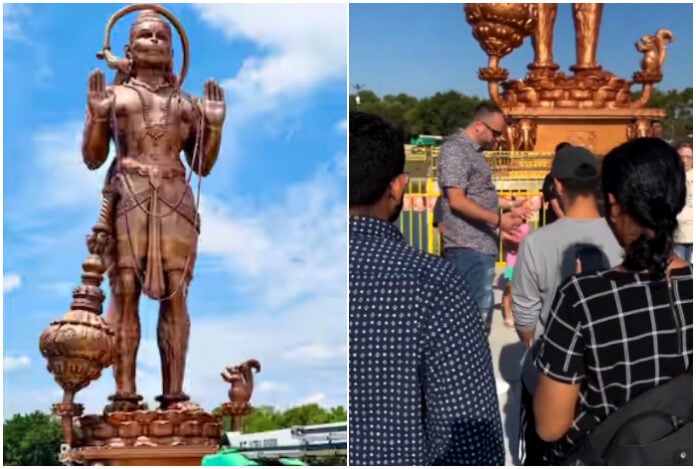
In a grand ceremony on August 18, 2024, a 90-foot-tall murti of Bhagwan Hanuman, named the “Statue of Union,” was unveiled at the Sri Ashtalakshmi Temple in Sugar Land, Texas. The Pran Pratishtha ceremony marked the inauguration of what is now North America’s tallest statue of Bhagwan Hanuman, an embodiment of strength, devotion, and selfless service. The murti commemorates Hanumanji’s role in reuniting Sri Rama with Sita, which inspired the name “Statue of Union.”
The project was the vision of His Holiness Sri Chinnajeeyar Swamiji, who envisioned the statue as a spiritual epicenter where devotees can find solace, peace, and a path to transcendence. The murti is made of Panchaloha, a traditional mix of five metals, and stands as a symbol of hope and strength, radiating benevolence to all who visit.
According to the official website, the project aims to create a lasting legacy for future generations, encouraging them to seek the divine blessings of Bhagwan Hanuman. The Statue of Union is set to become the third tallest statue in the United States, surpassing the Our Lady of the Rockies statue, which stands at 88.6 feet.
“Demon god” – Local Christian group protests at Hanuman mandir
On the day of the Pran Pratishtha, a local church group entered the premises of the Sri Ashtalakshmi Temple in Sugar Land, Texas, to protest the recently unveiled Hanumanji murti.
The protest involved 15-20 members of the Awakening Gen Church, led by Rev. Greg Gervais. The group gathered around the statue, praying and uttering what were described as “demonic curses,” with some protestors praying for the downfall of “non-believers” and attempting to proselytize temple-goers, including children. The demonstrators walked in a counterclockwise circle around the statue, an action that is considered inauspicious in Hindu Dharma. They did this before approaching temple visitors to preach about Jesus Christ.
Dr. Ranganath Kandala, joint secretary of the Ashtalakshmi Temple, recounted the events, stating that the group initially attracted little attention, as temple officials assumed they were there to admire the statue. However, the situation escalated when the protestors began making inflammatory remarks, including one individual saying, “May all the false gods burn to the ground.” The group continued to harass temple visitors until Kandala intervened, reminding them of the Hindu teaching, “Worship your own, but respect all.” Despite his efforts to de-escalate the situation, Kandala eventually had to threaten to call the police, which prompted the group to leave.
Rev. Gervais later claimed that the group was there to “pray peacefully” and denied that their actions constituted a protest. However, his statements only added fuel to the fire, as he referred to the Hanuman murti as a “demon god” in a Facebook video, reinforcing the belief that their intentions were far from peaceful.
Imagine the opposite
Had this been the other way around – Hindus protesting in a planted church calling their god names, the scenario would have been entirely different.
The double standards of the Christians are glaring. Had a Hindu group entered a church and engaged in similar activities, the response would likely have been swift and severe, with the media and authorities decrying the act as a hate crime and Christians portrayed as victims of persecution. Yet, when the roles are reversed, the incidents often go underreported, and the perpetrators face little to no consequences. They act with impunity when they are the minority in India and the majority in the USA. If Hindus in India stand against such actions, they are quickly labeled as persecutors, often with support from so-called “secular” Hindus. Today, Hindus find themselves with little power, unable even to defend their culture and traditions in their own homeland.
Incident from Chennai – Christian found praying ‘Paava Arikkai’ in temple
We take a look at an incident that occurred in Chennai in February 2024. A Christian woman entered the Kapaleeswarar temple in the city and began reading the Bible and reciting the Paava Arikkai, a Christian confession of sins, within the temple premises. The Paava Arikkai includes lines asking for forgiveness from Jesus Christ and condemning what the woman likely considered “false” gods and practices.
The Paava Arikkai is not a benign, universally accepted prayer. Here is an example of a passage within the prayer:
“O Lord, Our Father, we have transgressed against you in thought and speech.
We have not loved you with complete devotion.
We implore your mercy.
Remove our sinful impurities and cleanse us.”
Exemplar Paava Arikkai Jebam: “Almighty and compassionate Father, we have strayed from Your path like escaped sheep. We have followed the desires and thoughts of our hearts. We have violated your sacred commandments and engaged in forbidden actions. We are unwell. Yet, in accordance with the promises made by God through our Lord Jesus Christ to humanity, show mercy to us, the unwitting offenders. Be patient with us as we confess our transgressions and guide us in correcting our sorrow for our sins. Most Merciful Father, for the sake of Jesus Christ, grant us the grace to lead a life of godliness, righteousness, and clarity of mind, bringing glory to Your holy name. Amen.
God our Father, we have sinned against you in thought, word, and deed. Our love for you is not wholehearted. We do not treat our neighbor with the same love we have for ourselves. We earnestly seek your mercy. Purify us by removing the stains of our sins. Aid us in overcoming our transgressions. We offer this prayer through our Lord Jesus Christ. Amen.”
The situation at the Kapaleeswarar Temple is especially troubling given a recent ruling by the Madurai Bench of the Madras High Court, which restricted non-Hindus from entering certain parts of Hindu temples. Despite this, incidents like the one in Chennai continue to occur, often with little consequence for the perpetrators. The woman in question when confronted, refused to leave or accept the sacred Vibhuti, asserting that she had the right to pray as she wished within the temple. This brazen act of proselytizing in a Hindu temple sparked outrage among the Hindu community – it was blatant disrespect of our religious space and practices.
Hindu communities in both the United States and India are increasingly finding themselves targeted by the church that seeks to undermine Hindu beliefs and practices.
