


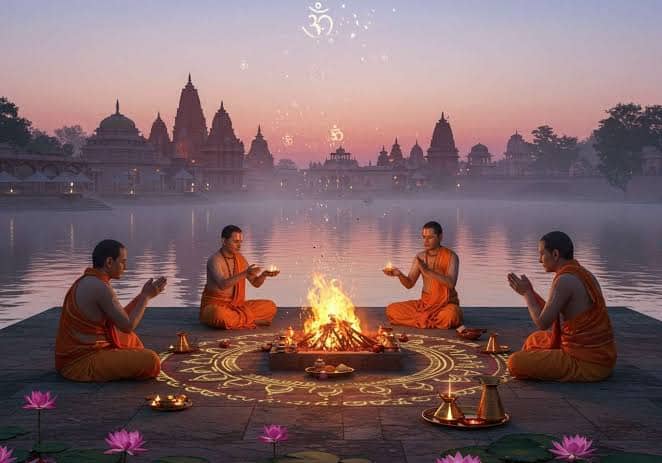
It is handed down from generation to generation and every civilisation survives because of it. Monuments may last for hundreds of years, but it is culture and values that keep a civilisation breathing.The empires have risen, bloomed and waned for thousands of years, but the pulse of the Hindu civilisation has never ceased.
The rituals for practitioners of Sanatan Dharma are not just religious in nature, but expressions of philosophy, values and identity. These are traditional Hindu practices that continue to be relevant in today’s age of rapid globalization and mass migration, providing a sense of continuity and connection, despite the shifting landscape of the world. There are some of the sacred acts that make sure that the Hindu culture is passed down from generation to generation through everyday activities.
1. Living Carriers of Hindu Civilisation.
How is it that a culture can exist for thousands of years without a single governing body, or hierarchy? The solution is in the proper use of the Vedic practices. Within the Indian spirit, daily and seasonal practices are the material vehicles of profound cosmic realities.
The Hindu rituals involve thousands of years-old traditions, which transmit collective memory, values, and customs. Each chant, each offering and each mudra carries deeper cultural and spiritual significance than the ceremony itself. The family today in ritual are doing more than acting out an act of faith; they are continuing a line of memory going back to Antiquity, keeping ancient cultural heritage alive and relevant.
2. Family Traditions: Micro habits of Dharma.
The small, repetitive acts in the household are usually the ones that are of great importance for the formation of cultural identity; it is not abstract lectures. These daily family traditions create the basic worldview of the younger generation and inculcate Hindu values in their daily activities.
- Daily Puja: Creating a dedicated time in the day (morning or evening) to calm the mind and connect with the Divine.
- Touching Elders’ Feet (Charan Sparsh): A physical demonstration of the reverence and the passing of knowledge from one generation to the next.
- Lighting the Diya: A reminder every day that knowledge dispels darkness and ignorance in the home.
- Reading Scriptures & Singing Bhajans: Making sacred texts the focus of reading and devotional songs the focus of singing, and making the house a sacred place.
Gratitude, discipline, respect, devotion (bhakti) are some of the values that are naturally ingrained in them through these subtle day-to-day Hindu traditions. These micro-habits are made routine and children learn the way of life in Hindu culture naturally, as if it were their own.
3. Festivals: Expanding the Circle of Connection.
While the daily puja is the quiet rock of the home, colourful Hindu festivals are the grand events that unite the community. Major festival days like Diwali, Navratri, Janmashtami, Raksha Bandhan, and Makar Sankranti are effective means of cultural continuity.
Festivals bring abstract philosophies to fruition in joyful reality. In the first instance, a child does not learn the intricate rules of cosmic rightness from a book, but he or she learns it naturally when he/she places a clay diya in the courtyard during Diwali and sees the victory of the light over darkness. As important as they are, these are often good times to tell stories and to pass on history, and to help keep special regional traditions alive.
4. The Journey of Life: The Role of Samskaras
The Hindu system has succinctly outlined the life cycle of an individual from birth to death in the hereafter through 16 Rites of passage called Samskaras. These holy landmarks help to make each major life transition sacred, celebrated and community-acknowledged, thereby strengthening one’s identity and life continuity with the family.
- Naming Ceremony (Namakarana): Welcome the newborn into the lineage and community.
- Annaprashana (First Solid Food): Celebrating the growth, nourishment and physical health of the child.
- Upanayana (Sacred Thread Ceremony): When formally introduced to education and spiritual duties.
- Vivaha (Marriage): Joining two families and taking the responsibility of the Grihastha (Householder).
- Antyeshti (Funeral Rites): The last of the sacrifices, the return of the physical body to the elements and the honouring of the soul’s eternal journey.
A life path that is organised and has power from an ancient text. As it is said in Taittiriya Upanishad (1.11.1):
मातृदेवो भव – Let your mother be a god to you, पितृदेवो भव – Let your father be a god to you, आचार्यदेवो भव – Let your teacher be a god to you, and अतिथिदेवो भव – Let your guest be a god to you.
The Samskaras provide a powerful sense of cosmic connection to each individual, reminding them that their lives are woven into the greater tapestry of the sacred traditions of the ancient Hindu scriptures.
5. Preserving Language, Scriptures, and Sacred Knowledge
It is a wonder that the ancient texts of India survived the foreign invasion and disruptions for centuries. This knowledge was not forgotten but has been maintained because of Hindu rituals. Many times large knowledge of sacred heritage has been passed down without the use of formal classrooms, via the Guru-Shishya Parampara (the teacher/disciples’ line) and oral transmission.
During the traditional Hindu practices, the family members are exposed to the Sanskrit Mantra, along with regional languages. The stories for such ceremonies are straight from the ancient epics such as the Ramayana and the Mahabharata. This fosters a natural environment for learning in which scriptural literacy, historical consciousness and linguistic heritage become easily absorbed at a young age.
6. The Indian Diaspora and Cultural Continuity
Preserving Hindu heritage is challenging for the millions of people of Hinduism who are thousands of miles away from Bharat. It is so easy in a foreign place for younger generations to feel like they are in some way displaced or diluted from their own culture when immersed in a dominant western narrative.
The regular abode of Hindu rituals is a lifeline for the Indian community overseas. Immigrant families can make a “home away from home” by maintaining a home mandir, by conducting traditional Pujas and by attending local community temples. These practices allow children to have a unique sense of self, to fit into multicultural societies without difficulty, and to remain emotionally, culturally and spiritually connected to their ancestral heritage.
7. Using Modern Technology as a Supporting Tool, Not a Replacement
Technology in the digital age has provided amazing new opportunities to preserve and connect to the Vedic traditions.
Today, families around the world can access digital scriptures which have accurate translations, listen to online satsangs, watch ancient Indian temples provide live darshan and benefit from interactive apps to learn correct mantra pronunciation.
A critical difference: Digital is amazing for education and world access, but it’s on top of something else. Technology can be a helpful way to expand our understanding, but it is no substitute for the real spirit of family involvement, the tangible experience of temple worship, or the individual devotion (sadhana) of actual Hindu rituals.
8. Why the Younger Generation Matters
The future of any civilization depends on its youth. To keep the Hindu culture alive in the modern world, parents should play a role as the first teachers and make children participate in all the ceremonies.
The secret to attracting young people is to explain rather than enforce. “Why do we do it? The young people today are very analytical and ask why do we do it? When explaining the science, psychology or spirituality behind certain Hindu practices, instead of asking them to act out of those rituals, it becomes meaningful to them. A harmonious blend of tradition and modernity helps youth to avoid the perception of a “burden of tradition”, but instead to see their heritage as a great spiritual power.
Conclusion:
Ultimately, Hindu rituals are far more than mere mechanical actions or superficial ceremonies. They are the highest protectors of our family values, our distinctive culture, and our profound spiritual knowledge. They give continuity to the history and keep alive the memory of a people that is not about to forget itself.
If these Hindu norms, beliefs and rituals continue to be understood with sincerity, affection and clear thinking, and continue to be practiced and passed down, the heritage of Sanatan Dharma will continue to be alive, unbroken and vibrant for generations to come.
—Team Satvik, a content team dedicated to creating well-researched and educational articles on Sanatan Dharma, Hindu traditions, Vedic knowledge, and contemporary topics related to Hindu culture
