


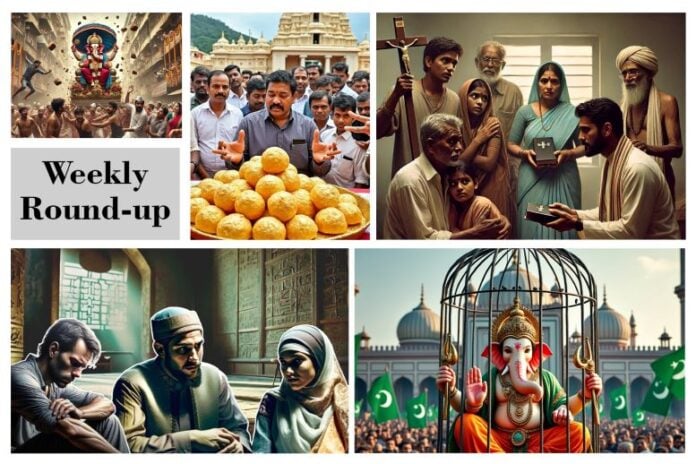
Attacks on Hindus and Hindu Dharma, both in Bharat and overseas, are frequent and unrelenting. In many regions of the world, this persecution is like a genocide slowly unfolding before our eyes. For decades, the world has ignored the actual depth and breadth of these attacks, driven by disturbing anti-Hindu bigotry. From murders, forced conversions, land grabs, assault on festivals, desecration of temples and murtis, hate speech, and sexual violence to institutionalised & legal discrimination, Hindus are facing an increasing assault on their very existence along with an unprecedented Hindu hatred.
In this weekly summary for the period from 01 March to 07 March 2026, we hope to provide a snapshot of such crimes and hopefully awaken more people around the world to this human rights crisis:
Bharat
1) A viral video from Rishikesh Kirtan Fest 2026 has ignited widespread controversy and racism concerns. It shows a Bharatiya man confronting a foreign staff member at the event entrance for reportedly denying local attendees access while prioritizing foreigners. The footage, shared on Instagram by Dehradun Raw, amassed over 378,000 views in days, amplifying public anger across social media platforms.
2) Activist Gautam was brutally attacked by a group of Muslim youths in Napoklu village of Madikeri taluk. The incident occurred when Hindu youths were moving in a pickup vehicle, making public announcements about the upcoming Hindu Samavesha scheduled to be held in Ballamavatti. According to reports, a group of Islamist youths objected to the use of a microphone and allegedly assaulted the activists near Ponnad Supermarket in Napoklu town. Gautam, who sustained serious injuries in the attack, was rushed to the district hospital in Madikeri for treatment.
3) The pattern that emerges from a decade of coverage in Bharat’s leading English‑language outlets is not accidental. From 2016 to 2026, at least 12 major media organisations have systematically framed Holi through the lens of danger, disease, environmental damage and public‑order risk, even as the same platforms, in the same season, portray Ramadan almost exclusively as a holy, healthy, serene month of fasting, spirituality and charity. This asymmetry is not about data or science; it is about narrative. It reveals a deeper ideological bias in which a Hindu festival is repeatedly medicalised and problematised, while an Islamic month of intensive ritual slaughter, mass food consumption after dark, and long‑hour dry fasting in hot climates is romanticised and cosmetically “health‑washed”.
4) Tension prevailed in Gangavathi, a town in Karnataka’s Koppala district, after Chandrashekhar was allegedly assaulted by a group of Islamist youths over a social media post related to Iranian Supreme Leader Ali Khamenei.
5) Clashes broke out in Rajkot’s Bhagwatipara area on the night of Holika Dahan after local residents objected to bike stunts being performed near a ritual bonfire, leading to police deployment and multiple detentions. Residents had gathered around a traditional Holika bonfire when two young Muslim men on a motorcycle allegedly rode close to the ritual area and performed stunts, triggering objections from locals who felt the acts were disrespectful and dangerous in the crowded festive setting.
6) Activists of Puthila Parivara have alleged that they received threatening phone calls from abroad aimed at stopping the free screening of the film The Kerala Story 2, which was planned in Puttur. The organizers claim the calls contained abusive language and warnings intended to prevent the event from taking place.
7) A clash marred Holi celebrations in Dehradun’s Gandhi Gram area on 4 March 2026, where a 65-year-old Hindu woman was allegedly slapped by a Muslim man, leading to communal tension. Videos of the incident quickly went viral on social media, amplifying public outrage and calls for swift police action. Local reports indicate the altercation began over a minor dispute but escalated rapidly, drawing crowds from both communities.
Bangladesh
Attacks on Hindus in Bangladesh are relentless and designed to cleanse the religious minority from the country gradually. According to a study by Prof. Abul Barakat of Dhaka University, no Hindus will be left in Bangladesh by 2050 due to systemic and institutionalized persecution. Temple desecration, land grabbing, mob attacks after false blasphemy charges, rape/forced conversion of women, and hate speech are tools used to intimidate and drive Hindus out.
1) Muhammad Rakib and two Associates named in the brutal all-night gang rape and torture of speech-impaired Hindu mother returning from Kirtan in Bhola. According to the victim and local sources, she had boarded an autorickshaw at around 11 p.m. to return home. The driver, later identified as Muhammad Rakib, did not take her home. Instead, he allegedly diverted the vehicle to a secluded betel nut grove in Shashiganj village. There, according to investigators, he and his two associates Muhammad Shakil and Muhammad Rasel had subjected her to hours of sexual abuse and brutal torture.
2) Akash Das was stabbed to death by local extortionists in Chattogram. The deceased Akash was the son of Babul Das of Dhopapara area adjacent to Alankar Mor in Chattogram. On the other hand, in Chandanaish upazila of Chattogram, 70-year-old Chandan Dey was shot dead by robbers. The incident took place around 4:45 am in Badrupura Hindupada of Ward No. 1 of Chandanaish Municipality.
3) At least ten people, including women, were injured during an attack on demonstrators who were holding a protest demanding the recovery of temple land in Arwail village of Sarail Upazila in the Brahmanbaria district.
Most hate crimes are driven by anti-Hindu bigotry encoded in certain religious teachings and political ideologies. While the anti-Hindu hate in Islamic countries is evident, there is another subtler form of anti-Hindu sentiment within institutions and the public sphere of ostensibly secular states (like India) that provides an enabling environment for Hinduphobia and hate crimes. This subtle, everyday discrimination can be missed unless one studies prevailing laws and patterns. The gradual ban on firecrackers during Diwali is a good example – it might seem pollution-related on the surface. Still, the double standards at play become apparent when one looks at the larger picture of restrictions on Hindu festivals and the lack of sound reasoning behind the ban.
We request all readers to share other anti-Hindu hate crimes that we might have missed in this period in the comments below or by emailing [email protected]. We also solicit support in maintaining the Hindu human rights tracker database.
