


A shocking incident of religious intolerance and anti-Hindu violence has been reported from Putpak village in Gurmatkal taluk of Yadagiri district, Karnataka, where a mother and her son were allegedly assaulted by a group of radical Islamist youths after the son uploaded a photograph of Kesari Dhwaj on social media
As per reports from Hosakannada, Kesari Dhwaj had been installed in the village as part of preparations for a religious program organized by Shiva Mala devotees. A local youth, identified as Ramesh, shared photographs of the flags on social media. However, the images were allegedly misinterpreted as showing Kesari Dhwaj placed on a mosque, triggering outrage among a group of seven Islamist youths.
Late in the night, the accused Islamist mobs reportedly barged into Ramesh’s house and physically assaulted him. When his mother, Nagamma, questioned the attackers and tried to intervene, she too was allegedly beaten by the radicalist group. The incident has sparked anger and fear among Hindu residents.
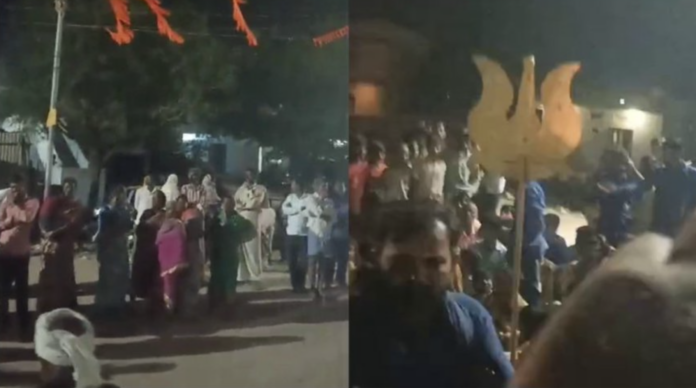
As news of the assault spread, Shiva Mala devotees and villagers gathered at midnight and staged a protest in the middle of the road. Holding portraits of Bhagwan Shiva, Devi Parvati, and Dr. B.R. Ambedkar, the protesters demanded immediate arrests of the accused and sought justice for the victims. The demonstration continued until authorities assured action.
Nagamma has filed a complaint at the Gurmatkal Police Station against seven Islamist individuals: Mulang, Riyaz, Khaja, Khaleel, Asif, Khaleem, and Sameer. Police have registered a case and initiated an investigation into the attack. Villagers have urged authorities to act swiftly to prevent further tension and ensure safety in the area.
Journalist slams assault, questions ‘Mohabbat Ki Dukaan’ narrative
Journalist Kiran Aradhya strongly criticized the assault in Yadagiri, Karnataka, saying it should not become normal that a family faces violence for sharing a Kesari Dhwaj photo. He stated that the image was an optical illusion that made the flag appear atop a mosque, yet a mob allegedly stormed the young man’s home at night and assaulted him and his family, including women and the elderly. The incident, he argued, reflects rising tensions over religious symbols and the misuse of social media to spark confrontation.
He further questioned what he described as selective responses by authorities, contrasting strict action in some online speech cases with what he called a softer response in this assault case. Referring to the political slogan ‘Mohabbat Ki Dukaan,’ he argued that such incidents raise concerns about law-and-order consistency and the need for equal protection and swift justice for victims of violence.
A similar controversy occurred during the Udupi Paryaya celebrations, when the use of the Kesari Dhwaj in a religious procession was questioned, and officials reportedly faced complaints. Much like the Yadagiri incident, a traditional Hindu symbol used in a religious context became a source of controversy, reflecting how cultural practices are increasingly being politicized and turned into flashpoints for tension.
This incident, in particular, points to how quickly social media can turn into a platform for confrontation amid rumors, assumptions, and misconceptions. A simple image of Kesari Dhwaj placed for a religious program was apparently misconstrued and provoked Islamist mob violence against an innocent Hindu family. This points to the larger phenomenon of how social media is being misused to instigate trouble and promote hostility towards Hindu dharma and its religious practices. However, if secularism is all about living in harmony and respecting other communities, then Hindu dharma and its practices must be treated at par.
Violence and intimidation in the context of a social media image are not just disrupting social harmony; they are undermining the rule of law. Thus, the pressing need of the hour is the responsible use of social media, combined with the realization that all religions are to be respected equally, to prevent such untoward incidents.
