


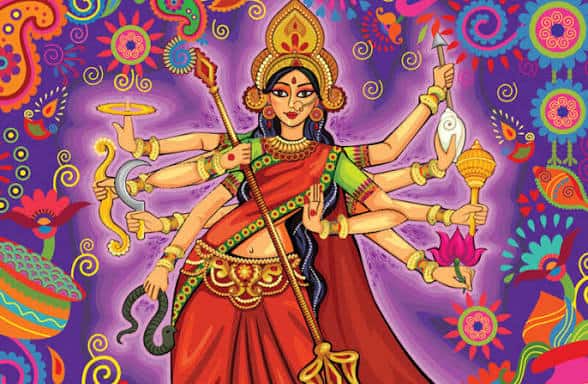
When the whiteness of the kash grass spreads across the autumn sky and the fragrance of shiuli fills the air, it is not merely a change of season that takes place; a subtle awakening also begins in the inner world of human beings. With the arrival of autumn, the consciousness of countless devotees turns naturally towards Jagatjanani Durga, the Divine Mother. Yet Durga is far more than the beautiful image installed in a festival mandap or the central deity of an annual celebration. She is the eternal symbol of Shakti, the primordial power through which the universe is created, sustained, and ultimately withdrawn into itself. She is at once the embodiment of motherly affection and compassion, the source of knowledge and intelligence, the destroyer of evil, the protector of dharma, and the supreme power leading the seeker towards liberation. To understand the doctrine of Durga, therefore, one must not see her merely as a mythological goddess. She must be understood as the unified expression of Shakti, Prakriti, Maya, intelligence, compassion, strength, and liberation. Such an understanding reveals the profound scriptural and philosophical greatness of Durga.
The very word “Durga” carries a far-reaching significance. Durga is that which is difficult to approach, difficult to cross, or difficult to overcome. Human life itself often becomes a kind of durga—a difficult passage filled with sorrow, illusion, fear, attachment, ignorance, uncertainty, and suffering. She who guides the individual through these difficulties and carries the devotee beyond them is Durga. Thus, Durga is not merely the destroyer of external dangers; she is the lamp of consciousness that continues to shine even in the midst of danger. Her name becomes reassurance at the end of fear, strength at the end of exhaustion, and a path towards truth when the mind is surrounded by confusion. The scriptures therefore reveal her through such meanings as Durgatinashini, Durlabha, Dustara, and Sarvamangaladayini. Her very name reminds the human being that no difficulty is ultimately insurmountable when consciousness takes refuge in the Divine Mother.
The description of the goddess in the Sri Sri Chandi is not merely poetic ornamentation but a profound interpretation of the doctrine of Shakti. The Devi is proclaimed as the power dwelling within every living being:
“Iya devi sarvabhuteshu shaktirupena samsthita, namastasyai namastasyai namastasyai namo namah.”
This declaration lies at the very heart of the philosophy of Durga. The goddess dwells in all beings in the form of Shakti. Shakti, therefore, is not an external force that exists somewhere beyond human experience; it is present within life itself, within consciousness, within nature, and within the entire process of creation. Human courage, intelligence, patience, affection, sacrifice, determination, and sense of justice are all manifestations of this divine power. Shakti does not mean merely the ability to fight or conquer an enemy; Shakti means the fullness and dynamism of existence itself. Goddess Durga is the complete and conscious expression of that eternal power.
The scriptures establish the goddess not only as Shakti but also as intelligence, prosperity, and peace. The universal presence of the Divine Mother is therefore expressed through many dimensions of human existence. The Sri Sri Chandi declares:
“Iya devi sarvabhuteshu buddhirupena samsthita, namastasyai namastasyai namastasyai namo namah.”
“Iya devi sarvabhuteshu lakshmirupena samsthita, namastasyai namastasyai namastasyai namo namah.”
“Iya devi sarvabhuteshu shantirupena samsthita, namastasyai namastasyai namastasyai namo namah.”
These invocations reveal a profound truth: the goddess is not merely the remover of fear but also the giver of knowledge, prosperity, harmony, and peace. Intelligence guides the individual towards the right path; Lakshmi represents abundance, prosperity, and the harmonious order of life; and peace calms the restless mind and makes spiritual awareness possible. Durga is the presiding power behind all these dimensions. Thus, the doctrine of Shakti is inherently multidimensional. The same Divine Mother who gives strength to overcome adversity also grants the wisdom to understand life, the prosperity necessary for righteous living, and the peace necessary for spiritual realization.
The supreme and transcendental nature of the goddess is further revealed when the scriptures declare:
“Sa vidya parama muktehetubhuta sanatani, samsarabandhahetushcha sa vai sarveshvareshvari.”
Here the goddess is identified with the supreme, eternal knowledge that becomes the cause of liberation, while she is also the power through which worldly bondage operates. This apparent paradox contains one of the deepest philosophical insights of the doctrine of Durga. The world is neither merely bondage nor merely liberation. The experience of bondage and the possibility of liberation both unfold through the mysterious power of the Divine Mother. As Maya, she envelops the individual in the phenomenal world; as Vidya and grace, she reveals the truth beyond that world. The same Shakti that creates the experience of multiplicity can ultimately lead the seeker beyond attachment to multiplicity. Durga, therefore, is not merely the deity of ritual worship; she is also the philosophical foundation of spiritual liberation.
For this reason, Durga worship cannot be regarded simply as an external religious ceremony. At its deepest level, it is a discipline of self-cultivation and inner purification. When a devotee takes refuge at the feet of the goddess, he is gradually taught to recognize not only the enemies that exist outside himself but also those that reside within. Ego, anger, greed, envy, lust, attachment, arrogance, and ignorance are the true asuras that obstruct spiritual progress. The battle between Durga and Mahishasura, therefore, possesses a meaning far beyond the literal story of a divine war. It becomes a symbolic representation of the eternal battle between divine consciousness and destructive tendencies within the human mind. The slaying of Mahishasura signifies the destruction of the forces that keep consciousness bound to ignorance. Durga is the presiding deity of this inner battle, and the victory of the goddess represents the triumph of dharma over adharma, knowledge over ignorance, and consciousness over unconsciousness.
The universal nature of the goddess is again expressed through her form as Maya:
“Ya devi sarvabhuteshu mayarupena samsthita, namastasyai namastasyai namastasyai namo namah.”
Maya, in this context, does not mean merely falsehood or deception. Maya is the mysterious divine power through which the world becomes manifest while, at the same time, its ultimate reality remains concealed from ordinary perception. In the philosophical traditions of Hinduism, Maya is therefore not simply a trivial illusion but an essential power of manifestation. Through Maya, the One appears as the many, the formless assumes innumerable forms, and the unmanifest becomes experienced as the universe. The goddess is the embodiment of this Maya because she gives form, movement, diversity, and appearance to creation. Yet Maya need not remain a force of bondage. When the individual approaches the Divine Mother with devotion and discrimination, the same Maya that once bound him to the world can become a means of spiritual awakening. What was once an obstacle becomes a stairway towards realization.
The Sri Sri Chandi also reveals another deeply universal aspect of the goddess:
“Ya devi sarvabhuteshu matrirupena samsthita, namastasyai namastasyai namastasyai namo namah.”
The Mother-form of the goddess is particularly significant because motherhood is not limited to biological birth. Motherhood represents refuge, acceptance, forgiveness, compassion, nourishment, protection, and unconditional grace. Before the Divine Mother, the devotee need not conceal weakness, fear, sorrow, or failure. Instead, these are offered to her with complete surrender. Durga as Mother accepts the individual in totality and gives the strength to rise again. From the scriptural point of view, motherhood is therefore not merely one temporary manifestation of the goddess; it expresses something fundamental about her very nature. She is the supreme repository of compassion, the universal mother before whom every being has a place.
The weapons held by Durga also possess a profound philosophical meaning. Her conch, chakra, sword, bow, arrow, and other weapons are not merely instruments of physical warfare. They symbolize conscious and righteous power. The conch represents auspiciousness and the proclamation of divine truth; the chakra symbolizes the wheel of dharma and the eternal movement of cosmic order; the sword represents the sharpness of knowledge that cuts through ignorance; the bow represents determination and focused intention; and the arrow signifies concentrated discipline directed towards a definite goal. The many weapons of Durga thus demonstrate that dharma is not passive or powerless. Righteousness possesses the strength to resist and destroy forces that threaten harmony and truth. Durga is therefore called the destroyer, but she is not a goddess of chaos or violence. Her destructive power is directed towards the destruction of adharma so that dharma may be protected and restored.
At the heart of the doctrine of Durga lies the inseparable relationship between Shiva and Shakti. The scriptures express this truth in the celebrated verse:
“Shivashaktyayukto yadi bhavati shaktah prabhutum.”
The philosophical meaning of this statement is profound. Shiva represents pure consciousness, while Shakti represents the dynamic power through which consciousness becomes manifest. Shiva is stillness; Shakti is movement. Shiva is the silent foundation; Shakti is its expression. Yet they are never truly separate. Without Shakti, Shiva remains without manifestation; without Shiva, Shakti lacks the consciousness that gives meaning and direction to her activity. They are two inseparable aspects of the same ultimate reality. Durga is the awakened and dynamic expression of this Shakti.
It is for this reason that the scriptures invoke her through many names—Narayani, Gauri, Parvati, Jagadamba, Chandi, and Mahamaya. Each name reveals another dimension of the same eternal reality. The multiplicity of her names does not indicate multiplicity of the Divine Mother herself; rather, it reflects the many dimensions through which the one supreme Shakti manifests in existence.
The Durgasaptashati further celebrates the goddess through a hymn that brings together many of her seemingly different qualities:
“Jayanti mangalakali bhadrakali kapalini, Durga kshama shiva dhatri svaha svadha namostute.”
This shloka is a remarkable expression of the manifold nature of the Divine Mother. She is Jayanti, the giver of victory; Mangala, the source of auspiciousness and welfare; Kali, the power that transcends and governs time; Bhadrakali, at once auspicious and fearsome; Kapalini, associated with the power of dissolution; and she is Kshama, Shiva, and Dhatri—the embodiment of forgiveness, auspiciousness, and nourishment. These apparently diverse qualities come together in one universal goddess. She can be tender without being weak and fierce without being cruel. She can nurture creation and also destroy what threatens its harmony. Her universality is precisely what makes her the Mother of the world rather than the possession of any single community, sect, or social group.
The exalted position of womanhood as an expression of Shakti is also deeply connected with this understanding of Durga. In the Srimad Bhagavat and Devi Bhagavat traditions, womanhood is associated with the sacred principle of Shakti, recognizing the potential for divinity within feminine existence. This vision elevates Durga worship beyond the boundaries of social custom or seasonal ritual. Whenever a woman expresses affection, patience, austerity, service, courage, sacrifice, resistance, and compassion, she becomes a reflection of the Divine Mother. To recognize Shakti in womanhood is therefore to recognize the sacredness of the feminine principle itself. In this sense, Durga worship also becomes a profound scriptural affirmation of respect, dignity, and reverence towards women.
The all-encompassing nature of the goddess is beautifully expressed in another hymn:
“Tvameva sarvajanani tvameva sarvadehinam, tvameva sarvabhutanamadharastvam para gatih.”
Here the goddess is addressed as the Mother of all, the Mother of all embodied beings, the support of all existence, and the supreme goal. This verse expresses the all-supporting nature of Durga. She is not merely the one to whom the devotee turns in times of distress; she is the foundation upon which existence itself rests. The spiritual journey of the devotee begins in dependence upon her grace and ultimately culminates in the realization of her supreme nature. She is both the beginning and the destination, both the refuge of the seeker and the goal towards which the seeker moves.
The importance of remembrance and devotion is similarly emphasized in the celebrated prayer:
“Durga smrita harasi bhitim asheshajantoh, swasthaih smrita matimativa shubham dadasi.”
The meaning is that merely by remembering Durga, the goddess removes the fear of countless beings, while remembrance of her in a state of well-being brings auspicious wisdom. This reveals a particularly intimate dimension of devotion. The goddess is not a distant deity accessible only through elaborate rituals. Her presence becomes immediate through remembrance itself. In moments of fear, uncertainty, sorrow, and despair, the name of Durga becomes a refuge for the human heart. At the same time, remembering her in moments of peace prevents complacency and turns the mind towards wisdom and righteousness. Thus, remembrance becomes both a source of consolation and a discipline of consciousness.
The philosophy of Shakti naturally raises a fundamental question: from where does Shakti arise? The scriptural answer is that Shakti does not come from outside. She is the inherent dynamic nature of consciousness itself. The goddess is the complete expression of that divine consciousness and its power of manifestation. Consequently, Durga worship can ultimately be understood as a search for one’s own deepest nature. When the devotee invokes the goddess, he is not merely calling upon an external supernatural power; he is awakening the divine potential that lies hidden within his own consciousness. Through devotion, discipline, knowledge, and surrender, the individual gradually discovers that the power he worships as Durga is also the sacred power sustaining his own existence. In this realization, the Upanishadic, Tantric, and Puranic traditions meet and illuminate one another.
Durgatinashini Durga, therefore, is not merely a goddess to whom offerings are made during the autumn festival. She is the living and profound expression of the doctrine of Shakti. She is knowledge and power, peace and prosperity, compassion and courage, Maya and Vidya, bondage and liberation. To worship her truly is to undertake a process of inner purification, to confront and overcome the asuras within, to establish dharma in one’s own life, and to awaken the divine consciousness that lies at the heart of existence.
The autumn mandap, the fragrance of incense, the glow of lamps, the flowers, the ringing of bells, the rhythmic beating of the dhak, and the chanting of sacred hymns are all external expressions of a much deeper truth. The goddess is not merely outside us in the form of an image, nor is she confined to an abstract idea within us. She is the deepest support of consciousness itself.
The scriptural vision may therefore be gathered into a few essential invocations:
“Iya devi sarvabhuteshu shaktirupena samsthita, namastasyai namastasyai namastasyai namo namah.”
“Sarvamangalamangallye shive sarvarthasadhike, sharanye tryambake gauri narayani namostute.”
Together, these prayers reveal the eternal form of Durga as the supreme expression of Shakti. In the heart of the devotee, she is the compassionate Mother; in the eyes of the seeker, she is supreme knowledge; in the language of philosophy, she is Shakti; in the struggle against inner darkness, she is courage; and in the discipline of life, she is refuge.
She is at once Durgatinashini, who destroys difficulties; Jagatjanani, the Mother of the universe; Mahamaya, through whom creation manifests; and Sarvamangaladayini, the bestower of all auspiciousness. The true greatness of Durga lies precisely in this unity of seemingly different dimensions. She is both the tender Mother and the invincible warrior, both the veil of Maya and the light of Vidya, both the dynamic force of creation and the stillness of ultimate consciousness.
To understand Durga in this way is to understand that the worship of the Divine Mother is ultimately a journey from fear to courage, from ignorance to knowledge, from bondage to freedom, and from the fragmented experience of existence to the realization of the one eternal Shakti that pervades all beings and all creation.
