


Between 2016 and 2025, several prominent international media organizations have published reports, articles, and photo-essays that scrutinize, criticize, or portray Hindu saints, sadhus, and dharmic leaders through a lens often riddled with suspicion, stereotypes, or overt negativity. This article summarizes and analyzes 10 of the most significant such incidents, highlighting their implications for the Hindu community and reflecting from a Hindu civilizational perspective. The aim is not only to document perceived media bias and selective reporting but also to emphasize the crucial need to safeguard Hindu culture and religious dignity in a rapidly globalizing, sometimes adversarial, media landscape.
1. CNN Article Criticizing Kanwariyas (25 July 2025)
On 25 July 2025, CNN published an article by Aishwarya S. Aiyar and Deepak Rao, sharply questioning the conduct of Kanwariyas (Shiva devotees who undertake an annual pilgrimage). The report takes issue with the consumption of intoxicants during the yatra and goes further to suggest that certain Hindu saints create a communal atmosphere, distributing such substances as “prasad.” This framing criminalizes an entire religious tradition and its leaders, fostering a narrative of suspicion and illegitimacy around a sacred practice.

2. Associated Press on Sadhus and Cannabis Use (26 February 2025)
During the Mahashivratri festival in Kathmandu, Nepal, AP News ran a report focusing on the open consumption of bhang and marijuana by sadhus and devotees. Labeling them “marijuana-smoking holy men,” the article centers the coverage on intoxicant use, overshadowing the broader spiritual context and inadvertently portraying Hindu ascetics as mere substance abusers.

3. Reuters Questions Miracles and Sadhus (8 July 2024)
Reuters published a piece on “Bhole Baba” (Surajpal Singh Jatav), raising pointed questions about miracles and ‘faith-healing’ claims. The article connects the appeal of Hindu saints to unemployment, social discrimination, and feelings of helplessness, portraying religious leaders as opportunists who exploit vulnerable populations.
4. Deutsche Welle on Superstition and Faith Leaders (8 January 2024)
DW profiled several Hindu gurus, including Gurmeet Ram Rahim Singh, Satpal Maharaj, and others, questioning the so-called “superstitious” nature of their practices. The article positions religious gatherings as commercial enterprises, painting an image of saints as self-serving and playing into deep-seated Orientalist clichés.
5. BBC on Bageshwar Dham and Faith Healing (6 February 2023)
BBC carried an article titled “Bageshwar Dham Sarkar: India’s Miracle Healers” that casts doubt on faith-based healing and rituals. It singles out Dhirendra Krishna Shastri for supposed commercial activity under the guise of religious service and frames the temple as a business enterprise.

6. BBC on Saints and Cannabis (25 February 2022)
A BBC feature from February 2022, focusing on the consumption of cannabis among sadhus during festivals, generalizes this practice to suggest a fundamental link between Hindu saints and intoxicant use, with minimal attention to the spiritual, ritual context or cultural legitimacy.

7. BBC on Ramdev and the Indian Medical Association (25 May 2021)
During a public dispute between Hindu yoga guru Ramdev and the Indian Medical Association (IMA), BBC published several articles portraying Ramdev as a charlatan and suggesting he was spreading pseudoscience under the garb of religious authority. The reporting emphasized skepticism about Ayurveda and Hindu systems of health, undermining centuries-old traditions.
8. Al Jazeera on “Corona Temple” (27 May 2021)
Amidst the COVID-19 pandemic, Al Jazeera covered a temple in Bharat dubbed the “Corona Devi” temple, implying through its reportage that Hindu devotees seek superstitious, irrational solutions to real-world problems. The article subtly equates Hindu religious practice with blind faith and irrationality.
9. Washington Post on Aghoris and Cannibalism (16 June 2017)
The Washington Post published an illustrated piece focusing on the Aghoris, a small sect of ascetics known for extreme practices. The sensationalist tone and emphasis on alleged cannibalistic rituals portray Hindu dharma as exotic and dangerous, feeding into global stereotypes.
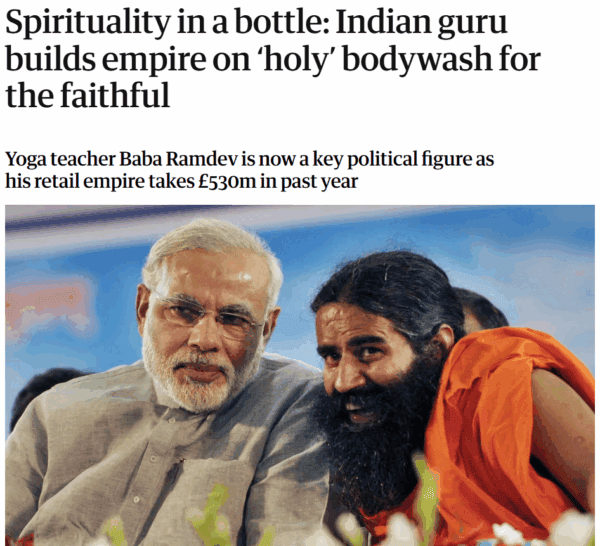
10. The Guardian on Baba Ramdev (10 April 2016)
A Guardian article addressed the controversies around Baba Ramdev, branding his rise as riding on “bottled mysticism” and associating him with deception and financial exploitation. The feature critiques faith-based healing and presents Hindu religiosity as fundamentally regressive.
Hindu Civilizational Perspective
From the Hindu civilizational point of view, these recurring narratives in global media demonstrate a pattern of selective reporting, misrepresentation, and, frequently, a lack of cultural understanding or sensitivity. Instead of exploring the depth, diversity, and intent behind Hindu practices, the focus remains disproportionately on outlier incidents, ritualistic visuals, or controversies. This systematically undermines public perception of Hindu saints and their positive community influence, spiritual legacy, and social work.
Key Observations
- Cultural Superiority: Many media reports are laden with implicit Western cultural superiority, treating Hindu customs as backward or in need of reform, ignoring the profound spiritual philosophies at their core.
- Sensationalism Over Substance: Focus on intoxicant use and miracles distracts from the central tenets of Hindu faith, such as self-realization and social harmony.
- Impact on Hindu Identity: Such persistent negative portrayals contribute to global Hinduphobia, risk violence or discrimination against Hindus abroad, and weaken Hindu self-confidence and civilizational continuity.
Conclusion
The protection of Hindus and Hindu culture requires not only inward reform and spiritual renewal but also vigilant advocacy at the level of international perception. Honest, context-rich, and respectful engagement—both with global audiences and international media—should be emphasized, holding media organizations to higher standards of fairness and accuracy when representing one of the world’s oldest and most inclusive spiritual traditions.
