


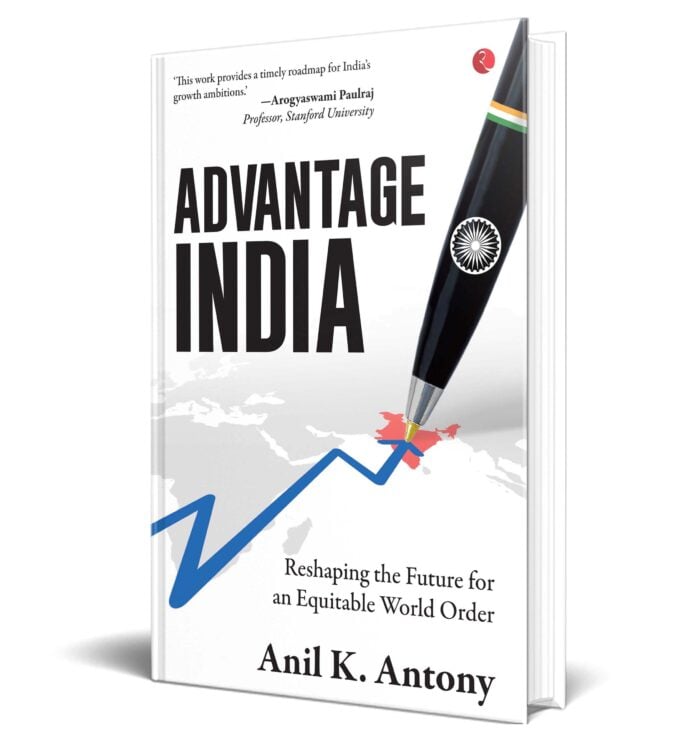
Anil K. Antony’s optimistic vision of technology, national capability and India’s place in a multipolar world
India’s emergence as a consequential global power has generated an expanding body of literature seeking to explain not only the country’s remarkable transformation but also the possibilities and challenges that lie ahead. Advantage India by Anil K. Antony enters this conversation with an ambitious and fundamentally optimistic proposition: India possesses the institutional, technological, demographic and civilisational foundations necessary to emerge as a major global power by 2047. Rather than presenting India’s rise as the product of isolated economic reforms or temporary geopolitical circumstances, Antony attempts to understand it as the cumulative result of national capability built across multiple domains.
The author brings an unusual combination of experiences to the book. His background in technology and Silicon Valley, combined with his engagement with public policy and Indian politics, gives the work a distinctive technology-and-governance perspective. This enables Antony to move comfortably between subjects such as artificial intelligence, semiconductors and digital infrastructure on the one hand, and diplomacy, defence, democracy and global governance on the other. The result is not simply an account of India’s economic growth but a forward-looking examination of what the country must build if its present momentum is to become enduring global influence.
The book is broadly divided into two sections: “The India Story” and “India and the World.” The first examines the domestic foundations of India’s rise, covering economic development, semiconductors, artificial intelligence, digital public infrastructure, defence, space, the green transition, education, women and youth. The second expands the argument into the international arena, exploring multipolarity, foreign policy and the restructuring of global governance. This structure is one of the book’s strengths because it makes a compelling connection between domestic capability and international influence. Antony’s underlying argument is that a country cannot exercise sustained geopolitical power without first developing the economic, technological, institutional and human capacities that support it.
One of the most important themes in Advantage India is technology. Antony argues that India must move beyond its traditional position as a participant in global technology and manufacturing networks and develop the capacity to become a technological leader in its own right. The discussion of semiconductors is particularly significant. Domestic semiconductor manufacturing, in his view, is not merely an industrial policy objective but a matter of strategic autonomy, investment, research and skilled employment.
The same philosophy is visible in the book’s treatment of India’s digital public infrastructure. Antony presents India’s digital transformation as an example of how technological systems can be deployed to deliver public services at enormous scale. This reflects a broader idea running throughout the book: technology acquires strategic value when it becomes embedded within institutions and improves the capacity of the state and economy.
Education and human capital form another essential pillar of Antony’s argument. He sees the National Education Policy as an effort to move Indian education away from excessive dependence on memorisation towards creativity, flexibility and critical thinking. But the demographic dividend, he argues, cannot be taken for granted. India’s young population will become an economic advantage only when accompanied by employable skills, quality education and greater participation of women in the workforce.
The book also makes a strong case for strategic self-reliance in national security. Antony argues that India must develop the ability not merely to react to security threats but to anticipate emerging challenges. Domestic defence production is therefore presented alongside international partnerships rather than in opposition to them. Space exploration, climate policy and emerging strategic domains are similarly viewed as areas in which India can combine national development with greater international influence.
Perhaps more distinctive is Antony’s attempt to connect India’s contemporary geopolitical ambitions with its older civilisational traditions. He refers to institutions such as the Vajji Confederacy and Buddhist assemblies to demonstrate that deliberative traditions existed in India long before the modern democratic state. He also presents pluralism as a source of strategic strength. In this interpretation, India’s ability to accommodate different traditions and identities is not merely a domestic characteristic; it can also inform how the country engages with an increasingly diverse international system.
The geopolitical section is where the book’s larger ambition becomes most evident. Antony argues that the international system is moving towards genuine multipolarity and that institutions established after the Second World War no longer adequately reflect contemporary economic and political realities. India, therefore, should not limit itself to seeking a larger seat at the existing table. It should participate in reshaping the table itself, particularly by advocating greater representation for emerging economies and the Global South.
His approach to foreign policy is correspondingly pragmatic. Rather than advocating permanent alignment with any particular bloc, Antony favours strategic flexibility and issue-based partnerships. India can deepen its relationships with the United States, Europe and Japan while maintaining important ties with Russia and strengthening its role across the Global South. Such flexibility reflects the realities of a multipolar world in which national interests increasingly require multiple and overlapping partnerships.
Yet the book’s optimism is also its principal limitation. Advantage India concentrates more heavily on opportunities, possibilities and policy choices than on the contradictions and structural difficulties accompanying India’s development. The challenges of raising per-capita income, improving productivity and ensuring that the demographic dividend does not become a missed opportunity are acknowledged, but the overall tone remains firmly affirmative.
Nevertheless, this does not diminish the book’s central achievement. Antony succeeds in bringing together subjects that are too often discussed separately—technology, education, demographics, defence, democracy, diplomacy and civilisational identity, and presenting them as interconnected components of national power. His central insight is that India’s future influence cannot rest on economic size alone. It will depend on the combined strength of institutions, technology, human capital, security preparedness and diplomatic credibility.
Ultimately, Advantage India is best understood as a strategic blueprint rather than a detached critique of contemporary India. It asks readers to look beyond the immediate headlines and consider what kind of capabilities India must develop before 2047. Its accessible style and broad thematic scope make it particularly relevant to policymakers, students of geopolitics, public-policy researchers and readers interested in India’s changing position in the world.
Anil K. Antony’s book is therefore a timely contribution to the debate over India’s future. Its message is clear: India’s rise should not be measured merely by economic growth or geopolitical visibility, but by its ability to convert its demographic strength, technological ambition, institutional resilience and civilisational confidence into durable national capability. Whether that vision is fully realised by 2047 will depend on choices yet to be made. But Advantage India provides a coherent and optimistic framework through which those choices can be examined.
