


Introduction:
The Government of India deeply values the lifelong dedication and unique insights of its retiring and retired officials.
On the directions of the Hon’ble Prime Minister of India, DoPPW had launched an online platform entitled ‘Anubhav’ in March 2015 for sharing experiences of retiring government employees while working with the Government.
Prime Minister Shri Narendra Modi launched The Anubhav Award initiative to serve as a national platform where veteran officers can document their journey, from administrative breakthroughs to lessons learnt in the field.

By recognizing these valuable contributions, the scheme not only rewards individual excellence but also builds a rich historical record that will guide and inspire the next generation of civil servants.
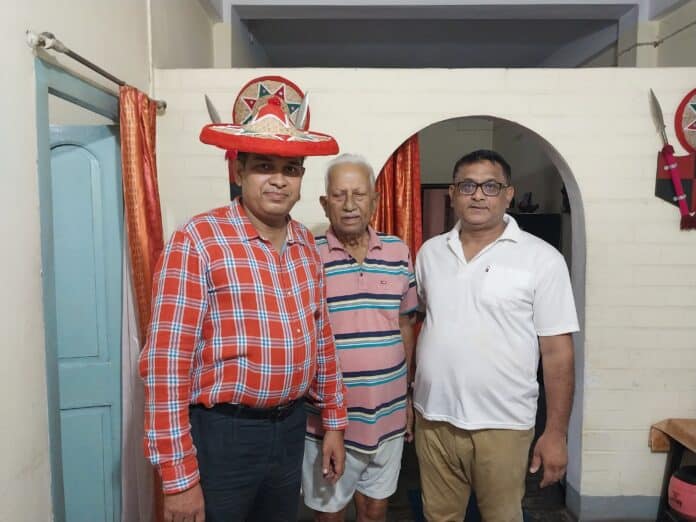
It is a moment of pride for North East India as Shri Mihir Bhattacharjee is the only person from this region to be selected for this prestigious award for the 2026 edition.
Background Brief :
Shri Mihir Bhattacharjee served in BSF as a Cryptographic Expert and in his illustrious career he was posted in various BSF Command Centers.
Post retirement, he has been actively involved as a Vikshit Bharat Ambassador. He was among the Final Winners of NAMO APPS 8 YEARS OF SEVA MODULE and presently he is regarded as one of North East India’s most active Namo App members or Star Sevaks.
Furthermore, he was chosen as a recipient of PM Modiji’s “Modi @20”(Dreams meet Delivery) book in appreciation of his work on the social welfare domain.
Champions like Shri Mihir Bhattarcharjee can contribute immensely to North East India’s Growth Story. Gathering practical insights from veterans like him, the government can further improve the administrative mechanism and create a transparent good governance system, particularly in the sensitive North Eastern region.
As a staunch Rastrabadi/ Nationalist, people from armed forces background like Mihir Bhattacharjee should be tapped and their vast experience put to good use by the government, thereby instilling values like discipline, selfless sacrifice, and national pride that veterans carry back into civilian society.
Belonia – My Hometown, Dreams & Aspirations……..
Introduction:
Belonia is my hometown and a place that nourished me in my childhood and I owe a lot to this town and its people. Located in South Tripura, Belonia is the headquarters of South Tripura District. It is linked with Agartala (the state capital) by National Highway 108A from Belonia to Jolaibari and via National Highway 8 from Jolaibari to Agartala. Belonia lies on the border with Bangladesh.
Belonia – Five Years from Now:
Tripura is all of 10,490 square km out of which 6292 square km, either 59.98% is covered by forest. The two major forest types are evergreen forest and moist deciduous forest. It isn’t surprising that much of Tripura is blessed with a clean natural environment largely due to the dense forest cover, which makes it ideal for bamboo-based eco-tourism options like tree house recreation, tribal tourism, village immersion tours, etc.
I am yet to see a region in India, which is so rich in bamboo cultivation as Tripura. What is more, bamboo is the most essential non-timber forest produce that tribal people rely upon and it plays a vital role in the socio-economic upliftment of the rural populace. In fact, bamboo touches every aspect of the lives of the people of Tripura by way of providing shelter, furniture and a bewildering array of art objects in the form of home decor, thereby providing livelihood to a large chunk of the rural poor.
The whole world is chasing sustainability and Tripura is an ideal region to launch the Tree House Tourism initiative which is gradually taking center stage in states like Kerala, Rajasthan and Maharashtra. Blessed with bamboo forests and exotic tribal culture, Tree House recreation could revolutionize Tripura’s tourism industry.
My expert comments on developing Tripura Tourism are available on Meer.com – one of the world’s finest online lifestyle and culture portals.
Tripura’s bamboo and tribal tourism – A Journey Back in Time.
https://www.meer.com/en/64251-tripuras-bamboo-and-tribal-tourism
“I have travelled the length and breadth of the Indian subcontinent and have first-hand experience of how states like Kerala and Rajasthan are implementing this rather novel, eco-friendly and green initiative and I have no hesitation in asserting that the state of Tripura is perfectly suitable for launching Nature based Eco-Tourism. The geography, landscape and the bewildering array of tribes that inhabit this magnificent state could be the ideal launching pad for Eco-Tourism”.
Key Developmental Initiatives for Belonia:
Ø Trishna Wildlife Sanctuary to be developed as one of the premier wildlife tourism destination of Tripura with active co-operation of organizations like WWF, UNESCO and Wildlife Trust of India with the overall aim to introduce better wildlife practices and biodiversity conservation of avian species, deer, hoolock gibbon, golden langur, capped langur, pheasant and many other reptiles.
Ø Accelerated development of Tourism Circuits surrounding Pilak Pathar, Yogmaya Temple, Raj Rajeswari Temple, Muhurichar River Island and the Bharat-Bangladesh Maitri Uddyan.
My expert opinion on Meer.com related to positioning Tripura as India’s most preferred Sustainable Village Tourism destination –
https://www.meer.com/en/64251-tripuras-bamboo-and-tribal-tourism
The days of hotel, sightseeing and back to the hotel are gone. These days’ tourists demand real experiences during his/her holidays. The demand is for pleasant surroundings, usually at reasonable rates which Tripura does have in abundance.
The essential ingredient of this new kind of tourism package is the organization of recreation which alone can enrich the tourism experience by allowing greater integration with the place visited and fuller involvement in the social and cultural life of the rural destination.
According to Mihir Bhattacharjee:
“The tourists on their arrival to the village are allowed to fish in the pond at a very concessional rate. The gardens are open for the tourists so that they can “pay, eat and pluck” the vegetables and fruits. When this system is fully evolved, the middle man who gets a major share of the income finds no place and the market is brought close to the village”.
The local government (Municipality) first needs to identify a bunch of bamboo villages for accelerated tourism development. The pivotal idea is to construct tree houses made of straw and bamboo alongside the water bodies so as to provide shelter to the tourists. Unique tribal folk songs and traditions can be showcased on the central podium of the village. For the diehard fishing and angling enthusiasts, leisurely boat rides on the water bodies may be encouraged and permission may be granted for fishing in the waters, which will come at a price. Fishing equipment may be rented out to the tourists as well to heighten the touristy experience.
It has to be borne in mind that the village tourism which would be developed will not at all be a simulated one. The configuration of the village which has the set-up according to the caste and class would be explicitly exhibited. The city residents who have not seen the authentic village life would get a glimpse of the village life without paying the charges which the travel agents sell.
Even a decade back, tree houses used to be kid stuff, but not anymore as more adults are building houses in trees to get high. The joy of being tucked up in a remote arboreal hideaway is the stuff that dreams are made of and they have even been the subjects of best-selling books and popular exhibitions.
Hopefully, Tripura will metamorphose into one of India’s idyllic Tree House Tourism hub.
The One-India Concept:
Armed Forces have been a symbol of unity through turbulent times faced by the country and have fostered the spirit of One-India, like no other organ of the state. Be it the sectarian clashes, terrorism or insurgency, the Armed Forces in particular have maintained their ethos; an ethos that has proved to be a strong fabric for National Integration.
People from armed forces background continue to play a critical role in nation building. This onerous responsibility has been undertaken with utmost responsibility and maturity.
Not only have many areas been rid of violence and fear of terrorism, succour has also been provided by undertaking extensive public support programmes like Operation Sadbhavana and Operation Samaritan. From building of roads, schools, public health facilities, vocational facilities, sporting facilities and provisioning essential supplies, they have been at the forefront of nation building in these troubled areas.
Wrapping Up:
To conclude I would once again like to re-emphasise the beliefs of Field Marshal Cariappa, that “the Armed forces has always in the past and also in the future will continue to play a pivotal role in the Nation Building.
The military virtues of sacrifice, loyalty and discipline have always remained and must serve as objects of veneration for the rest of the nation.”
India being a Nation with a young demographic profile and an increasingly aware and aspirational young population, it is pertinent to assimilate the huge repository and wealth of experience which armed forces personnels possess.
