


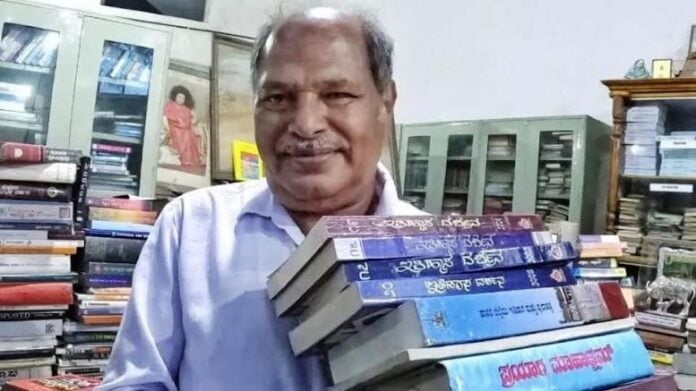
In a world where recognition often follows wealth, fame, or power, the story of Anke Gowda, a Padma awardee of 2026, stands apart as a quiet yet extraordinary testament to passion, sacrifice, and the transformative power of knowledge. From humble beginnings in rural Karnataka to becoming the founder of one of Bharat’s largest free-access libraries, Anke Gowda’s life is a remarkable journey of dedication to literacy and learning.
Who is Anke Gowda?
Anke Gowda, born in a farming family in Karnataka’s Mandya district, grew up in an environment where books were scarce and reading was not a common habit. Yet, even in such circumstances, he developed a deep curiosity for knowledge. His turning point came during his college years, when a teacher inspired him to cultivate reading as a lifelong habit. That spark of inspiration would go on to shape the rest of his life.
Anke Gowda’s early career was far from glamorous. He worked as a bus conductor and later as a timekeeper at a sugar factory. Despite modest earnings, he made a life-altering decision: to spend a large portion of his income on books. In fact, reports suggest that he devoted nearly 80% of his savings, salary, and pension to collecting books. What may have seemed like an unusual obsession to others gradually evolved into a monumental vision—to create a space where knowledge would be freely accessible to all.
Encouraging reading
Over five decades, this vision materialized into Pustaka Mane (House of Books), a massive personal library located in Pandavapura taluk of Mandya district. Today, this library houses over two million books and magazines in more than 20 languages, including rare manuscripts, research journals, dictionaries, and historical texts. It is widely regarded as one of the largest free-access personal libraries in Bharat, and possibly the world.
What makes Anke Gowda’s achievement even more remarkable is that he built this vast repository without institutional funding or government support. Every book, every shelf, and every corner of the library is a result of his personal sacrifice. He even sold his own property at one point to purchase more books, underscoring his unwavering commitment to his mission.
Unlike many private collections, Pustaka Mane is not a closed or exclusive space. It is open to everyone—students, researchers, civil service aspirants, and even scholars from across the country. For many, it has become a sanctuary of learning, especially in a rural setting where access to such resources is limited. Gowda himself lives within the library, continuing to manage and expand it despite financial constraints.
In 2026, the Bharatiya Government recognized his lifelong contribution by awarding him the Padma Shri, one of the nation’s highest civilian honours, under the category of Unsung Heroes. This recognition was not merely for the size of his library, but for the values it represents —selflessness, dedication, and the democratization of knowledge.
Anke Gowda’s story is not just about books; it is about vision. At a time when digital distractions dominate, he chose to preserve and promote the culture of reading. His library contains works on diverse subjects, from religion and philosophy to science, literature, and global history, reflecting his belief that knowledge should be inclusive and universal.
However, his journey has not been without challenges. The sheer scale of the collection has created issues of space and preservation. Reports indicate that a significant portion of the books is stored in less-than-ideal conditions due to lack of infrastructure. Yet, even in the face of such difficulties, Gowda continues his work with humility and determination, driven by a single goal: to ensure that knowledge remains accessible to future generations.
Anke Gowda’s life offers a powerful lesson in purpose-driven living. He did not seek fame, wealth, or recognition. Instead, he chose a path of quiet service, investing his life in books so that others could learn, grow, and dream. His story reminds us that true impact does not always come from grand gestures; sometimes, it comes from consistent, selfless effort over time. His House of Books is more than a library. It is a symbol of hope, a beacon of learning, and above all, a reminder that the pursuit of knowledge can change the world—one book at a time.
(Featured Image Source: Deccan Herald)
