


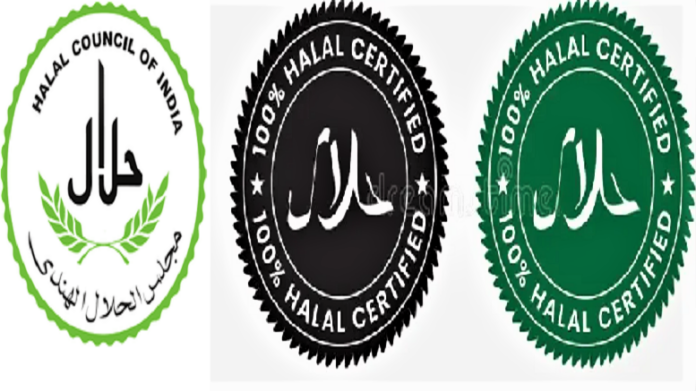
On Monday, 21 January, the Uttar Pradesh (UP) government in the Supreme Court exposed the halal certification process saying that several other products other than meat were also labelled as ‘halal certified’, requiring the products to meet the specifications of the Islamic Law. Solicitor General Tushar Mehta while representing the Uttar Pradesh state government in the Supreme Court stated that the state was shocked to see products other than meat like cement, iron rods, water bottles, etc., requiring halal certification.
Background of the case: UP banned Halal-certified food items, filed an FIR against companies selling Halal goods
Food Security and Drug Administration of UP govt had in Nov 2023 banned the “manufacture, sale, storage and distribution of halal-certified products with immediate effect”. “In compliance with Section 30(2)(d) of the Food Safety and Standards Act, in the exercise of the authority vested in Section 30(2)(a) of the said Act, given public health, food with Halal certification is being banned within the limits of Uttar Pradesh”, the notification said.
The Uttar Pradesh police registered FIRs against several companies selling ‘Halal-certified’ products using forged documents. The companies booked were Halal India Private Limited (Chennai), Jamiat Ulama-i-Hind Halal Trust (Delhi), Halal Council of India (Mumbai), and Jamiat Ulema (Mumbai). These companies sold products such as bathing soaps, spices, snacks, dairy, and garments with fake Halal certifications. Lucknow Police booked the accused under sections 120b/153a/298, 384, 420, 467, 468, 471, and 505 of IPC.
Notably, the two pleas were filed by Halal India Private Limited and Jamiat Ulama-i-Hind Halal Trust Maharashtra against the state seeking quashing of notification wherein the manufacture, sale, storage, and distribution of halal-certified products were banned in UP. The Supreme Court (SC) in January 2024 then granted protection from any coercive action against Jamiat Ulama-i-Hind Halal Trust chief Mahmood Madani and other office-bearers. A bench of Justices BR Gavai and Sandeep Mehta ordered no coercive action by UP police against Madani and others.
UP govt in its affidavit said the ‘halal’ certification of food products acts as a parallel system that creates confusion regarding the quality and is completely against the basic intention of the Food Safety and Standards Act. The court later posted the hearing to March 25.
Arguments raised by Solicitor General Tushar Mehta defending the ban on Halal products
The solicitor general submitted that the issue has to be adjudicated by the apex court while highlighting that the price of products increases due to halal certification and it affects consumers. The court was hearing a plea challenging UP government notification. During his arguments, the Solicitor General put forth certain notable arguments in front of the apex Court to defend the decision of the UP government.
1. Halal certification lobby forcefully increases product prices
The court was hearing petitions challenging the ban imposed by UP on halal-certified products within the state. “So far as Halal meat etc. is concerned, nobody can have any objection… even cement used is to be halal-certified. Sariyas (iron bars) used have to be halal-certified. Water bottles are required to be halal-certified. Even atta (wheat flour) and besan (chickpea flour) have to be halal-certified. How can besan be halal or non-halal?” Solicitor General Tushar Mehta added that the agencies imposing halal certification labels were earning crores by requiring even products other than meat to have halal certificates.
The state further informed the bench of Justices B R Gavai and A G Masih that halal certification on meat was not objectionable but other products like cement, water bottles, etc needed no certification. Meanwhile, Senior Advocate M R Shamshad representing the petitioner stated that halal is not restricted only to non-vegetarian food and that it is elaborately mentioned in the Centre’s policy.
Mehta further stated that the halal certification on several products was driving prices and those who do not subscribe to the halal certification were being forced to pay higher prices unnecessarily.
2. Halal certification imposes Islamic religious beliefs onto others
He also pointed out religious beliefs and understanding in the case of meat saying that while Islam says meat should be halal, other religions believe that it should be jhatka. “Another concern. Suppose I am Sikh and for me, halal meat is prohibited. Halal would mean that the animal would die slowly. Other religion says that you should not. Then he will have to consume halal because it has to be halal certified. There are several issues, my lord,” Mehta added.
Responding to this, Shamshad stated that nobody was forcing the customers to buy halal-certified products and that it was not mandatory. “All are voluntary. Nobody is forcing,” he said. Following this, Mehta said that several FIRs were registered against Halal India Pvt Limited and Jamiat Ulama for violating the law and the notification issued by the government from time to time.
The dark face of Halal Economy: Islamo-fascism, terror links, and more
According to reports, most businesses have today started serving only halal meat to save the cost of maintaining two supply chains, for halal and non-halal meat. People who may not be comfortable with halal meat, or people with religions where only jhatka meat (Hindus and Sikhs) is allowed, no longer have any choice in the matter. If they are ordering meat at a restaurant, they get halal only by default.
Further, for a meat product to be halal, the animal must be slaughtered only by a Muslim. To achieve economies of scale, the meat industry ends up operating large-scale abattoirs to produce all their meat. They end up using only Muslims at these abattoirs. In such a scenario, many Hindu communities, especially some Scheduled Caste communities (Dalits), who were traditionally butchers, miss out on employment opportunities in the sector.
The darker face of the Halal Economy is that Jamiat Ulama-i-Hind is known to be a supporter of terrorists by providing legal aid in defending murderous Islamist terrorists. Jamiat Ulema-i-Hind, one of the oldest halal certifying trusts in Bharat, is constantly in the news for their legal support of the accused in terror-related cases. Even in murder cases, like in the case of Kamlesh Tiwari, bomb blasts and terror funding cases, the organisation extended legal support to the accused.
Raj Thackeray-led MNS (Maharashtra Navnirman Sena) in 2022 had launched a “Say No to Halal” campaign. The party highlighted that the halal industry is the largest terror funding mechanism. It also said Hindus have lost their revenue and livelihood to the Islamic industry.
The halal economy is not just restricted to meat products now. Pharmaceutical products, personal care products, cosmetics, and even flour, all come with halal certification. With its ever-growing scope, it is creating the grounds for restricting the job prospects in these sectors to people from only one religion. Further, this parallel system of certification runs without any checks and balances from the government.
When the government has all the existing government-specified norms, quality parameters, and regulatory requirements that companies have to meet to get their products certified fit to be marketed, there is hardly any need for such a parallel system of certification. This system also poses a systematic threat to several private companies that do not produce halal-certified products. This eventually allows the agencies producing halal-certified products to sell goods at higher prices, making their way to creating an alleged monopoly in the market.
(Featured Image Source: OpIndia)
