


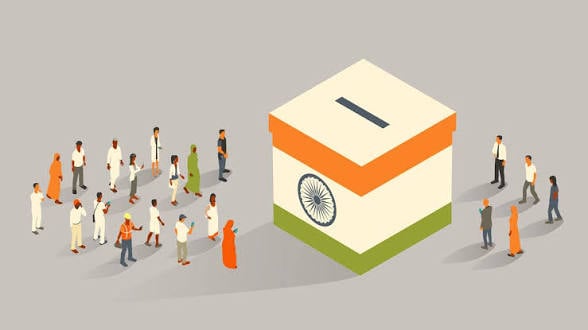
The Women’s Reservation Bill, 2023 is a constitutional amendment law that provides 33% reservation for women in India’s national and state legislatures. The Women’s Reservation Bill was first proposed in 1996, reintroduced multiple times (1998, 1999, 2003, 2008) but failed due to lack of consensus. The 2010 version passed in Rajya Sabha but lapsed. This bill was passed in both the houses of the parliament and assented by President on September 28, 2023. As per this bill within SC/ST reserved seats, 1/3 will be reserved for women. Reservation valid for 15 years, extendable by Parliament. However, the implementation of this law is linked to the next Census, followed by Delimitation of Constituencies. The Act came into force on 17th April, 2026 (notification was issued).
Constitution (131st Amendment) Bill, 2026 was introduced to Increase Lok Sabha strength (approx 543 → ~850 seats), enable fresh delimitation, Operationalise women’s reservation faster and Change population basis for representation. The Government could not get the required 2/3 rd majority for this Constitution amendment though the Opposition supported women’s reservation because they have opposed linking it with delimitation for fear of seat redistribution (North Vs South imbalance). Delimitation-related constitutional changes and Parliament/Assembly expansion framework that are part of the above Constitution amendment are also stalled in Lok Sabha. Accordingly, this Constitution (131st Amendment) Bill, 2026 was defeated in the Lok Sabha on 17th April, 2026.
Critics point out that by removing the linkage of women’s reservation to the next Census and Delimitation of the Constituencies through an amendment, the extant Women’s Reservation Act, 2023 could have become very simple and operational as on date.
One can understand the concerns of the opposition and particularly the Southern states as far as the delimitation is concerned because they apprehend losing relative share/political weight” in the Lok Sabha, though they may not “lose seats” in absolute numbers. These states have successfully controlled population growth and hence their share in the country’s population has fallen. Whereas, states like Uttar Pradesh, Bihar, Rajasthan, Madhya Pradesh have higher population growth and expected to gain more seats.
Incidentally southern states also complain that the devolution of their share in the central taxes is getting reduced though they are the top contributors to tax revenues whereas highly populous states like UP, Bihar, Madhya Pradesh corner major share in the devolution of the taxes even though their contribution to tax revenues is low. This statement is justified by the taxes received through devolution for every rupee Contributed as per the following chart.
| Top 10 states in terms of SGDP (2023-24) | Ranking in terms of population (2011 Census) | No of Lok Sabha Seats | Taxes received through devolution for every Rs.1 contributed |
| Maharashtra | 2 | 48 | ₹0.30 – ₹0.35 |
| Tamil Nadu | 7 | 39 | ₹0.40 – ₹0.45 |
| Uttar Pradesh | 1 | 80 | ₹2.0 – ₹2.5 |
| Gujarat | 10 | 26 | ₹0.40 – ₹0.45 |
| Karnataka | 9 | 28 | ₹0.35 – ₹0.40 |
| Rajasthan | 8 | 25 | ₹1.6 – ₹1.9 |
| West Bengal | 4 | 42 | ₹1.2 – ₹1.4 |
| Andhra Pradesh | 5 | 25 | ₹1.2 – ₹1.3 |
| Telangana* | 17 | ₹0.50 – ₹0.60 | |
| Madhya Pradesh | 6 | 29 | ₹1.8 – ₹2.2 |
(Ranks based on nominal GSDP at current prices. Figures in red indicate net contributing states who pay more to Union than they get back. * Telangana state was formed in 2014.)
Bihar the third largest populous state in the country (2011 Census) having 40 seats in Lok Sabha but ranks 14 in terms of SGDP. Low performing states like UP, Bihar (₹3–4 per ₹1 contributed), MP get greater allocation of funds from the Union government under devolution of the taxes, whereas high performing states like Maharashtra, Gujarat and Karnataka get very low share, despite contributing more taxes to the union government’s exchequer. Haryana ranks 17 th in terms of population (2011 Census), 13th in terms of SDGP, 5th in terms of GST contribution to the Central exchequer. Haryana also ranks No.1 in terms of GST/SDGP (%) at 8-9% whereas it just gets 0.30 per ₹1 contributed under the devolution of the tax revenues.
Though the main objective of the Finance Commission is to ensure fair and efficient distribution of financial resources between the Union (Central Government) and the States, the above-mentioned anomaly has only increased over a period of time and it is a fact that the performing states are effectively penalised and the non performing/ low performing states continue to be patronized.
There is a need for the finance commission to revise the existing complex mechanism in computing the devolution of the taxes to the states from the union government and at the same time to ensure that all the states are treated with fairness. In this regard the author suggests the following measures.
SGDP and states’ contribution of taxes to union government should be the two components that carry equal weightage (say 50% each) which should be the basis for computing the devolution of the taxes from the Union government to the states.
The states that are lagging behind to be given grants-in-aid by the union government and the amount of such grants in aid to be decided by the finance commission. The laggard states may be free to use these grants in aid in the manner that they deem fit but it should result in five specific measurable outcomes, viz., (i) improving the SGDP, (ii) reduction in the poverty, (iii) improvement in the education, (iv) reduction in unemployment and (v) population control, as per the target set by the respective Finance Commission covering a period of five years. There should be a transparent mechanism in place to compute and disclose in public domain the above five specific measurable outcomes at periodical intervals. Niti Aayog to be assigned the task of monitoring the utilisation of these grants in aid and do an impact evaluation.
The 42 nd amendment brought in 1976 led to freeze on Lok Sabha and Assembly seat allocation based on 1971 Census to protect the southern states who had taken active measures to control the population. 84th amendment brought in 2001 extended this freeze up to 2026. Delimitation can begin only after the first Census is conducted post 2026. These constitutional amendments were done to bring demographic convergence between high-fertility and low-fertility states over a period of time so that it would be sufficient to permit reapportionment of the seats without structural injustice to the early-compliant states. However, the fact remains that the demographic difference between the states has only widened during this period. Therefore, instead of complicating the things further and things become more of a political issue, it is suggested that the following sequence of action may be initiated.
Removing the linkage of women’s reservation to the next Census and Delimitation of the Constituencies through an amendment and make the extant Women’s Reservation Act, 2023 operational as on date.
Bringing a constitutional amendment to extend the freeze on Lok Sabha and Assembly seat allocation based on 1971 Census to another 20/25/30 years based on consensus of political parties.
Assigning a specific mandate to the Finance Commission under Article 280 (3) (d) to work on the goal of bridging the gaps between the states for sound financial management and that exercise to be completed successfully during the extended time period of freezing the Lok Sabha and Assembly seats mentioned in point no.2 above. Accordingly, the Finance Commission may advice the laggard states to focus on achieving the five specific measurable outcomes mentioned above during this extended tenure of freeze of Lok Sabha and Assembly seat allocation.
On completion of the first Census post 2026, introduce OBC reservation for women in Lok Sabha and Assembly seats.
The above measures will ensure in maintaining financial harmony and cooperative federalism in the country in the long run. Let us hope that wisdom will prevail on the political parties to address this trilemma of Census, Delimitation and Devolution to taxes.
