


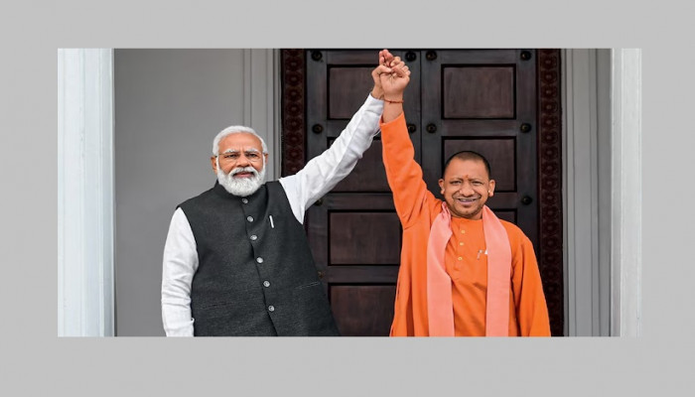
“The 2017 Landslide and the Dawn of the Yogi Adityanath Era: A Civilisational Mandate Part 25”, MyIndMakers, 15 Sep 2026.
“The Uttar Pradesh Assembly election results of March 11, 2017, produced one of the most decisive electoral verdicts in Indian state-level democracy. The Bharatiya Janata Party won 312 seats in the 403-member Vidhan Sabha, an absolute majority of extraordinary scale, with 39.67 per cent of the vote and a turnout of 61 per cent. Added to the seats won by its NDA allies, the BJP-led alliance commanded 325 seats. The SP, which entered the election in an alliance with the Congress (and with Akhilesh Yadav projecting a reformist image against his father’s association with jungle raj), fell to 54 seats from 224 in 2012. The BSP, which had entered the election with Mayawati’s claim to represent all oppressed communities, was decimated to 19 seats from 80. The Congress, which Rahul Gandhi had personally campaigned for, won 7 seats. The verdict was not merely an electoral result; it was a civilisational statement by UP’s 200 million citizens about the kind of governance they wanted and the political identity they wished to claim.
The Social Anatomy of the 2017 Mandate
Understanding the 2017 result requires disaggregating the vote to see the specific social communities that made up the BJP’s majority coalition. The Lokniti-CSDS post-poll survey and the BJP’s internal data tell a consistent story: the party achieved a degree of cross-caste Hindu consolidation not seen in UP since the Ram Janmabhoomi mobilisation of 1991, but with a social breadth that far exceeded even that historic moment.
Upper-caste Hindu Brahmins, Rajputs, Banias, Kayasthas voted for the BJP at over 72 per cent, a consolidation that reflected both the cultural nationalist identity the party offered and the specific relief that an end to SP’s jungle raj represented for communities that had been disproportionately targeted by the SP’s patronage of Yadav criminal networks. Non-Yadav OBC communities voted for the BJP at approximately 42-46 per cent, nearly double the party’s performance among these communities in 2012, reflecting the success of Amit Shah’s targeted community outreach and widespread OBC frustration at being treated as minor partners in the SP’s Yadav-dominant political economy. Non-Jatav Dalit communities Pasis, Valmikis, Koris, and dozens of other smaller SC communities voted for the BJP at approximately 28-34 per cent, representing a significant fracture in the BSP’s Dalit coalition built on communities that had experienced BSP’s Jatav-centrism without corresponding Jatav material improvement………”
Read the full article at MyIndMakers.
