


“Precedents are dangerous things.”
George Washington advocated for a steady hand in governance.
The idea of writing this article had been buzzing in my head for a while, and the recent debates on TV channels and podcasts prompted me to do some serious ‘Chintan’ to see what can be done. Recently, I watched a roundtable discussion on Jaipur Dialogues on the subject, with guests like Anand Ranganathan and other experts discussing the issue. The roundtable was a debate- just a good debate- where the matter and grey matter were going round and round, and it was concluded that there is no simple solution in sight and we need to have more debate. Debate par debate, debate par debate….
The good thing was that at least the debate has started, as the topic itself, for several decades after its implementation by V. P. Singh, had become literally ‘Untouchable’. As they say, “well begun is half done”. Thank God we have at least started talking about it. It is high time we did.
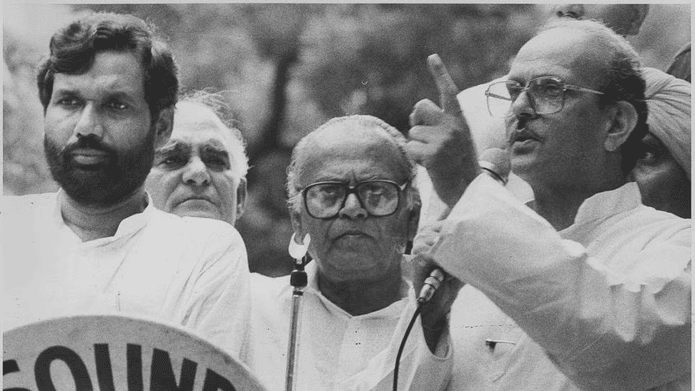
Prime Minister V. P. Singh announced implementation of the Mandal Commission recommendations on August 7, 1990, under the Janata Dal government who can be blamed squarely for getting the nation into a cliffhanger situation! The commission was originally set up on January 1, 1979, by the Janata Party government led by Prime Minister Morarji Desai, and chaired by B. P. Mandal. For almost ten years, no one touched this report. As this meant playing with fire.
V. P. Singh announced a 27% reservation in central government jobs and public sector undertakings for Other Backward Classes (OBCs), based on the commission’s report submitted in 1980. V.P. Singh did it as he faced severe internal power struggles within his fragile National Front government, particularly from Deputy Prime Minister Devi Lal and leaders like Chandra Shekhar. Implementing the report was a tactical move to check his rivals and consolidate a massive vote bank of OBCs, Scheduled Castes, and minorities. And see what we are up against today! A tactical move snowballed into a strategic national blunder. The beginning itself was laced with self-interest.
Hold your breath- 69% is the highest long-standing implemented total reservation percentage among major Bharatiya states today. Jai ho.
This can be called ‘race for reservations’.
The conference points
There is no straightforward solution to this, which was pretty obvious from the discussion. Someone also quoted Arun Shourie: the moment this was announced, Shourie said, ‘genie is out of the bottle, and no one will ever be able to put it back!’ I think he was spot on. Once you set a precedent and extend a privilege/facility, it is impossible to withdraw it. Jeffrey Benjamin stated simply, “You succumb to the precedent you set”.
The powers that be have actually let the genie out and broken the bottle, it seems. So, you keep searching for the bottle first and then look for the genie.
Now in 2026, the limits have been crossed- even though the Supreme Court of India had capped it at 50 per cent in Indra Sawhney (1992). But the politicians cared two hoots and went along, taking it from bad to worse. Each state government wants to outdo the other as it directly pumps up its vote bank. The learned panellists were clear on one account: that no political party or politician is bothered about the country. They let the genie out, and now they cannot and dare not try to put it back in the bottle.
If they cannot do it, then who will? Dr. Ranganathan put it very well ‘jo karenge woh marenge’. This is now such a dangerous situation that talking about it itself is a taboo. You speak, and you are dead- politically.
The entire nation is suffering. Merit has gone to take a walk. You have a reserved category candidate scoring -40 marks out of 800 marks getting admission in a medical college, but a deserving, hard-working general category candidate can’t get it at 90 per cent! Is this not discrimination? Yes, it is. To help the ones who were under-privileged for centuries, you are persecuting the present youth now.
And this cannot be going on for centuries; it needs to be re-examined and modified in a pragmatic way. If it is ‘sabka saath aur sabka vikas’, then let it be for everyone. You need to provide a level playing field, but not for eternity. The panellists went into a lot of history, but that does not solve today’s problem. You cannot and should not take the entire nation on a round-robin guilt trip! And a meritorious student doesn’t care for guilt- and why should he- because he never did what his ancestors did centuries ago. You cannot make the next generations pay for what their forefathers did. You can’t be hanged because your great-grandfather murdered someone a hundred years ago.
We are talking about the future of the nation and 1.5 billion people and not a golf tournament where the primary purpose of a golf handicap is to level the playing field!
What can be done?
The panellists looked helpless and rightly so. Going back into a historical loop will not solve the problem, and everyone knows the history as much as it matters. Someone suggested that it is like a boiling potato that no politician can take in his mouth because, if he does, he will not be able to eat anything for the rest of his life. Bang on. So, the solution is that a common man – general category will have to shove that hot potato into the mouth of policymakers who send their kids to study abroad. So much so that they go abroad for medical treatment- let them go to a doctor for treatment who got admission with minus forty marks!
Make it mandatory to put a certificate along with the MBBS degree reflecting the cut-off you got for admission on the wall of the clinic displaying your credentials and degrees.
The worst is that this has created another problem- a ‘backward race ‘- worse than the nuclear race. Each one is trying to prove that he/she is more backward than others.
The solution
There is no single magic “silver bullet” to resolve Bharat’s reservation issue, because the policy sits at the intersection of two competing constitutional imperatives: substantive social justice (correcting centuries of systemic caste exclusion) and formal equality of opportunity (rewarding individual merit and addressing economic deprivation). A multipronged strategy to rein in the genie is therefore required.
Because government jobs and elite university seats are scarce—accounting for a tiny fraction of Bharat’s total workforce—quotas often act as a battleground for broader economic anxiety. Policy experts, economists, and legal scholars generally point to multi-pronged structural reform rather than outright abolition or unchecked expansion.
Currently, reservation policies are rarely audited for outcomes once implemented. Establishing an independent, non-partisan Equal Opportunity Commission to conduct periodic socio-economic surveys would allow the state to objectively measure representation, exit groups that have achieved parity, and recalibrate policies based on empirical evidence rather than electoral politics. It should be like SIR, special intensive revision.
A Politician says, ‘tum mujhe vote do main tumhe reservation doonga’. Where can this lead us to?
As far as discrimination is concerned, it runs both ways. Part III of the Constitution covers Fundamental Rights, with the Right to Equality specifically detailed across Articles 14 to 18. Beyond Part III, the Preamble also explicitly commits to securing “Equality of status and of opportunity” for all citizens.
This is a catch-22 situation: “damned if you do, damned if you don’t”.
First, decide who needs it. Conduct a rigorous caste census to align quotas with updated demographic realities.
Some very radical and economically impractical ideas are also suggested, such as making military training mandatory. People also suggest increasing seats in colleges by the percentage you want to cater to reservation. This is also very expensive, with annual recurring expenses.
A Composite Disadvantage Scoring: This can streamline the system and optimise the solution. Awarding structured grace points based on a combination of caste, family income, rural/district backwardness, gender, and quality of schooling rather than a rigid binary cutoff.
If you want to simplify it, a one-size-fits-all formula can be learned from playing cards. You are given a trump card (Aka Joker) only once, which is a one-time grant for a family to come out of a ‘situation’. Especially in job reservations. For instance, if you play your trump card, join the elite IAS, then thereafter ‘you’ need to ensure that the rest of your family is uplifted, and it is already being done by many.
Yet a person keeps getting several trump cards, generation after generation, in the present state of affairs. This is discriminating against the general class. This way, a person will use his trump card prudently and ensure he does his best in order to uplift his own family. You, in a way, are ‘rationing’ reservations. You are not stopping but streamlining. The policymakers must be supported by courts. Courts don’t have to win elections like political parties and can act rationally.
Limiting quota benefits to one or two generations within a family prevents intergenerational hoarding of reserved seats while preserving upward mobility for first-generation learners.
This can be compared to ‘free rations’, which are given per person and not on a whim.
This is either for university admission or for an initial job entry, but not for promotions. This prevents a compounding advantage within specific families and opens up opportunities for first-generation learners and job seekers. Gradually phase out caste filters in favour of strict economic criteria.
If anyone is thinking, and many are,-especially politicians- who want to come to power at whatever cost to our progress, of extending reservations to the private sector, which is at the core of our progress and economy, it will be a death knell delivered to the entire 1.5 billion people.
If Bharat has to clock higher GDP and become the number one economy, which is largely due to our demographic dividend, you cannot create an ‘artificial demographic disaster’ with recurring reservation. Indirectly, you are creating an inefficient system that will pull you down- we do not have the luxury of time or remaining young forever as a nation. You need to give credit to merit-based selection and promotion.
It will take time, and the government is on a tightrope walk. You have to remain in power to do any good, and for that the nation, especially the general category, may have to suffer for some more time, – ‘give their today for someone’s tomorrow’.
“Infinite-minded leaders don’t ask their people to fixate on finite goals; they ask their people to help them figure out a way to advance toward a more infinite vision of the future that benefits everyone.”
- -Simon Sinek
