


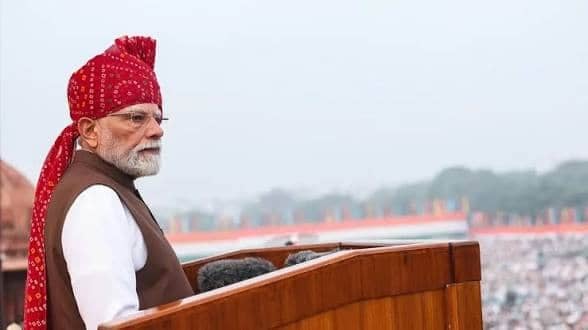
On every Republic Day and the Independence Day of the nation, the President of India addresses the nation on the eve of the most important two days of the Republic. However, in regard to the Independence Day, the whole focus of the nation remains on the address of the Prime Minister from the ramparts of the Lal Qila in Delhi. Prime Minister Narendra Modi addressed the nation consecutively for the 13th time from the ramparts of the Lal Qila on the Independence Day this year. Keeping in view the current socio-political scenario and the background of the parliament’s stormy monsoon session that ended two days earlier to the Independence Day, the address received great attention this time from all quarters.
Besides the usual references to the advance march of the nation, the security related issues and the welfare measures of the government (both currently in vogue and those to be taken up in future) the Prime Minister in his speech referred to the finish of the armed Naxalite movement in the country for which 31st March 2026 was the deadline fixed by the government. In connection with the successful annihilation of the violent Naxalism, PM Modi made a very pointed reference to those who still keep on harnessing Naxalism in their thoughts and continue to pursue the divisive theory in the society.
He categorized them as the ‘Dimagi-Naxals’. He warned the country against these Dimagi Naxals (intellectual or mental Naxals), stating that while armed Naxalism has been largely eradicated from the forests, its hidden ideological backers and mindset particularly in urban areas still pose a threat by trying to create societal unrest. These people continue to operate within intellectual spaces, media and power corridors and leave no opportunity to influence people to keep on making efforts to stage anarchy on streets and in the important institutions of the country. PM Modi urged the public to identify and isolate these ideological elements to keep the youth aligned with national development, its civilizational ethos and the mainstream.
In order to add their bit, the Congress leaders Mallikarjun Kharke, President of Congress Party and the leader of opposition in the Rajya Sabha, Rahul Gandhi, LoP in Lok Sabha and Sonia Gandhi, Chairperson of Congress Legislature party in parliament didn’t attend the main function of the Independence Day at Delhi. They virtually ‘boycotted’ the most important national function echoing their conduct in the recently held monsoon session of the parliament which created a very bad taste on an occasion of national prestige and honour.
On the same day, all these three leaders of the Congress party were seen attending a programme at the Congress headquarters in New Delhi wherein they were seen objecting to the recitation of full national song -Vande-Mataram! This further added to the already existing distaste in this connection. The whole nation witnessed how the Congress top leadership in presence of their workers at their main office insulted the national song. This is indeed the lowest level of position that the Congress stooped to publicly in regard to Vande-Mataram that has been accorded the status of national song by the Indian constitution.
In the recently held monsoon session of the parliament, Prevention of Insults to National Honour (Amendment) Bill 2026 was duly passed by the Rajya Sabha and the Lok Sabha. The legislation amends the 1971 Act to place the national song -Vande-Mataram, on par with the National anthem, making intentional interruptions or insults a punishable criminal offense. Intentionally preventing the singing of the song or disturbing an assembly reciting it carries up to three years in prison, a fine or both. Any second or subsequent conviction mandates a minimum jail term of one year.
The government of the day in recognition of the people’s wishes, sentiments and the pent-up feelings for a long time, took this step to honour the national heritage and provide legal sanctity to the complete song as was written by its author Bankim Chandra Chatterji during its 150th anniversary milestone. The aspirations in this regard were expressed by the people immediately after passing the Bill and particularly during the Tiranga Yatra conducted on the sacred occasion of this year’s Independence Day.
What Congress leadership did, unfortunately, reflects the mindset that the Prime Minister in his address to the nation referred to when he talked about the Dimagi-Naxals active in the country. A number of politicians, the so-called intellectuals, activists and anti-Modi elements came out declaring that they are ‘proud of being Dimagi-Naxals’. These elements included P. Chidambaram, Arvind Kejriwal, Mehbooba Mufti, Renuka Chaudhary and others of their ilks. Though the Union Minister Kiran Rejiju clarified that the label wasn’t meant for the general political rivals, but for those who reject the constitution or back separatism and support anarchy and violence in this regard. All the above mentioned characters fit in the definition as recommended by both the Prime Minister and the Union Minister. Here it will be important to go to some facts of history in this connection.
Naxalism in its violent form began in India around 1967 during the peasant uprising in Naxalbari-Darjeeling, West Bengal. It followed the Maoist revolutionary ideology and was led by Charu Majumdar and Kanu Sanyal. Naxalism expanded through violent land seizures, guerilla type attacks on the state forces and preaching pseudo-socialism. They later joined with the Communist Party of India (Maoist) and formed a number of splinter groups to pursue their agenda of armed activity against the landlords and the state of India.
The leaders of this extreme-left oriented ideology argued that the socio-economic change required armed revolution and encouraged the extremist ideas in remote villages and tribal areas in a number of states. Though police and paramilitary deployments and actions suppressed the expansion of the revolt, however, it emerged as a major security threat internally. They grew support from some key urban intellectuals and other politically connected activists and leaders and emerged as a real threat in states like Bihar, Chattisgarh, Jharkhand, Orissa and parts of Telangana.
The high intensity violence unleashed by these Naxal-terrorists peaked around the year 2010 with nearly 2,000 violent incidents and hundreds of security and civilian deaths recorded in that single year. The active and passive support by the Urban-Naxals to this violence and the extremists involved in this carnage created a number of problems on ground for the State. On the one hand, the coordinated counter-insurgency measures, effective and aggressive camp setups by the security forces, road building and intelligence tracking reduced major rebel strongholds and on the other hand, the Urban-Naxals put all efforts to protect them legally, politically and by building a false narrative in their favour.
On 25th May 2013, the Maoist insurgents in a deadly attack ambushed a full convoy of Congress leaders and workers in Jiram Ghati-Bastar region in Chhattisgarh. The ambush killed around 30 people, virtually wiping out the entire top leadership of the state Congress party. The dead included among others VC Shukla, Nand Kumar Patel, Mahendra Karma and Uday Mudliyar. The government of India in an affidavit to the SC during the UPA rule in November 2013 said that “academicians and activists in urban centres had come to control ‘mass organisations’ organically linked to Maoists under the cover of human rights indicating how governments irrespective of political cover have seen ‘urban-naxals’ as a threat” and noted “that these cadres are in many ways more dangerous than the cadres of the People’s Liberation Guerrilla Army (PLGA)”.
Sushil Kumar Shinde (UPA) led Home ministry in 2013 had clearly said ‘how urban-naxal warfare was part of a strategy of CPI (Maoist) to mobilise opinion through bodies tied to the party structure but which maintained a separate identity to avoid legal liability’. It is very unfortunate that P. Chidambaram, Renuka Chaudhary of the same Congress party and others are taking pride in being ‘Dimagi Naxals’ about which their own government had in the Supreme Court declared the intent and the strategy of these anti-social and anti-national elements.
Salwa Judum was introduced as a state-sponsored vigilante movement against the Naxalites in some states in rural India. It was like a counter-insurgency operative in the hands of the local people that had gained bipartisan support from the ruling as well as the opposition parties. Unfortunately, on the petition filed by one Nandini Sundar, a sympathiser of the Naxals in the Apex Court, Justice B. Sudershan Reddy and Justice S.S.Najjar disbanded the Salwa Judum to the detriment of the anti-Naxal operations initiated by the then government. It was the same Justice Reddy who was later, after his retirement, sponsored by the Congress party and the other opposition parties as a candidate for the President’s post. This invariably is a fit case of Dimagi-Naxal that was referred to by the Prime Minister in his speech.
The BJP led NDA government immediately after assuming office in 2014 took very serious note of the activities of the Naxals and the Urban-Naxals both. Time specific plans were made to eradicate the Naxal groups. Time-scale strategy and planning was devised to organise large-scale surrenders of these extremists; and security pressure reduced their active zone significantly by the year 2026, marking a sharp decline in their geographic spread and active armed conflicts. As a travesity of justice in this regard, there are still many forces which continue to pursue the Naxal agenda in one or the other form. The expression of Dimagi-Naxals used by PM Modi has surely unmasked these elements and forced them to get exposed before the nation. It is just the beginning in this regard, more to follow in very near future.
