


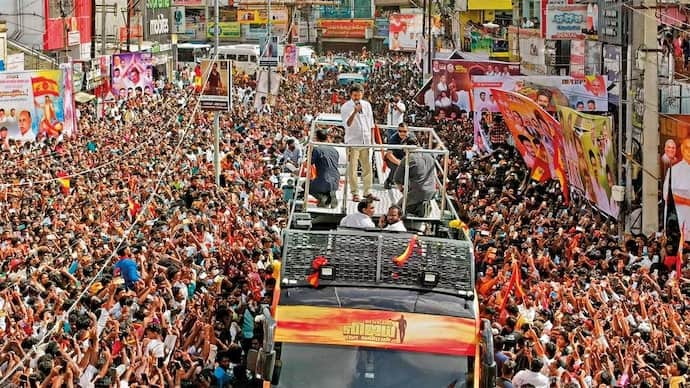
From Stampede to Sympathy, and Now to Structural Consolidation Tamil Nadu Enters a Dangerous New Phase of Leader-Centric Politics
The Karur crowd crush of September 2025 should have been a political funeral. Forty-one people died including a two-year-old child, young couples, entire families standing together in hope crushed in three successive waves at a TVK rally where the FIR explicitly named party office-bearers for reckless over-mobilisation. In any functioning democracy, this would have triggered political exile, if not criminal consequences, for the leader whose rally turned deadly. But instead, Vijay returned to the campaign trail in weeks, rebranded himself as the victim of a DMK conspiracy, and was promptly reinforced by one of the most seasoned organisation men in Dravidian politics. That trajectory from culpability to consolidation is the real story of late 2025.
The Psychology of Absolution
Karur’s uniqueness does not lie in the tragedy itself. India has endured fatal stampedes before. It lies in the psychology that followed. Families who had just lost children and parents told cameras that Vijay should not be blamed. Some even said they consoled him. Supporters reframed the disaster as a DMK-engineered plot to halt his rise. The cognitive contortions required to turn a preventable death toll into a story of someone else’s villainy are staggering and yet, the narrative stuck.
This is beyond fan worship. It signals a new political psychology: emotional investment so deep that culpability simply cannot penetrate it. The same public that would demand resignations if a DMK or AIADMK rally killed dozens instinctively granted Vijay an exemption. That exemption is now a political fact, one that every other actor in Tamil Nadu’s ecosystem must reckon with. And importantly, not every leader will ever enjoy such unquestioned grace.
Vijay’s Transformation: From Screen Persona to Political Inevitability
Until the launch of TVK, Vijay’s political identity rested on three flimsy pillars: a vigilante-hero screen persona; his father S.A. Chandrasekhar’s unrealised ambitions; and the lack of any visible ideological framework or cadre structure. He is neither an orator like Karunanidhi, Seeman, nor Annamalai; nor an administrator with the all-round depth of Jayalalithaa. Unlike MGR or Jayalalithaa, he never built a grassroots party network. His speeches still resemble scripted cinematic monologues more than political communication. Many, including this author, long believed Vijay was all hype with no substance.
But Karur changed the game. His first major speech after the tragedy was combative rather than remorseful, reframing the deaths as the result of a hostile DMK administration. The public that once saw him merely as a superstar now sees him as a wronged challenger an underdog forced to fight back. Karur, perversely, accelerated his transformation from celebrity to political inevitability.
Yet this narrative has limits. TVK’s strength is heavily urban and peri-urban, rooted in first-time voters and disillusioned middle-class blocs. Its penetration among Dalit-dominated constituencies remains minimal. The cadres, panchayat-level networks, and trade-union infrastructures that power long-term survival are still embryonic. Treating TVK as the “new AIADMK” is exactly the premature coronation the ecosystem risks falling for.
Sengottaiyan: The Full-Stack Organisation Man
Into this delicate moment steps K.A. Sengottaiyan, a man who spent half a century shaping AIADMK’s machinery from MGR’s early campaigns to Jayalalithaa’s iron rule. His reputation is not charisma but organisation: an enforcer of discipline, a master of caste arithmetic, a strategist who understands the booth-level pulse of western Tamil Nadu.
His decision to resign, get expelled from AIADMK, and join TVK not DMK and not the BJP signals several things. First, he views AIADMK as a sinking ship. Second, he believes TVK offers him genuine authority, not decorative titles. And TVK validated that instantly by placing him at the top of its organisational ladder, giving him command over the crucial western belt a region AIADMK has long dominated.
This is fast-track institutionalisation. A party once dismissed as a fan club now has a chain of command, region-wise responsibilities, and an old-school operator supervising young aspirants.
The Double-Edged Sword
But Sengottaiyan brings risks. He personifies the very Dravidian realpolitik Vijay’s Gen-Z vote bank claims to reject: opaque deals, caste-weighted calculations, and rigid top-down control. Vijay must now explain why a party marketed as a clean break has appointed one of the most traditional strongmen at its apex.
There’s also tactical danger. If TVK underperforms in the Kongu belt, or if Gounder blocs resist this defection, reducing Sengottaiyan’s influence later will be humiliating and costly.
AIADMK’s Historic Blunder
For AIADMK, losing Sengottaiyan is more than an embarrassment it may be a historical blunder. EPS’s iron-grip leadership style is pushing veterans away at a time the party most needs stability. Sengottaiyan’s shift gives TVK immediate access to longstanding Kongu networks that no new party could build organically.
Even if TVK doesn’t win dozens of seats immediately, it can fracture the anti-DMK vote, deny AIADMK clean sweeps, and speed up the decay of its once-solid base.
BJP’s Silent Loss
Just weeks before joining TVK, Sengottaiyan met Amit Shah and Nirmala Sitharaman. Had he joined the BJP before alliances crystallised, he could have strengthened their weak booth-level presence. But with the BJP locked into its partnership with EPS, Delhi chose not to poach him. Now, his defection leaves the BJP sidelined, watching Tamil Nadu’s reshuffle from the gallery.
DMK’s Comfort and Blind Spot
The DMK alliance remains numerically strong Congress, Left, VCK, MDMK, and even MNM are within its umbrella. But the party risks complacency. It has mocked TVK’s lack of ideology while ignoring how post-Karur sympathy, anti-corruption messaging, and a modernised social-justice plank are reshaping youth sentiment. With Sengottaiyan’s induction, the “TVK is just fan club politics” dismissals sound increasingly outdated.
The Larger Precedent: Impunity Through Fan Consent
The true danger of Karur is not merely the tragedy but the precedent: the normalisation of impunity so long as blame can be outsourced. When a leader survives a mass-casualty event politically unscathed, it signals to every party that unsafe rallies are survivable with the right narrative machinery.
India still lacks binding frameworks for crowd-flow monitoring, density limits, or emergency protocols at political events. Karur exposes not just TVK’s failures but the systemic disregard for public safety across parties.
Where This Trajectory Points
It is premature to predict vote shares. Court findings may still reshape memories. But three trajectories are clear:
- Vijay survived a moment that ethically should have ended careers and emerged stronger.
- TVK gained one of the last “full-stack” organisation men capable of turning crowds into structure.
- The anti-DMK space is fracturing, with TVK emerging as the apex of a potential third front.
If this phase must be summarised in one line, it is this: Karur did not break Vijay’s politics; it baptised it in blood, and Sengottaiyan’s entry has now built the organisational church around that baptism.
Whether Tamil Nadu rewards or punishes this combination will shape not just 2026 but the post-Dravidian political order itself.
