


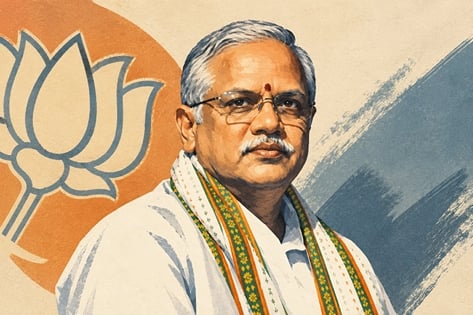
Summary: The BJP's national general secretary (organisation) B L Santhosh, an RSS pracharak, discusses the party's growth in an interview recorded for the Jana Sangh's 75th foundation day, which fell on Vijayadashami this year. He traces the arc from the 1951 founding, when the party won three Lok Sabha seats, to today's organisation, which plans to train more than 48,000 block-level councillors. Santhosh argues that many of the ideas the Jana Sangh was formed to press, including the abrogation of Article 370 and the Ayodhya temple, have largely prevailed. The interview also covers Syama Prasad Mookerjee, Deendayal Upadhyaya, the Emergency and the Janata Party.
Why it matters: The interview shows how a party founded on a set of Bharatiya ideas now sees its own organisational reach and the spread of those ideas into policy. It is a useful account of how the Jana Sangh's vision has moved from the margins to the centre of politics. It also addresses the twin challenges of decolonisation and development facing the BJP, which alone can build a Viksit Bharat: freeing people and institutions from a slave mentality and seizing the AI/Industry 4.0 revolution.
“A Temple You Could See, Decolonisation You Cannot. The BJP’s Organisational Problem At 75” — Swarajyamag, 27 Oct 2026
A few months after the third wave of Covid-19, the BJP held a workshop for its councillors. When the organisers sat down afterwards to list everyone the party ought to be training, the block-level councillors alone came to more than 48,000.
No existing training camp could take that many people, so the party designed a new one.
A figure of 48,000 would have been hard to picture for the men who met at a girls’ school in Delhi on 21 October 1951 to found the Jana Sangh. In the first general election a few months later, their party won three Lok Sabha seats and about 3 per cent of the vote…
Read the full article at Swarajyamag →
