


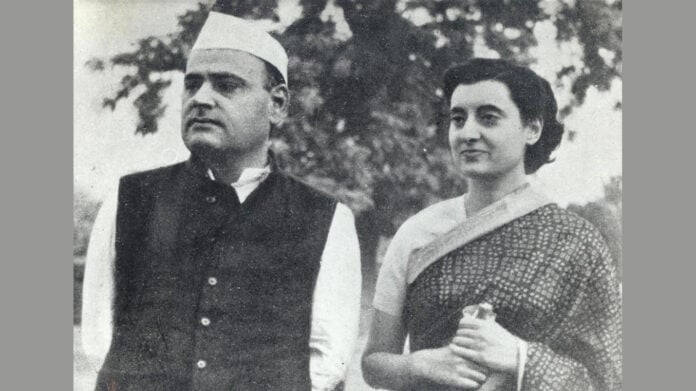
Feroze Ghandy, in full Feroze Jehangir Ghandy, was born on 12 September 1912 in Bombay, the son of Parsi parents. His birth certificate spells the surname Ghandhy; his father was Jehangir Faredoon Ghandy. By the early 1930s, as a young Congress volunteer in Allahabad, he was appearing in print as “Gandhi”. On 8 December 1933, The Leader reported the arrest of “Firoze Ghandhy” in its text and called him “Gandhi” in its headline, Zee News found. His biographer Bertil Falk says the newspapers made the change; others credit the young man’s devotion to ‘Mahatma’ Mohandas Karamchand Gandhi. No record of a formal change of name has ever surfaced. In March 1942 he married Indira Nehru, and she took his surname.
So the dynasty acquired the most powerful surname in Bharatiya politics, one ‘Mahatma’ Gandhi never conferred and to which it had no claim of blood.
A halo that kept on giving
Whether the change was a young man’s homage or a newspaper’s convenience, what followed was no accident. “Indira Gandhi” carried the aura of the Father of the Nation into every village. In 1951 fewer than one in five Bharatiyas could read; in 1971, barely a third. Rajiv, Sanjay, Sonia, Rahul and Priyanka inherited the halo along with the name.
When Gandhi’s real grandson, Rajmohan Gandhi, stood against Rajiv Gandhi in Amethi in 1989, it was the borrowed Gandhi who won. No pollster appears to have measured how many Bharatiyas still believe the family descends from ‘Mahatma’ Gandhi, but Encyclopaedia Britannica keeps a page devoted to answering exactly that question, “Is the Indian National Congress’s Gandhi family related to Mahatma Gandhi?” That tells its own story.
Psychologists have a name for the mechanism. Edward Thorndike called it the halo effect in 1920: a positive impression in one domain spills over onto everything associated with it. Marketers call it borrowed equity, the practice of attaching a new product to a name the customer already trusts.
The missionary’s costume
The dynasty did not invent this technique; the Church perfected it in Bharat centuries earlier. In 1606 the Italian Jesuit Roberto de Nobili settled in Madurai, shaved his head but for a tuft, wore the dhoti and wooden sandals of a sannyasi and slung a three-stranded thread across his chest. Locals called him the “White Brahmin”. His aim was to win ‘high-caste’ converts by looking like one of them. In 1623 Pope Gregory XV formally permitted converts to keep the sacred thread, the tuft and sandalwood paste on the forehead, provided these were emptied of their Hindu meaning.
The Church calls this inculturation, and it never stopped. In 1950 French monks founded a “Christian ashram”, Shantivanam, in Tamil Nadu, took Sanskrit names such as Abhishiktananda and adopted the forms of Hindu sannyasa. In 1999 Pope John Paul II signed Ecclesia in Asia in New Delhi itself. It told missionaries to prefer “narrative methods akin to Asian cultural forms” and promised that “a great harvest of faith will be reaped in this vast and vital continent”. By 2009 a Catholic missionary society’s ashram in Varanasi had gathered about 30,000 “Khrist Bhaktas”, devotees who “continue to remain in their own culture” while worshipping Christ, AsiaNews reported. Evangelical strategists call such converts “insider movements”.
The end result is the crypto-Christian. In 2022 Justice G.R. Swaminathan of the Madras High Court observed that Scheduled Caste converts to Christianity “call themselves Hindus on record for the purpose of availing reservation”, and that Hindus in Kanyakumari “are in minority in the district though the 2011 census tells us otherwise” (Bar & Bench).
Rajiv Malhotra has given this process its proper name: digestion. In Being Different (2011) he describes how a dominant tradition appropriates the outer forms of another, a “digestible difference”, until nothing distinct of the original remains. In Breaking India, he and Aravindan Neelakandan traced how foreign-funded networks turn identity into a weapon against the Hindu whole.
Social psychology explains why the costume works. In a much-cited 1999 study, Tanya Chartrand and John Bargh found that mimicry “increases liking between interaction partners” (Journal of Personality and Social Psychology), and Donn Byrne’s similarity-attraction research showed decades earlier that we trust those who seem like us. Missionaries learnt this long before the laboratories did.
The same script, from Turtle Island to Tamil Nadu
The Native Americans saw the whole play. Papal bulls of 1452, 1455 and 1493 gave Christian monarchs licence to claim lands not ruled by Christians, the so-called Doctrine of Discovery, which the Vatican repudiated only in March 2023. First the missionaries learnt the natives’ languages and borrowed their symbols. Then came the boarding schools, whose founding ideologue, Richard Henry Pratt, summed up their mission in 1892: “Kill the Indian in him, and save the man.” In 2015 Canada’s Truth and Reconciliation Commission called its residential schools what they were: cultural genocide.
The sequence never varies. First wear the native’s clothes. Then take his children, his name and his gods.
Saris, bindis and the politics of costume
Modern Bharat’s secular elite has learnt the same lesson. The big-bindi brigade, CPM’s Brinda Karat and others like her, wear the large bindi and the handloom sari as badges of Bharatiya authenticity while their parties fight every Hindu cause from Sabarimala to Ayodhya. In Kerala, the CPI(M) government escorted women into Sabarimala in January 2019 against the shrine’s tradition and the devotees’ protests.
Sonia Gandhi’s saris reassured a nation that the Italian-born daughter-in-law had become one of us. Yet the UPA she presided over told the Supreme Court in 2007 that the accuracy of the texts on Bhagwan Ram’s Setu was “largely unascertainable” (Organiser). In 2011 her National Advisory Council drafted a Communal Violence Bill built on the presumption that only the majority community causes communal trouble (Organiser). The same years gave us the “saffron terror” narrative. Priyanka’s draped cotton saris and her grandmother’s haircut are a studied echo of Indira. The costume is Bharatiya; the policy is Western liberalism, with its reflexive suspicion of the Hindu.
Calling things by their names
None of this requires a conspiracy theory. A Parsi spelling became a political brand. A Jesuit’s thread became a missionary method. A sari became a campaign uniform. In each case, the outward marks of native identity were put on to win trust, while what the wearer actually did undermined the native’s faith.
Hindus need not be fooled twice. The first step is to call things by their real names: Rahul Gandhi, grandson of Feroze Ghandy, heir not to ‘Mahatma’ Gandhi but to a borrowed halo.
