


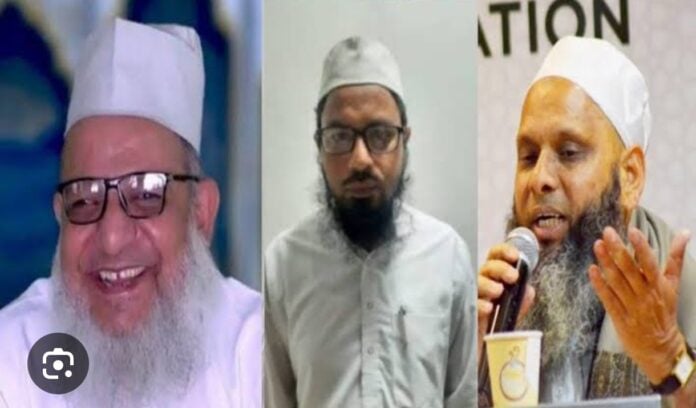
In a landmark judgment on Wednesday, September 11, a court in Lucknow sentenced 12 individuals, including a rabid Islamic ‘scholar’ Kaleem Siddiqui from West Uttar Pradesh to life imprisonment, while four others received 10-year jail terms. The court found them guilty of orchestrating an inter-state syndicate that unlawfully converted Hindus to Islam. This marks the first major conviction under the controversial Uttar Pradesh Prohibition of Unlawful Conversion of Religion Act, 2021, introduced to prevent forced or unlawful religious conversions.
The 16 individuals were convicted under various sections of the Prohibition of Unlawful Conversion of Religion Act, including Sections 3, 5, and 8, which criminalize conversions carried out through coercion, misrepresentation, or fraudulent means. They were also charged under several sections of the Indian Penal Code (IPC), including promoting enmity on religious grounds and cheating. Of the convicted, 12 were sentenced to life imprisonment under Section 121A of the IPC, which pertains to waging war against Bharat.
Key convictions: Maulana Kaleem Siddiqui and Maulana Umar Gautam
Among those sentenced to life were Maulana Kaleem Siddiqui, a rabid Islamic cleric, and Maulana Umar Gautam, a preacher and the founder of the Islamic Da’wah Centre (IDC) in Delhi. Gautam, who was born into a Hindu family and later converted to Islam, was accused of being the “kingpin” of the conversion syndicate while Siddiqui was said to be the “mastermind” by the Uttar Pradesh Anti-Terrorist Squad (ATS). Both denied allegations of forced conversions, with Gautam asserting that individuals who embraced Islam did so voluntarily and followed legal procedures.
The court also found Gautam and his son, Abdullah Umar, guilty of violating Section 35 of the Foreign Contribution (Regulation) Act, 2010. They were accused of receiving foreign funds unlawfully in non-FCRA accounts, allegedly using the money to finance conversions and support the new converts.
Case background and arrests
The case dates back to June 2021 when the UP ATS arrested Gautam and Mufti Qazi Jahangir Alam Qasmi in New Delhi. They were charged with mass converting Hindus to Islam by offering inducements such as jobs, money, and marriage, as well as exerting mental pressure. Over the course of the investigation, 17 people were charged, with individuals hailing from multiple states, including Uttar Pradesh, Maharashtra, Delhi, Gujarat, Haryana, and Bihar.
The police accused the defendants of using the IDC as a hub for mass conversions, citing documents that revealed the religious conversions of 450 individuals and marriage certificates of converts. The police also alleged that Gautam had converted approximately 1,000 people and facilitated many interfaith marriages.
Foreign influence and extremist links
According to the ATS, some of the accused were found to be influenced by the teachings of Anwar Al-Awlaki, an extremist Islamic preacher linked to Al-Qaeda. This led to the invocation of Sections 121A and 123 of the IPC, which deal with waging war against the government. The ATS stated that the ultimate goal of the syndicate was to destabilize the government, change the country’s demographics through mass conversions, and implement Sharia law.
The ATS further said that Siddiqui used platforms like YouTube and religious literature to propagate Islamic teachings and encourage conversions, often targeting vulnerable groups such as women, minors, and members of the Hindu SC (aka Dalit) and janjati communities. The police also linked the IDC to the International Open University, an institution run by Bilal Philips, a controversial Islamic preacher.
Court’s ruling and sentences
Special Judge Vivekanand Sharan Tripathi, presiding over the National Investigation Agency (NIA) and ATS court in Lucknow, handed down the sentences. The victims of the unlawful conversions, Aditya Gupta and Mohit Chaudhary, were awarded Rs 2 lakh each as compensation under the provisions of the 2021 Act.
The four individuals who received 10-year sentences were convicted under Sections 3, 5, and 8 of the Uttar Pradesh anti-conversion law, in addition to sections of the IPC, including 120B (criminal conspiracy), 153A (promoting enmity between different religious groups), 153B (assertions prejudicial to national integration), 295A (outraging religious feelings), 417 (cheating), and 298 (uttering words with deliberate intent to wound religious feelings). These sections cover offenses ranging from promoting religious enmity to cheating and hurting religious sentiments.
The court also convicted these individuals for violating procedural requirements under the anti-conversion law, such as failing to provide prior notice to the district magistrate before conducting religious conversions.
Police reaction
Uttar Pradesh’s Director General of Police, Prashant Kumar, hailed the verdict as a landmark decision that validated the police’s investigation and allegations. He described the case as significant in proving that mass conversions were being orchestrated through foreign funding, fraud, and religious misrepresentation. With this conviction, legal proceedings remain ongoing for one defendant, Idris Qureshi, whose case has been stayed by the Allahabad High Court.
As the detailed order is awaited, this judgment sets a crucial precedent in the state’s crackdown on unlawful conversions, a subject that has sparked widespread debate across the country.
