


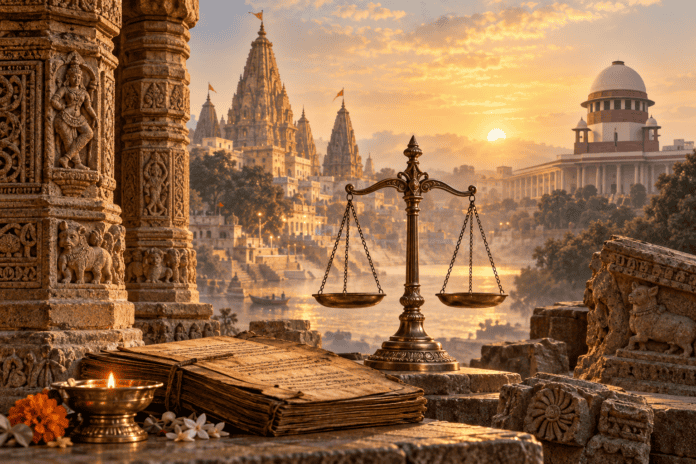
Satyam eva jayate nānṛtaṃ
Truth alone triumphs, not falsehood.
Muṇḍaka Upaniṣad 3.1.6
I. The Constitutional Problem of Enforced Closure
The debate over the Places of Worship (Special Provisions) Act, 1991 is ordinarily framed as a contest between communal peace and historical grievance. That framing is incomplete. The deeper question is whether a constitutional republic may extinguish an entire class of civil and religious claims, not after examining their evidence, but by declaring that the religious character of every place of worship must be treated as frozen on a politically selected date. The Act does not merely prescribe a limitation period, regulate remedies, or erect exacting evidentiary thresholds. It converts the religious status of 15 August 1947 into a legally protected settlement and generally prohibits courts from considering claims that seek to disturb it.
The statute was enacted in the shadow of the Ayodhya movement. Section 3 prohibits the conversion of a place of worship, including the conversion of one denomination’s place of worship into that of another denomination. Section 4(1) declares that the religious character of a place of worship as it existed on 15 August 1947 “shall continue to be the same.” Section 4(2) provides for the abatement of pending proceedings directed at altering that character and bars the institution of new proceedings. Section 5 excludes the Ram Janmabhumi-Babri Masjid site at Ayodhya from the Act. The statute contains additional exceptions, including certain ancient monuments and archaeological sites governed by the Ancient Monuments and Archaeological Sites and Remains Act, 1958, matters finally decided before commencement, disputes settled by the parties, and conversions accomplished by acquiescence before commencement.
These details matter because criticism of the Act is sometimes caricatured as a demand that every structure in Bharat be subjected to archaeological excavation. That is neither necessary nor constitutionally responsible. The stronger objection is narrower: Parliament should not prohibit judicial inquiry into every pre-1947 sacred-site claim regardless of the quality of evidence, the continuity of worship, the status of the deity, the civilizational importance of the site, or the possibility that the claimed act of dispossession was legally incapable of extinguishing an existing religious endowment.
The constitutional controversy is therefore not simply about whether old grievances should be reopened. It is about whether access to adjudication may be closed in advance, and whether the State may treat the material result of conquest or desecration as the juridical baseline of secularism.
The principal defence of the Act received powerful expression in the Supreme Court’s Ayodhya judgment, M. Siddiq (D) through LRs v. Mahant Suresh Das. The Court described the Act as protecting secularism and as enforcing a constitutional commitment to equality among religions. It treated the statutory cut-off as an instrument of “non-retrogression,” under which the Republic refuses to permit the use of law to revisit the religious character of places of worship inherited at independence.
That reasoning commands respect, but it does not end the constitutional debate. The observations concerning the Act were made in litigation from which the Ayodhya site was expressly excluded. The constitutional validity of the Act itself was not the question finally adjudicated. A judicial endorsement of the Act’s purpose cannot substitute for a full examination of whether its means are compatible with equality, religious freedom, judicial review, remedies for continuing wrongs, and the legal personality of Hindu deities.
The real constitutional question is consequently more difficult than either side often admits. Peace and fraternity are unquestionably constitutional goods. But so are truth, equality before law, freedom of religion, denominational autonomy, and access to courts. “Closure” cannot be treated as a self-authenticating constitutional value. The State must still explain why the most drastic form of closure, a categorical bar on adjudication, is necessary and proportionate.
II. Why 15 August 1947 Cannot Be a Complete Theory of Justice
The date chosen by Parliament has undeniable political significance. It marks the end of British rule and the emergence of independent Bharat. Yet political significance is not identical to juridical or moral significance. Independence did not retrospectively validate every pre-existing title, extinguish every trust, dissolve every religious endowment, or cure every continuing injury.
The problem becomes especially acute where a Hindu deity is the juridical owner of endowed property. Hindu endowment law does not treat the mūrti merely as an object belonging to a congregation. The deity may be recognized as a juristic person; endowed property is administered for the deity and the purposes of worship; and the shebait acts as the human manager and representative of that sacred interest. The supplied Hindu-law text accordingly describes a murti as a juridical person capable of holding legal rights and describes the deity as owner of debutter property. It also distinguishes a temple, a place of worship, from a maṭha, a center of theological learning, while explaining the managerial and religious responsibilities of the shebait and mahant.
That doctrine changes the nature of the constitutional inquiry. If endowed property belongs in law to a continuing juristic personality, the mere physical suppression of worship does not necessarily answer whether the endowment was lawfully extinguished. Nor does a sovereign transition automatically transform an alleged wrongdoer’s possession into the norm from which constitutional justice must proceed. The Act’s cut-off date risks conflating the factual condition of a site in 1947 with the lawful character of the underlying religious interest.
Section 4 is therefore unlike an ordinary statute of limitation. Limitation generally bars a remedy after a prescribed period, often subject to rules concerning disability, fraud, acknowledgment, adverse possession, and continuing causes of action. The Places of Worship Act instead declares a religious character and then commands its continuation. It moves from procedural finality to substantive statutory reclassification.
This raises an equality concern under Article 14. Ayodhya was exempted because Parliament recognized its unique public and historical character. But once the law acknowledges that at least one pre-1947 sacred-site dispute warranted adjudication, the exclusion of every other claim must rest on a defensible principle. Why should another site supported by comparably compelling evidence, continuing worship, or exceptional civilizational importance be jurisdictionally silenced rather than judicially examined? Ayodhya may well have been unique in political salience, but political salience is not an obvious constitutional classification for determining who may enter a court.
The bar also implicates Articles 25 and 26. Article 25 protects freedom of conscience and the right freely to profess, practise, and propagate religion, subject to public order, morality, health, and other fundamental rights. Article 26 protects the rights of religious denominations to manage their own affairs in matters of religion and to own, acquire, and administer property in accordance with law. These guarantees do not automatically establish a right to restoration. But where a community alleges that an indispensable sacred site remains subject to a continuing impairment, a law denying even the forum in which that claim could be tested burdens religious exercise in a manner that demands serious justification.
The constitutional issue is sharpened by Article 32 and the basic-structure doctrine. Kesavananda Bharati v. State of Kerala established that parliamentary power is limited by the Constitution’s basic structure. L. Chandra Kumar v. Union of India located judicial review by the constitutional courts within that basic structure. I.R. Coelho v. State of Tamil Nadu reaffirmed that legislation cannot be insulated from scrutiny when it damages fundamental constitutional principles. These decisions do not by themselves invalidate the Places of Worship Act. They do, however, undermine any suggestion that Parliament may conclusively define a class of historically rooted rights out of judicial cognizance merely by invoking secularism.
The stronger constitutional objection, therefore, is not that every historical Hindu claim must prevail. It is that Parliament has replaced adjudication with legislative closure. It has determined, without hearing site-specific evidence, that the condition existing on 15 August 1947 must prevail over all competing claims.
III. Hindu Temples Are Not Merely Buildings
A jurisprudence developed primarily around modern property categories easily misunderstands the Hindu temple. A church or prayer hall may also possess sacred meaning, but the theological structure of a Hindu temple demands an analysis in its own terms. The temple is not simply a building in which believers assemble. Nor is the mūrti merely an artistic representation of an absent deity.
In many Hindu traditions, prāṇa-pratiṣṭhā ritually establishes the divine presence in the consecrated image. The temple becomes a devasthāna, an abode of the deity; a kṣetra, a sacred field; and, in particular settings, a tīrtha, a crossing place between ordinary and transcendent reality. The deity is awakened, bathed, clothed, adorned, fed, put to rest, taken in procession, and worshipped according to āgamic or other inherited prescriptions. The daily and festival cycles are not optional decorations around an architectural monument. They constitute the life of the institution.
This does not mean that every Hindu school advances an identical theology of images. Hindu Dharma contains non-dual, dualist, devotional, ritual, yogic, renunciatory, and philosophical traditions. The point is not uniformity. It is that a significant and enduring body of Hindu practice understands consecrated space as ontologically and ritually alive.
The legal personality of the deity is one juridical recognition of this reality. As the supplied material notes, gifts for Hindu religious and charitable purposes have traditionally been associated with religious merit, while the construction of temples, tanks, wells, dharmaśālās, gośālās, and institutions of learning was treated as pūrta, a meritorious public or charitable act. Once dedicated, temple property is not simply the disposable property of the archakas, worshippers, founder’s descendants, or State. It exists for the deity and religious purpose.
Justice V. Ramasubramanian’s account of Hindu philosophy and jurisprudence is valuable here because it resists the colonial assumption that Hindu Dharma supplied only ritual prescriptions and not a developed conception of jurisprudence. He identifies Dharmaśāstra and Nyāya among the traditional fields directly concerned with law and justice and discusses substantive law, procedure, pleadings, evidence, judicial qualifications, adjudication, and reasoned decision-making. He further explains the traditional sources of Dharma through Veda, Smṛti, the conduct of the virtuous, and conscience.
The Manusmṛti verse discussed in that lecture states:
vedo’khilo dharmamūlaṃ smṛtiśīle ca tadvidām
ācāraś caiva sādhūnām ātmanas tuṣṭir eva ca.
In the lecture’s explanation, the roots or sources of Dharma include the Veda, remembered tradition, the conduct of the good, and inward conscience. This is not a warrant for mechanically importing every historically contingent rule of every Smṛti into modern law. It is evidence of a sophisticated jurisprudential tradition that connected authoritative sources, social practice, ethical character, and conscience.
Nyāya adds another dimension. Justice Ramasubramanian describes ānvīkṣikī, disciplined reasoning, as the method by which conflicts between competing duties may be resolved. He invokes the well-known narrative of King Śibi, where compassion for the creature seeking refuge conflicts with the legitimate claim of another creature to sustenance. The resolution does not come from denying either side. It comes through reason, sacrifice, and the search for a solution that satisfies both duties as far as possible.
That jurisprudential instinct is directly relevant. The contemporary conflict is not “Hindu truth” against “constitutional peace.” Both truth and peace are legitimate goods. A Nyāya-informed constitutionalism should ask how each can be respected, not declare one legally nonexistent.
The Taittirīya Upaniṣad enjoins, satyam vada, dharmam cara, “speak truth; practise Dharma.” The Muṇḍaka Upaniṣad declares, satyam eva jayate nānṛtam, “truth alone triumphs, not falsehood.” These propositions do not compel a predetermined judgment in any particular temple dispute. Their jurisprudential significance is subtler: a system of justice should ordinarily proceed through truthful inquiry. It may deny a remedy for compelling reasons, but it should hesitate before making ignorance compulsory.
IV. Iconoclasm as a Global Civilizational Phenomenon
Any account of iconoclasm must be carefully qualified. The term, derived from the Greek words for image and breaking, refers to the destruction of icons, images, or monuments, usually for religious or political reasons. It is not limited to the destruction of one religion’s images by another. It has occurred within religious traditions, between competing sects, during conquest, under revolutionary regimes, and in campaigns directed at political symbols.
Nevertheless, ideas matter. Certain theological systems, specifically Abrahamic religions, have condemned images as idolatrous, while revolutionary ideologies such as Communism, have regarded inherited religious institutions as impediments to the construction of a new society. At particular historical moments, those teachings have furnished a vocabulary through which the destruction of another community’s sacred forms could be represented as purification, reform, liberation, or obedience.
The Hebrew Bible contains passages commanding the destruction of Canaanite cult objects and high places. Christianity likewise contains a complex history. Early Christian writers debated images; the Christianization of the Roman world was accompanied in some locations by the closure, conversion, or destruction of polytheistic temples; Byzantine Christianity later underwent fierce internal struggles over icons; and the Protestant Reformation produced major waves of destruction directed against Catholic statues, paintings, relics, books, and liturgical objects. At the same time, Catholic, Orthodox, and Lutheran traditions developed strong defences of religious art and sacred imagery.
Islamic history similarly includes a strong and consequential aniconic current. The destruction of the vigrahas in the Kaʿba has foundational significance in Islamic sacred history, and traditions concerning images have shaped the visual norms of many mosques. The destruction of the Bamiyan Buddhas by the Taliban in 2001 illustrates a modern iconoclastic act. Bharat has been on the receiving end of the Islamic iconoclasm, as seen by the thousands of temples which were destroyed during the invasions, which have been documented by the likes of Shri. Sita Ram Goel, and many others.
The modern international response to the destruction of sacred heritage is particularly instructive. In Prosecutor v. Ahmad Al Faqi Al Mahdi, the International Criminal Court convicted the accused of intentionally directing attacks against ten buildings of religious and historical character in Timbuktu. The Court proceeded under Article 8(2)(e)(iv) of the Rome Statute, which protects buildings dedicated to religion, education, art, science, or charitable purposes, as well as historic monuments, when they are not military objectives. The case demonstrates that international criminal law understands attacks on sacred heritage as attacks upon communities and the inheritance of humankind, not merely damage to replaceable masonry.
Revolutionary secular ideologies have also engaged in iconoclasm. The French Revolution attacked royal and ecclesiastical symbols as embodiments of the old order. The Soviet state closed, demolished, or repurposed religious institutions and suppressed the social authority of clergy. Mao-era campaigns, reaching a climax during the Cultural Revolution, targeted temples, monasteries, ancestral objects, manuscripts, and inherited customs among the “Four Olds.” In such cases, iconoclasm was not driven by a prohibition on idolatry in the Abrahamic sense. It arose from the belief that a new political human being required the destruction of the symbolic and institutional world of the past.
The common thread is not any single religion. It is the use of power to delegitimize a predecessor’s sacred order. The destruction of an image communicates that the god represented by it is powerless, that the community attached to it has been subordinated, and that a new sovereignty now determines what may be worshipped and remembered.
V. Temple Destruction in Bharat: Historical Reality and Constitutional Evasion
Any serious discussion of the Places of Worship Act must begin by acknowledging a historical reality that has become difficult to discuss honestly in elite discourse: large-scale destruction, desecration, appropriation, and conversion of Hindu temples occurred during significant phases of Islamic rule in the Bharatiya subcontinent.
This proposition is no longer sustainable as a matter of denial. The evidence arises from multiple categories of sources: Persian court chronicles, royal inscriptions, archaeological remains, surviving architectural fragments, contemporary travel accounts, local traditions, and administrative records. The debate among historians today is less about whether such events occurred than about how frequently they occurred, what motivations predominated, and how they should be interpreted within broader political history.
Yet an examination of primary Persian chronicles reveals that many temple destructions were not described merely as military actions against political adversaries. They were frequently celebrated in explicitly religious language. Rulers and court historians often portrayed the destruction of temples, murtis, and sacred institutions as demonstrations of Islamic triumph over unbelief, as acts of piety, or as fulfilment of religious duty. To pretend that theology was irrelevant to these actions is as historically untenable as claiming that politics played no role whatsoever.
The history of Somnath remains an enduring symbol because it reveals this complexity. Economic motives, military considerations, royal prestige, and religious symbolism coexisted. Yet it is impossible to understand the enduring memory of Somnath among Hindus without acknowledging that the destruction of the temple was experienced not merely as plunder but as an assault upon a sacred space.
The same observation applies to Kashi and Mathura. These are not obscure archaeological sites rediscovered through modern excavation. They have remained living centres of Hindu devotion across centuries. The issue is therefore not whether modern claimants have suddenly manufactured a connection with these locations. The continuity of religious memory itself precedes the modern Republic by many centuries.
Indeed, one of the peculiar features of the contemporary debate is that historical evidence is often subjected to standards of skepticism that would be considered unreasonable in many other areas of historical inquiry. When indigenous communities elsewhere invoke sacred memory, continuity of worship, collective tradition, and historical grievance, these factors are often treated as relevant forms of evidence. When Hindu communities invoke similar considerations regarding sacred geography, the conversation frequently shifts from evaluating evidence to denying the legitimacy of the inquiry itself.
The legislation enacted in 1991 performs a subtle but significant juridical transformation. Instead of asking whether a particular site was altered through processes that modern constitutional principles would regard as unjust, it declares that the condition existing on 15 August 1947 shall be treated as normative. In effect, the law privileges the outcome of history over investigation of history.
From a Hindu perspective, this creates a profound moral difficulty. If a temple was indeed destroyed and replaced in a manner celebrated by contemporary chroniclers as an act of religious supremacy, then the Places of Worship Act does not merely preserve peace. It grants continuing legal protection to the consequences of that act. The law may not endorse the original destruction, but it does insist that courts ignore the question when determining present legal rights.
This is not neutrality. It is a decision. And it is a decision whose burden falls disproportionately upon Hindu sacred geography.
The constitutional question is therefore not whether every historical claim should succeed. It is whether a constitutional republic should permanently immunize the consequences of historically documented acts of religious iconoclasm from judicial examination.
VI. Memory, Restoration, and Comparative Jurisprudence
Comparative law does not establish a universal right to repossess every sacred site lost in history. It does, however, show that modern constitutional and international orders increasingly recognize collective memory, sacred relationships to land, and remedies for historical cultural destruction.
The United Nations Declaration on the Rights of Indigenous Peoples recognizes the importance of collective cultural and spiritual relationships. Article 11 addresses the right to practise and revitalize cultural traditions and calls for redress concerning cultural, intellectual, religious, and spiritual property taken without free, prior, and informed consent or in violation of law and custom. Article 12 recognizes rights concerning spiritual and religious traditions, customs, ceremonies, religious and cultural sites, ceremonial objects, and human remains. Article 25 addresses distinctive spiritual relationships with traditionally used lands and waters. Its jurisprudential premise is important: the passage of time does not render a community’s sacred relationship to place legally unintelligible.
The same principle appears in different forms in settler societies. Māori claims in Aotearoa New Zealand have been addressed through the Treaty of Waitangi settlement process. Canada has developed constitutional and negotiated mechanisms for Indigenous land, cultural, and religious claims. Australian law contains heritage regimes directed at Aboriginal sacred sites, though their effectiveness remains contested. The United States has enacted legislation concerning Native American religious freedom and cultural patrimony, while its constitutional jurisprudence on sacred lands remains significantly less protective than many advocates seek.
These examples should not be romanticized. Restoration is incomplete, remedies are contested, and courts frequently prioritize state or private property interests. Yet the direction of modern jurisprudence is clear: sacred relationships, historical dispossession, and collective memory are proper objects of law. They are not disqualified merely because the original wrong is old.
Post-conflict jurisprudence reinforces the point. South Africa’s Truth and Reconciliation Commission proceeded from the belief that political settlement without truth would be unstable and morally deficient. Germany’s culture of remembrance refuses to treat the end of a criminal regime as a command to forget. Restitution of Nazi-looted art remains an active legal and moral field generations later. These examples differ radically from temple disputes, but they refute the general proposition that peace requires historical silence.
The better comparative principle is that remedy and truth need not be identical. A society may acknowledge a wrong without ordering physical restoration. It may provide access, shared arrangements, compensation, memorialization, reconstruction elsewhere, or negotiated transfer. What it should not casually do is make the question legally unaskable.
VII. Two Hindu Approaches: Limited Settlement or Community-Led Adjudication
Within Hindu public thought, at least two broad approaches deserve serious consideration. The first may be described as the limited-settlement position. It seeks resolution at a very small number of exceptionally important sites, most commonly Ayodhya, Kashi, and Mathura, while accepting general statutory closure elsewhere. Its strength is prudential. It recognizes limited state capacity, the risk of opportunistic litigation, the possibility of social unrest, and the need for a politically comprehensible endpoint.
This position has often been associated, in different forms and at different times, with mainstream Hindutva institutions and political strategy. It does not necessarily deny the wider history of temple destruction. Rather, it treats a few sites as civilizationally representative and views their resolution as sufficient for broader reconciliation.
The competing position may be called the community-rights approach. It argues that neither the State nor a national political organization has authority to decide in advance which Hindu sacred sites are important enough to deserve legal examination. Religious meaning is frequently local. A village deity, regional kṣetra, monastic seat, or temple associated with a particular sampradāya may be central to its worshipping community even if it lacks national political visibility.
On this view, the proper right is not a political promise to restore thousands of temples. It is a legal right to institute a claim subject to rigorous standards. The local community, deity through its lawful representative or next friend, denomination, or endowment should be able to seek adjudication. Courts, not crowds, should determine standing, evidence, continuity, title, legal character, limitation, and remedy.
The community-rights approach better reflects Article 26’s protection of denominational autonomy, but it also carries greater risks. Organized campaigns could overwhelm local courts, weaponize uncertain traditions, and create continuous tension around functioning places of worship. Those risks justify procedural safeguards. They do not necessarily justify total prohibition.
VIII. Why Repeal, Not Reform, Is the Better Constitutional Path
Many commentators seek a middle position. They accept that historical grievances deserve recognition but argue that the Places of Worship Act should merely be modified through procedural safeguards and stricter evidentiary requirements.
Such proposals are understandable. Yet they may underestimate the deeper problem.
The central defect of the Act is not procedural. It is conceptual.
The statute is founded upon the assumption that historical religious claims constitute a unique category of disputes that must be excluded from ordinary legal adjudication. Once that assumption is accepted, debates about exceptions, thresholds, or evidentiary standards become secondary. The constitutional injury has already occurred.
In every other area of law, the Republic trusts courts to distinguish valid claims from invalid ones. Courts regularly examine questions involving property rights, historical records, archaeological evidence, constitutional interpretation, religious freedom, adverse possession, trust administration, and competing claims of ownership. There is no principled reason to assume that courts suddenly become incapable of performing their constitutional function when the subject matter concerns sacred geography.
Nor is there convincing evidence that repeal would unleash uncontrollable social disorder.
Before 1991, Bharat did not witness a continuous nationwide cycle of temple-restoration litigation engulfing the judiciary. The enactment of the Places of Worship Act was not a response to thousands of ongoing disputes overwhelming the courts. Rather, it emerged from a specific political moment shaped by the Ayodhya controversy.
Its defenders often invoke a slippery-slope argument: if one site is reconsidered, all sites will be reconsidered. Yet constitutional governance cannot operate on hypothetical catastrophes alone. Courts routinely manage potentially disruptive disputes by applying standing requirements, evidentiary standards, procedural safeguards, doctrines of limitation, and principles of public order.
The answer to weak claims is dismissal. The answer to strong claims is adjudication. The answer to constitutional anxiety cannot be a permanent prohibition on seeking justice.
Historical Justice and the Problem of Institutional Closure
The tendency toward closure is not confined to disputes involving sacred geography. It reflects a broader challenge within Bharatiya constitutional practice. As events recede into the past, institutions often become increasingly hesitant to revisit them, even where the consequences of those events remain alive for the affected community.
A revealing example arises from litigation connected to the persecution and displacement of Kashmiri Pandits. In September 2022, the Supreme Court declined to entertain a petition seeking a probe into the 1989 assassination of T L Taploo, a prominent Kashmiri Pandit leader murdered during the period that preceded the mass exodus of the community from the Kashmir Valley. The Court observed that the petitioner could pursue appropriate remedies before the High Court and permitted withdrawal of the petition. During the hearing, counsel drew attention to the gravity of the matter and pointed out that prosecutions and convictions had occurred decades after the 1984 anti-Sikh riots.
The significance of this episode lies not in the precise procedural outcome. The Court did not hold that historical crimes are incapable of investigation. Yet the case illustrates a deeper reality. Communities seeking justice for collective injuries often encounter increasing institutional barriers as time passes, even when the underlying events are comparatively recent and many perpetrators are still alive. What begins as a demand for accountability gradually risks being transformed into a matter of historical memory rather than legal remedy.
For many Kashmiri Pandits, the violence, displacement, destruction of temples, loss of homeland, and rupture of civilizational continuity associated with the exodus remain living experiences rather than closed chapters of history. The passage of three decades has not dissolved the injury. The wound survives in community memory, cultural identity, and collective consciousness.
The same jurisprudential problem appears in an even more pronounced form in relation to Hindu sacred sites. A devotee approaching Kashi, Mathura, or another historically contested site does not necessarily regard the underlying grievance as an event that ended centuries ago. The sacred relationship to the site never ceased. Worship, pilgrimage, memory, and religious consciousness have persisted despite political conquest, changes of sovereignty, and interruptions of institutional control. From that perspective, the issue is not merely historical. It is continuing.
The Places of Worship Act resolves this tension in the most restrictive way possible. Rather than permitting courts to determine whether a claim remains legally cognizable despite its antiquity, Parliament has itself predetermined the answer. The age of the dispute becomes a substitute for legal examination of the dispute.
Yet constitutional democracies routinely recognize that time alone does not extinguish moral and legal significance. Across the world, legal systems continue to address indigenous land claims, religious-property restitution, cultural-heritage disputes, wartime dispossession, and historical injustices whose origins may lie decades or even centuries in the past. The existence of temporal distance may affect the remedy. It should not automatically prohibit inquiry.
The fundamental question, therefore, is whether a constitutional republic committed to justice should trust courts to evaluate historical claims on evidence, or whether Parliament may simply declare entire categories of historical grievance beyond judicial scrutiny.
Repeal Restores the Ordinary Constitutional Framework
From a Hindu perspective, repeal is preferable because it restores a basic constitutional principle: courts should decide claims on evidence rather than legislation deciding them in advance. Repeal would not guarantee restoration. It would not guarantee success for claimants. It would not predetermine outcomes.
It would merely return these disputes to the ordinary constitutional framework where they belong.
If a Hindu community cannot establish continuity of worship, historical evidence, legal standing, or a cognizable cause of action, the claim should fail.
If a Hindu community can establish those elements, the claim should be heard.
This is how constitutional justice ordinarily functions.
There is also a deeper civilizational dimension. Hindu Dharma today remains the last major surviving ancient religious civilization that retains an unbroken connection with many of its original sacred geographies. The temples of Bharat are not museums preserving a dead faith. They are living institutions of worship, pilgrimage, ritual, memory, and spiritual practice.
A civilization cannot be expected to sever itself from its sacred geography and remain unchanged.
Nor can a constitutional republic permanently deny a civilization the right to seek judicial examination of claims concerning its most sacred spaces.
The Republic need not promise restoration. It need not promise victory. But it should promise a hearing. The Places of Worship Act denies even that.
For this reason, the most constitutionally coherent solution is not amendment but repeal, accompanied by reliance upon ordinary principles of constitutional law, religious freedom, trust law, evidence, archaeology, and judicial review. A mature civilization does not fear the truth. A mature judiciary does not fear history. And a mature republic should not fear allowing courts to examine both.
IX. The Hindu Case Against Permanent Forgetfulness
Hindu Dharma is not merely one confessional option among many in the history of Bharat. It is a family of traditions rooted in the civilization’s languages, sacred geographies, philosophical disciplines, ritual systems, pilgrimage networks, arts, festivals, and inherited modes of life. This assertion does not diminish the equal citizenship of anyone else. It identifies a civilizational reality relevant to the interpretation of sacred-space claims.
Many pre-Christian traditions of Europe and West Asia survive primarily through texts, reconstructed practices, archaeological remains, and small revival communities. Hindu Dharma, by contrast, remains a living civilizational continuum practised on a vast scale. Its temples are not museums marking a vanished religion. They are active institutions within ongoing sacred geographies.
This continuity creates responsibility. Bharat is the principal civilizational home in which Hindu traditions possess the demographic, linguistic, institutional, and geographic depth necessary for full cultural reproduction. Hindus elsewhere enjoy important rights and have built flourishing institutions, but no other modern state contains the same concentration of Hindu sacred geography or bears the same historical relationship to its traditions.
The constitutional implication is not Hindu supremacy. It is that equal religious freedom must be interpreted with enough cultural intelligence to understand what Hindu sacred continuity requires. Formal equality that protects a structure while rendering the displaced sacred claim permanently non-justiciable may reproduce rather than correct inequality.
Hindu Dharma’s strongest case is therefore not a demand for vengeance. It is a demand for truthful adjudication. It is not a claim that every mosque is historically suspect, or that every chronicle is accurate, or that modern neighbours should be punished for medieval events. It is the proposition that where a living Hindu community presents compelling evidence concerning a living sacred site, the Republic should not answer that the result of history has been frozen beyond law.
Conclusion: Peace Must Be More Than the Preservation of an Inherited Outcome
The Places of Worship Act was enacted for an intelligible reason. Parliament feared that proliferating sacred-site disputes would destabilize Bharat and transform history into a permanent theatre of political mobilization. That fear cannot be dismissed. A mature Hindu position must recognize the constitutional value of public order and the vulnerability of ordinary citizens to the consequences of religious conflict.
Yet the legitimacy of an end does not establish the constitutionality of every means. The Act’s central mechanism is not reconciliation but compulsory closure. It does not examine truth and then fashion a restrained remedy. It declares the condition of 1947 legally normative and blocks the ordinary path to adjudication.
Comparative jurisprudence increasingly recognizes that communities possess legitimate interests in sacred sites, cultural memory, and redress for historical dispossession. International criminal law treats the intentional destruction of protected religious heritage as a grave offence. Indigenous-rights instruments recognize continuing spiritual relationships with place. Post-conflict societies have repeatedly discovered that durable reconciliation requires truth, even where full restitution is impossible.
Hindu jurisprudence reaches the same conclusion through its own vocabulary. Satya requires fidelity to truth. Nyāya requires reasoned examination. Dharma requires the balancing of competing obligations rather than the annihilation of one of them. Justice V. Ramasubramanian’s account of Dharmaśāstra and Nyāya reminds us that the Hindu legal imagination contains developed ideas of courts, pleadings, evidence, judicial ethics, reason, conscience, and conflict resolution
The constitutional demand should therefore be precise. Hindu society need not ask the State to guarantee the success of every restoration claim. It should ask that no law permanently disqualify Hindu civilizational memory from the judicial process.
A Republic may conclude, after evidence and argument, that a particular site cannot or should not be restored. That is adjudication. A Republic may facilitate settlement that preserves worship while acknowledging history. That is reconciliation. But when the State declares that the historical question itself may not be judicially asked, it ceases to preserve peace neutrally. It protects an inherited outcome by placing its origin beyond scrutiny.
The issue is ultimately not whether Bharat should live in the past. It is whether Bharat can enter the future while making truthful inquiry into its past a legal impossibility. For a civilization whose national motto is Satyam eva jayate, that should never be an easy settlement to accept.
Selected References
Primary legal materials
- The Constitution of Bharat, arts. 14, 25, 26, 32 and 226.
- Places of Worship (Special Provisions) Act, 1991, ss. 3-5.
- Ancient Monuments and Archaeological Sites and Remains Act, 1958.
- M. Siddiq (D) through LRs v. Mahant Suresh Das, (2020) 1 SCC 1.
- Kesavananda Bharati v. State of Kerala, (1973) 4 SCC 225.
- L. Chandra Kumar v. Union of India, (1997) 3 SCC 261.
- I.R. Coelho v. State of Tamil Nadu, (2007) 2 SCC 1.
- Deoki Nandan v. Murlidhar, AIR 1957 SC 133.
- Yogendra Nath Naskar v. Commissioner of Income Tax, (1969) 1 SCC 555.
- Ram Jankijee Deities v. State of Bihar, (1999) 5 SCC 50.
- Prosecutor v. Ahmad Al Faqi Al Mahdi, ICC-01/12-01/15, Judgment and Sentence, 27 September 2016. [icc-cpi.int]
- United Nations Declaration on the Rights of Indigenous Peoples, arts. 11, 12 and 25. [ohchr.org]
Dharmic and jurisprudential sources
- Muṇḍaka Upaniṣad 3.1.6.
- Taittirīya Upaniṣad, Śikṣāvallī 1.11.
- Manusmṛti 2.6 and ch. 8.
- Yājñavalkya Smṛti, Vyavahāra-kāṇḍa.
- Kauṭilya, Arthaśāstra, books III-IV.
- P. V. Kane, History of Dharmaśāstra.
- Donald R. Davis Jr., The Spirit of Hindu Law.
- Robert Lingat, The Classical Law of India.
- Justice V. Ramasubramanian, “Hindu Philosophy and Modern Jurisprudence,” Shimla Law Review, vol. V. Link to PDF
- M. S. Rama Rao, HINDU_LAW_2012, especially the sections on sources of law and religious endowments.
History, iconoclasm, and memory
- Richard M. Eaton, Temple Desecration and Muslim States in Medieval India.
- Finbarr Barry Flood, “Between Cult and Culture: Bamiyan, Islamic Iconoclasm, and the Museum.”
- Jan Assmann, Writings on monotheism, memory, and iconoclasm.
- Ruti G. Teitel, Transitional Justice.
- Aleida Assmann, Cultural Memory and Western Civilization.
- Sita Ram Goel et al., Vols. I-II. Link to PDF
