


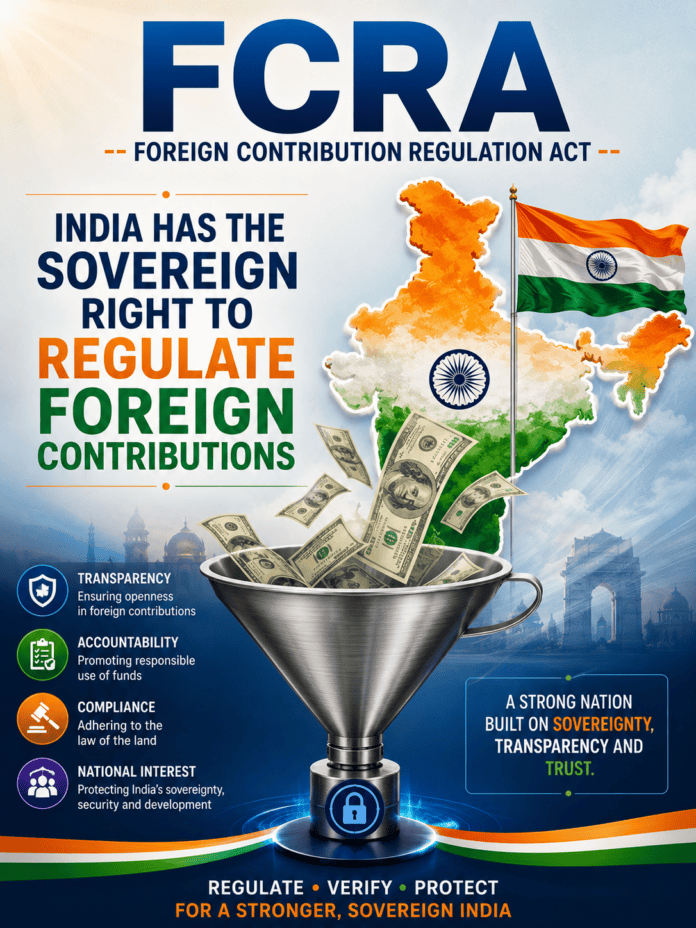
“The Dollar, the Ballot, and the Cross: The Real Reason Behind India’s Decisive FCRA Overhaul”, India Fact, August 01, 2026
“Editor’s note: Christianity and Islam are two supremacist, violent, hegemonic, and monopolist “faith” traditions whose followers have, since the founding of their religions, sought to make the world Christian or Muslim. Of the 193 UN member states, 115 are Christian-majority, and 50 are Muslim-majority. India, with its Hindu civilizational foundation, has been the target of these predatory religions and has been colonized by Christians and Muslims. Post-independence, the efforts to convert Hindus into Christianity or Islam have gone on through “wars” by other means. This article deals with important legislative attempts in India to deal with predatory religions and their international affiliates that seek to funnel massive amounts of money into the country.
Much has been said about the proposed Foreign Contribution Regulation Act (FCRA) amendments in Parliament. The debate has also unfolded against the backdrop of the recent student protests at Jantar Mantar in Delhi, with sections of the political and policy establishment linking the agitation to the proposed amendments. Whether or not that assessment has merit, the issue has drawn significant public attention. Church bodies have officially opposed the amendments, and the Kerala Assembly has passed a resolution against them.
Why have these amendments generated so much noise?
One reason the Foreign Contribution Regulations Amendment 2026 changes have generated intense debate is that they fundamentally change how foreign-funded organizations operate. India’s framework for regulating foreign funding has steadily evolved in response to changing security concerns, financial transparency standards, and the growing scale of international donations. The journey began with FCRA 2010, which created a modern legal framework for receiving and using foreign contributions. A decade later, the FCRA 2020 introduced tighter controls to improve traceability, accountability, and direct oversight of foreign funds. These changes were challenged before the Supreme Court in the landmark Noel Harper v Union of India case, where the Court upheld the amendments and reaffirmed that receiving foreign contributions is a regulated statutory privilege rather than a fundamental right. Building on this legal and regulatory foundation, the government has now proposed the Foreign Contribution Regulation Amendment Bill, 2026, together with new rules and digital reforms, signaling another step towards a more disclosure-based and compliance-driven foreign funding regime…….”
Read full article at indiafacts.org.in
