


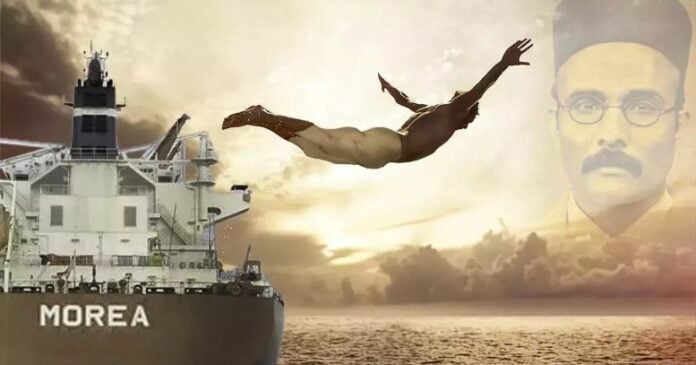
Vinayak Damodar Savarkar, popularly known as Veer Savarkar, is a towering figure in Bharatiya history. Savarkar is renowned for his revolutionary activities and unwavering commitment to Bharat’s independence. He remains unsung despite his unparalleled contribution to the country’s independence cause. Savarkar’s life is filled with episodes of extraordinary bravery and sacrifice. Among these, his daring attempt to escape from British custody by jumping into the sea is a testament to his indomitable spirit and relentless pursuit of freedom.
Early life and revolutionary zeal
Born on 28 May 1883 in Maharashtra’s Bhagur village, Savarkar’s early life was marked by a deep patriotism and an earnest desire to see Bharat free from British rule. He was a gifted student and a prolific writer, penning works that inspired many to join the cause of independence. His seminal work, “The First War of Indian Independence,” detailed the 1857 uprising and was banned by the British government for its ‘incendiary’ content.
Savarkar’s revolutionary activities soon caught the attention of the British authorities. He was involved in forming the Free India Society and the Abhinav Bharat Society, which aimed to overthrow British rule through armed struggle. His association with these organizations eventually led to his arrest in 1909 following his involvement in a conspiracy to assassinate British official Jackson.
Savarkar’s arrest and imprisonment
In 1909, Savarkar was arrested in London for his revolutionary activities and was sentenced to 50 years of imprisonment. He was to be transported to Bharat to serve his sentence in the dreaded Cellular Jail in the Andaman and Nicobar Islands, a place notorious for its harsh conditions and the inhumane treatment of political prisoners. As he was being transported from London to Bharat on board the SS Morea, Savarkar seized an opportunity that would etch his name in the annals of history.
The Daring escape attempt
On 8 July 1910, while the ship was docked at France’s port of Marseilles, Savarkar made a bold and desperate bid for freedom. Knowing that this might be his last chance to escape the clutches of the British, he made his way to a porthole in the ship’s lavatory. With sheer determination and calculated risk, he squeezed through the small window and leapt into the cold waters of the Mediterranean Sea.
As he swam towards the shore, Savarkar’s thoughts were focused solely on evading capture and continuing his fight for Bharat’s independence. He reached the French coast and, soaking wet and exhausted, ran towards the French authorities, hoping to seek asylum. However, his freedom was short-lived. The British officers, who had quickly realized his escape, alerted the French authorities, and Savarkar was recaptured and returned to the British within a few hours.
The aftermath and legacy
Savarkar’s escape attempt, though unsuccessful, was a bold act of defiance against British colonial rule. It demonstrated his unwavering resolve and his willingness to risk everything for the cause of Bharat’s independence. Following his recapture, Savarkar was transported to Bharat and incarcerated in the Cellular Jail, where he endured years of solitary confinement and brutal treatment. Despite these hardships, he continued to inspire and motivate his fellow prisoners and Bharatiyas outside the jail through his writings and poetry.
Savarkar’s life and his daring escape attempt have left an indelible mark on Bharat’s struggle for freedom. This is a landmark event that could have potentially altered Bharat’s independence struggle if Savarkar had been successful. Though it didn’t turn out exactly as desired by the braveheart, the incident profoundly inspired other freedom fighters.
His contributions to the independence movement, both as a revolutionary and a thinker, are immense. He was a staunch advocate for Hindutva, emphasizing the importance of cultural and national identity in the fight against colonial oppression. His vision for Bharat was one of a robust and self-reliant nation, free from foreign domination.
Conclusion
Veer Savarkar’s leap into the sea is more than just a story of a failed escape; it is a powerful symbol of the relentless pursuit of freedom and the undying spirit of resistance against oppression. His bravery and determination continue to inspire generations of Bharatiyas, reminding them of the sacrifices made by their forefathers in the quest for independence. His life serves as a beacon of courage and patriotism, urging us to cherish and protect the hard-won freedom of our nation.
(Featured Image Source: Navbharat Times)
