


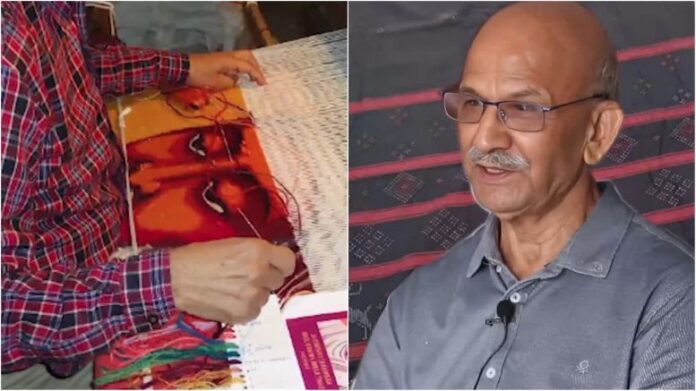
Khem Raj Sundriyal is one of the Unsung Heroes who is among the recipients of Padma Awards this year (2026). In a country celebrated for its rich textile traditions, countless artisans have quietly dedicated their lives to preserving Bharat’s weaving heritage.
Among the unsung custodians of craft stands Khem Raj Sundriyal, whose lifelong contribution to Bharatiya handloom and tapestry weaving earned him the prestigious Padma Shri in 2026. His recognition was not merely a personal honour, but a tribute to generations of traditional weavers whose artistry has shaped Bharat’s cultural identity.
Who is Khem Raj Sundriyal?
Khem Raj was born in the Himalayan region of present-day Uttarakhand. Sundriyal’s journey began with a deep fascination for textiles and traditional weaving techniques. He pursued formal training in weaving and dyeing at Srinagar in Uttarakhand in the early 1960s. At a time when industrialisation was rapidly transforming Bharat’s textile sector, he chose a different path that was rooted in craftsmanship, patience, and creativity.
After initially working with Delhi Cloth Mills, Khem Raj joined the Weavers’ Service Centre in Delhi in 1966. This decision would define the rest of his life. The Weavers’ Service Centres, established to support traditional artisans, became the platform through which he explored and mastered multiple weaving traditions from across Bharat. Rather than limiting himself to one regional style, he travelled extensively, learning from craftsmen and experimenting with indigenous techniques.
Contributions of Khem Raj to Bharat’s Handloom Heritage
Over the decades, Khem Raj Sundriyal emerged as one of the country’s finest practitioners of tapestry weaving, Jamdani weaving, and macrame art. His work combined technical brilliance with artistic imagination. He was not merely reproducing traditional patterns but was reinventing them for contemporary audiences while preserving their authenticity.
One of Sundriyal’s greatest contributions lies in reviving and modernising traditional weaving practices that were slowly disappearing. In particular, he played a major role in strengthening the weaving traditions associated with Haryana’s Panipat, a city globally known for its textiles. His efforts helped transform local handloom practices into a more organised and respected craft ecosystem.
What makes Khem Raj exceptional was his ability to innovate without compromising tradition. He experimented with materials, introduced new design sensibilities, and adapted heritage techniques for changing markets. Yet, despite these innovations, his work always retained the soul of handmade Bharatiya craftsmanship.
Many artisans credit him not only as a designer but also as a mentor. Over the years, he trained and guided thousands of weavers, helping younger generations sustain livelihoods through traditional skills. In an era when machine-made products dominate global markets, such mentorship has become invaluable. Sundriyal understood that preserving craft traditions required more than personal excellence; it demanded the transfer of knowledge.
His artistic philosophy reflects patience, discipline, and respect for manual labour. Every woven piece carries the marks of meticulous effort. Unlike mass-produced textiles, handloom weaving involves rhythm, concentration, and human emotion. Khem Raj often treated weaving as both an art and a form of meditation.
Despite his immense contribution, he remained largely outside the spotlight for much of his career. Like many traditional artisans in Bharat, his work received admiration within craft circles but little mainstream recognition. The Padma Shri announcement earlier this year therefore came as a moment of national acknowledgement for decades of quiet dedication. It highlighted the importance of Bharat’s handloom sector and the individuals who sustain it against tremendous odds.
The honour also symbolised a broader shift in how Bharat views its cultural workers. Increasingly, national recognition is reaching grassroots artists, folk performers, and craftsmen whose work preserves intangible heritage. Khem Raj Sundriyal’s recognition belongs to this important movement of honouring Unsung Heroes.
Even in his eighties, Sundriyal continues to inspire younger artisans with his passion for weaving. Those who know him describe him as humble, disciplined, and deeply committed to craft education. He never viewed weaving merely as a profession. For him, it was a lifelong mission to preserve Bharat’s artistic traditions.
His journey also reflects the larger story of Bharatiya handloom itself, one of resilient, diverse, and deeply connected to community life. Bharat’s weaving traditions are among the oldest in the world, yet they face constant challenges from mechanisation, changing consumer habits, and declining artisan incomes. Through his work, Sundriyal demonstrated that traditional crafts can survive and evolve when supported by innovation, training, and cultural respect.
Today, as conversations around sustainability and ethical fashion gain global momentum, artisans like Khem Raj Sundriyal appear more relevant than ever. Handloom textiles are environmentally sustainable, culturally rich, and rooted in local economies. They represent an alternative to fast fashion and industrial excess. Khem Raj Sundriyal’s life therefore carries lessons not only for artists but also for policymakers, designers, and consumers.
The Padma Shri awarded to Khem Raj Sundriyal is ultimately a celebration of Bharat’s living heritage. It honours the silent labour behind every handwoven fabric, every intricate pattern, and every loom that continues to operate despite modern pressures. His story reminds us that cultural preservation is not achieved through museums alone, but through individuals who dedicate their entire lives to keeping traditions alive.
(Featured Image Source: ETV Bharat)
