


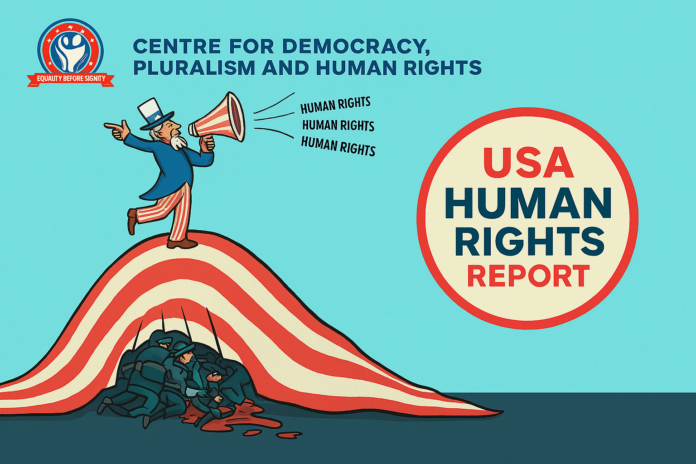
Political rights form the core of any democratic system. The right to vote, to stand for office, to associate freely, and to influence public policy are commonly presented by the United States as both constitutional guarantees and benchmarks for judging other nations. Yet Unit 5 of the Human Rights Report: USA – Equality, Justice, Dignity advances a far more critical assessment. It argues that political discrimination in the United States is systemic, manifesting not primarily through overt denial of rights, but through institutional arrangements that restrict meaningful participation, distort representation, and concentrate power in increasingly narrow hands.
Rather than focusing on isolated electoral controversies, Unit 5 examines how law, party structure, campaign finance, and administrative control collectively produce a democracy in form but oligarchic tendencies in practice.
Voter Suppression as Policy, Not Anomaly
The report documents how access to voting in the United States is unevenly distributed along racial, economic, and geographic lines. Voter ID laws, purging of voter rolls, reduction of polling stations, limits on early voting, and restrictions on mail‑in ballots are presented as neutral anti‑fraud measures, yet their effects are predictably asymmetric. Poor voters, racial minorities, the elderly, and students are disproportionately affected.

Unit 5 emphasizes that these practices do not operate in isolation. They are clustered disproportionately in regions and electoral contexts where demographic change threatens entrenched political power. The result is not the outright abolition of voting rights, but the creation of administrative obstacles that selectively burden certain populations, effectively transforming a universal right into a conditional privilege.
Disenfranchisement Through the Criminal Justice System
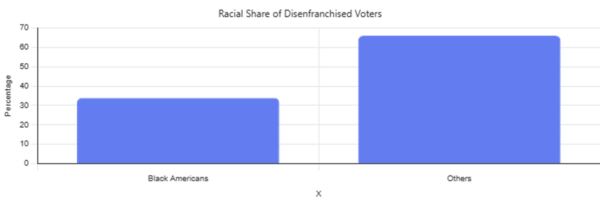
One of the most consequential forms of political discrimination identified in Unit 5 is felony disenfranchisement. Millions of Americans are denied voting rights due to past criminal convictions, often long after their sentences have been served. The report underscores that this practice disproportionately affects Black and minority populations as a direct consequence of racially imbalanced policing and sentencing.
In several states, disenfranchisement is permanent unless restored by executive or legislative action, rendering political participation contingent upon discretionary mercy rather than citizenship. This mechanism transforms the criminal justice system into a political filter, excluding entire communities from democratic participation and reinforcing cycles of political invisibility.
The Two‑Party Duopoly and the Closure of Political Space
Unit 5 devotes significant attention to the structural exclusion produced by the two‑party system. Ballot access laws, debate rules, campaign finance networks, and media coverage collectively form barriers that make it extremely difficult for third parties or independent candidates to compete meaningfully.
The report argues that this is not merely a cultural preference for two parties, but a legally and economically enforced duopoly. Independent candidates often face higher signature requirements, earlier filing deadlines, and exclusion from televised debates, ensuring that political competition remains narrowly constrained.
For marginalized communities, this structure is especially damaging. Without viable alternative parties, voters are compelled to choose between options that may differ rhetorically but converge substantively on issues such as military spending, corporate regulation, and financial policy.
Campaign Finance and the Commodification of Political Influence
The role of money in American politics features centrally in Unit 5. Following judicial decisions that equate campaign spending with protected speech, political influence has become increasingly correlated with wealth. Super PACs, corporate donations, and billionaire‑funded campaigns have reshaped electoral competition into an arms race of financial leverage.
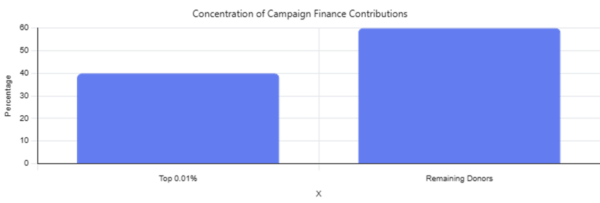
The report argues that this development introduces a form of economic discrimination into political participation. While voting remains formally equal, agenda‑setting power is overwhelmingly concentrated among donors capable of funding campaigns, shaping media narratives, and exerting influence beyond the ballot box.
This asymmetry undermines the democratic principle of political equality, substituting popular sovereignty with donor responsiveness.
Gerrymandering and the Engineering of Electoral Outcomes
Electoral district manipulation constitutes another structural mechanism of political discrimination identified in Unit 5. Gerrymandering enables political actors to select voters rather than voters selecting representatives. Through sophisticated data analytics, district lines are drawn to dilute opposition votes, concentrate minority populations, or lock in partisan advantage for a decade or more.
The report emphasizes that gerrymandering does not merely skew electoral outcomes; it discourages participation by rendering elections non‑competitive. When outcomes are predetermined by map design, voting becomes symbolic rather than consequential, eroding civic trust and democratic legitimacy.
Media Control and Democratic Illusion
Political discrimination is also perpetuated through media structures. Major media conglomerates shape which voices are amplified, which candidates are considered viable, and which policy questions remain off the agenda. Unit 5 notes that electoral discourse is often reduced to personality clashes or cultural skirmishes, while structural issues—such as wealth inequality, military expenditure, or corporate power—receive limited sustained scrutiny.
This narrowing of political discourse creates the appearance of pluralism while maintaining substantive continuity. Voters are presented with choice, but within a carefully bounded spectrum that excludes challenges to foundational economic and geopolitical arrangements.
Protest, Surveillance, and the Criminalization of Dissent
While protest is constitutionally protected, Unit 5 documents a growing trend toward surveillance and criminalization of dissent. Protesters—particularly those advocating racial justice, labor rights, or opposition to war—have faced aggressive policing, pre‑emptive arrests, and expansive surveillance under national security frameworks.
The differential treatment of protest movements reveals that political expression is not equally protected across causes. Dissent that challenges structural power frequently invites state scrutiny, while expression aligned with established interests encounters minimal resistance.
Conclusion: Democracy as Procedure, Not Power
Unit 5 culminates in a diagnosis that cuts to the core of American political identity. The United States maintains the procedural forms of democracy—regular elections, constitutional guarantees, a free press—yet increasingly restricts the substantive capacity of citizens to influence outcomes.
Political discrimination in this context is not about the absence of rights but about their strategic dilution. Participation is permitted; power is not. Until political equality is measured not only by access to the ballot but by the ability to shape policy, representation, and collective futures, American democracy will remain formally intact yet substantively hollow.
Link to the Report: https://www.cdphr.org/USA%20Report.pdf
